Friday, July 20, 2012

The Underground Movement in support for The Dark Knight Rises that exposes negative attitudes towards the critics that are to guide moviegoers


The Dark Knight Rises


Whatever you say about critics they cannot influence the course of history unless they are prepared to change it from a materialist basis. Speaking negative or positive things about something does not guarantee success or failure of a particular enterprise it is how you are prepared to physically make a difference to that enterprise. It is clear that most critics, particularly those labeled as the so called top critics, cannot make a film. There have been cases where the idealist relinquishes his high handed idealism and goes about effecting a material change based on his ideals. As an idealist his views are not worth anything particularly as the tide of history sweeps him under the rug. You can only be an idealist unless you are prepared to make a change based on the material circumstances that surround you. You do not pronounce judgment because you subjectively dislike something. There are some film critics in America that have assumed the position of the 1% in the film industry and seem incongruous and so incapable of change. The venom dished out against The Dark Knight Rises (2012) by some critics seems highly biased from a classist perspective. They hail the ambition but trounce its shortcomings as a convoluted film and, most importantly, that it does not reach the standards set by The Dark Knight (2008). The point of this commentary is to highlight an issue that I have addressed only briefly before: The Hollywood industry is elitist and some of those labeled as top critics are vulgar propagandists.  You can check the many statements I make in my blog posts stating that the claim of some of these critics to be the representatives of moviegoers is bogus hypocrisy. It only serves to get them to the front of the line and then they turn around and trounce the film to gain some prestige in the Academy of Arts and Sciences. I refer to some of these critics as so called top critics most of the time. See my review of The Artist (2011). In some cases for you to come to the fore you have to trash a movie to get in the spotlight or  conversely you celebrate the film thoroughly and enhance your reputation with a particular studio or director.

If you read any of my critiques you will see suggestions abound for I don’t trash films for trashing sakes. I am not saying that one is not entitled to their subjective opinions but when the reviews are blatantly biased it becomes obvious particularly if the review itself is not logical or is convoluted and riddled with high emotion. In this case the fans of The Dark Knight Rises are justified in their responses. I am not referring to the death threats. Most of the negative reviews have not provided a substantial analysis of the film and its themes which would make the reviews much more comprehensive. In most cases they are short and vitriolic which is similar in fashion to a mere comment. Unless a comprehensive logical review is done the readers will not be satisfied and you will be exposed as a so called professional film critic. You are being paid to guide moviegoers and the most you can do is poison them with your high strung emotionalism that masquerades as logic. If you read some of the negative reviews they are well written but are completely faulty from a logical standpoint. As a student of the dialectic philosophy a lot of these top critics sound like buffoons. These negative reviews do not make suggestions or give some insight as to the direction the film might have taken especially if it is so bad. When it is universally clear that a film is bad what should be done  by the critic is a clear assessment based on their knowledge of film as to how it could have been improved. You do not trash a film and offer no suitable alternative or you will be accused of encouraging emotionalism. The only alternative these high minded critics are offering is that The Dark Knight Rises is not at the level of The Dark Knight; that is an abominable form of criticism. You should note that they don’t say the film borrows heavily from The Dark Knight (2008) but that it does not raise the bar any higher.  

The criticism is foolish for they have disregarded the context within which the film was made. The film is a trilogy it is not an independent batman film or a new spin off.  This film is merely continuing the story of batman that comprises three films. This is the cardinal sin of some of these critics. The foolishness they imbue in their followers is that The Dark Knight Rises is not at the level of its predecessors as if it is a separate film. These critics should be assessing the trilogy as a whole and question whether or not the trilogy is wound up accurately. The avid followers of the dark knight would do well to read some of the reviews that are not entirely favourable but acknowledge that the story of batman is wound up in a satisfactory fashion thereby emphasizing the strength of the series as opposed to one particular film in the franchise. Those are the best critiques; fans should not be reading the reviews that simply claim that the final chapter never met the high standards of its predecessor or that Bane is no Joker. Is the trilogy wound up sufficiently? That is the only question that fans such as myself will be prepared to answer.  If they assess the film on these grounds they are denying the reader a satisfactory analysis of the current film itself. They give the impression that this is an entirely new interpretation of batman on film; the film should be assessed within the context of the trilogy.

I have not watched the film but I can address the issue of comparing the film to The Dark Knight. It is testament to Nolan’s vision that he attempted to advance beyond the shadow of The Dark Knight and thereby offer some closure to the series. What is being said about the scale of the action all boils down to one of the main themes of the trilogy: escalation. In Batman Begins (2005) Lieutenant Gordon warned Batman at the end that this element of escalation would be the result of his actions. The criminals would seek to adapt to the force of change that batman represented. In order to emphasize his point he shows Batman the card of the joker left behind at  a crime scene  as his moniker. The Joker came along in the The Dark Knight and fulfilled the prophecy of escalation. The Joker was a sensationalist that promised a lot in terms of revolutionary change, particularly after he defeats the mob, but resorted to mere social experiments. The joker was therefore limited and never approached the scale of destruction envisioned by Ra’s Al Ghul and now Bane. The joker never seemed to be able to go so far as attempting wide scale destruction, he only promised it and was unable to deliver. He seemed to be more interested in his celebrity cult where he brandishes his signature cards all over the place and broadcasts himself through television. The Joker and the Batman represent the dark side of the celebrity cult. This is why people are so in love with the Joker since he represented outright sensationalism although he never took it to the next level of Ra’s or Bane: Citywide destruction. The batman sometimes masquerades as a hero when in fact he is a brutal enforcer and Nolan acknowledges this masterfully by the end where Batman gives up his celebrity status for a more heroic gesture by sacrificing himself for the crimes of Harvey Dent, the warped idealist.  In The Dark Knight Rises we have Bane and from what I have seen he is remorseless and not prone to sensationalism as the Joker was in the previous film. He has a plan geared towards outright destruction and so where the joker would taunt Bane actually delivers. The Joker represents a brand name whereas Bane represents a brand crusher which is why he humiliates the Batman physically. Try and recall that Batman himself is a brand name like the Joker. It is clear therefore that were Bane to encounter the Joker he would not hesitate to pound him into the earth. The power embedded in his physique would not see the Joker laughing off the hits as he did with batman. We would watch the thorough humiliation of the Joker as I am sure people have witnessed the humiliation of Batman. It is a point I have raised in the past although not in my blog posts that had Ra’s al Ghul encountered a character like the joker he would kill him instantly. He would not entertain pleasantries like the Batman which is a result of his compassionate nature. ‘Compassion is a weakness your enemies will not share,’ says Ra’s in Batman Begins. If Batman was as ruthless as Ra’s or Bane the Joker would have been a minor villain regardless of the great performance of Heath Ledger known for its sensationalism. 

It is this sensationalism that has stuck with audiences and so confusion set in where it was stated that The Dark Knight could not be topped. Regardless of what you say Nolan had to resolve the precarious batman mythos because Batman is at heart or by tradition a hero. He cannot be known as a criminal because batman is an ideal supposedly representing good hence this new film. Batman after his encounter with the joker fell into a dark patch and he must be rescued from the ashes. Bane is a perfect counterpoint to the Joker in that he does not hesitate to put his plans into operation. His mind is more fixed and resolute as opposed to a man like the Joker who says ‘I’m like a dog chasing cars. I wouldn’t know what to do with one if I actually caught it.’ Bane is more threatening as opposed to the Joker that merely dangled the carrot. The case in point is that people should get over the Joker and lay Heath Ledger to rest. He did a fantastic, sensationalistic job in his performance but the reality is that the Joker was essentially limited in his scope. It is time to move on and it is clear that the plan for citywide destruction is more direct and this is what is required to drive the point of escalation home. These so called critics must stop comparing The Dark Knight Rises to The Dark Knight because it is one story. The Dark Knight represented a highpoint because of the Joker’s nihilism that threatened to disrupt Gotham significantly but never did actually because of the sacrifice by the batman (it was the joker that convinced Harvey Dent to act foolish). Bane is not into guessing games based on what I have seen he is more direct and he is a brand crusher. Those people who do not give into sensationalism are usually more direct. The idea of sensationalism has been heralded to the point of frenzy in the West where celebrities are trumpeted as godlike individuals. The Joker and the Batman bought into this concept whereas Bane does not. As Ra’s tells Bruce ‘You’re defending a city so corrupt that we’ve infiltrated every level of its infrastructure.’ Bane attempts to crush the brand of the batman and then crush what Gotham is supposed to represent greed, filth and rampant exploitation of the working class. All great cities of the world share this history of exploitation and this exploitation is inevitable based on the concept of a ruling class and those that serve them. This comparison with The Dark Knight is untenable particularly because it did not end on a decisive note and people should lay Heath ledger to rest and stop buying into elitist perceptions. What I mean here is that as a result of the success of The Dark Knight  some  people just imagined that it should be left where it was despite the fact that batman retired as a criminal. Nolan had to rescue him because it was inevitable. It still remains the same story however and so if you prefer The Dark Knight go and watch it again and again without demonstrating any interest in how the series will be resolved. People recall The Dark Knight primarily because of The Joker and nothing is wrong but it was not a much better film than Batman Begins which has the same tone of The Dark Knight apart from the menace of the clown in the latter and the more shady texture of the former. This ceaseless comparison with The Dark Knight does not make sense within the context of the trilogy. It is a thing with elites where they tend to get stuck in the past and then become romantic to the point of lunacy. The bar was set with Batman Begins and not The Dark Knight. The latter only expanded the themes of the former. If you find flaws in this film you will find these same flaws in the first two whether you like it or not. This is made more apparent because this new film is larger in scale and the larger the film the more it becomes exposed. The first two were pretty small based when compared to what is being advertized for the final chapter of the trilogy.

                Lastly the poor critiques of those critics that gave negative reviews have exposed their fallibility especially as they claim to be professionals. I am speaking about the venom dousing present in some of the critiques that have no rational basis. The fans that have dared to challenge the 1% of the film industry have exposed one glaring fact: these said critics are not consistent. A critic that chastised  The Dark Knight Rises will give into the celebrity cult of Kate Perry or male strippers in Magic Mike or surprisingly the less than definitive  The Amazing Spider-Man. Most of these critics do not have a clear method of analysis that should be a clear feature of someone’s writing particularly if he or she claims to be original. Some of these critics are consistent for the wrong reason. REX REED is one of the worst film reviewers I have ever encountered. The analysis is poor generally and this is disguised by his acerbic wit. This is a reviewer who gets attention by giving bad reviews. He is consistent in his dislike for the Nolan trilogy and for that I commend him and so it is no surprise to see him dislike the latest offering. The other critics would praise the first two of the trilogy and then trounce this one because in their grand romantic estimation it does not set a high bar.  That is all romantic drivel; it either concludes the trilogy in a satisfactory fashion or it does not. Nolan has been consistent in his approach to filmmaking and he never veered like Sam Raimi in Spider-Man 3. This has made him into a visionary filmmaker as opposed to those filmmakers that act cowardly and weak as soon as a critic passes judgment. If you have a vision see it through and know when to put the brakes once it’s finished or when the vision cannot possibly continue on the path it’s on. These same critics will inflate unoriginal films with praise and push their own agenda although it hardly makes an impact on the film’s box office success. Look at the prestigious acclaim given to The Artist (2011) yet it only catered to those with elitist, romantic views. It goes without saying that The Artist will be forgotten in a couple years time simply because it was hardly original. One must also bear in mind that a lot these critics are reactionary, blatant conservatives that cannot identify change and who clearly represent the 1% in Hollywood. Thank god Nolan is an outsider. The artsy films that the critics inflate with praise are not always justified because these films are formulaic and do not advance film but for some of the dunderheaded critics once you act like they taught you in drama school etc and abstract appropriately then you will be rewarded by being excessively praised never mind that you’re not pushing the envelope. These artsy films conform to type and are excessively praised. It is only the films that push the envelope that will survive for the future. Nolan has done this with his Batman trilogy whether or not The Dark Knight Rises does not miraculously produce a Joker phenomenon to give the series another push into fantastical sensationalism which is not always as concrete as the vision of the creators.

In some cases the fans are justified in voicing their outrage apart from the death threats. These critics do have an agenda and they are political whether they like it or not especially as a lot of them represent the 1% in Hollywood that enjoys the privileges that we lowly attendees cannot hope to enjoy. The outrage voiced by the underground has highlighted that critics are not necessarily the ones who will determine whether or not a film is a success. This is not 1950 it is 2012. When I watch the film for myself I will take the usual objective logical approach to my reviews which may be biased in its own way but at least I am consistent in using my own criterion for assessing something. My criterion is to look for films that are seeking to keep the film industry alive. The people on the ground level (99%) are more aware of what is coming than the 1% and that is the truth Ruth.

One critic made the important point that Nolan is aware that the fanbase for the batman trilogy is in the 99%.


Friday, July 6, 2012

The Amazing Spider-man (2012) **½ /5: As a definitive interpretation of the Spiderman mythos this film misses the mark


The Spiderman film legacy has officially been muddled by inchoate pseudo- scientific explanations and a mish mash of facile commentary futilely seeking to be absorbed within the superhero film canon. Did you get that? Well it’s the same feeling you will get when you encounter the mysterious formulas that propel the story of  this film The Amazing Spider-Man up until its lazy climax. You should not worry however for these formulas mean nothing and amount to mere twaddle.  The film does have engaging set pieces and the 3D stereoscopic images do enhance the scale of the picture on display although artificially. It is unfortunate however that the film was not able to supersede the original Spider-Man (2002) as well as Spider Man 2 (2004). It will go down in history as a farcical version of its predecessors by trying to engage the audience with a script that would be more suitable within the context of Frankenstein and Dr. Jekyll and Mr. Hyde rather than in the Spiderman universe. Peter Parker also seems to be a tortured beautiful mind (reference to the film A Beautiful Mind (2001)). I say that it is unfortunate because this film makes it clear that gaps were indeed left by Raimi and his crew such as the mystery behind who were Peter’s parents etc. It borrows shamelessly from the precepts developed in its predecessors as well as a plot influenced significantly by Christopher Nolan’s Batman Begins (2005). The main villain’s plan in The Amazing Spiderman (2012) is similar to the one orchestrated by Ra's Al Ghul in Batman Begins where he attempted to spread fear toxins throughout Gotham city. The main failure of this film therefore is that it failed to supersede its predecessors as well as other superhero films. It has therefore contributed nothing new to our understanding of what it means to be a superhero in the mythical fantasies that have gripped the imagination of film goers. The film has good moments that are not elevated sufficiently to the point where the premise would soar into that great creative void of filmdom. The inability of the screenwriters and the directors to flesh out a premise therefore reveals the struggle in the final scenes of the film to achieve the emotional release it sought in the retelling.  These final scenes seem to be tacked on mercilessly as the filmmakers make it apparent that they are seeking that moment where the emotions or the imaginations of the various audience members will rally around this misunderstood hero.  The wrong approach was taken in this film where the elements of  Raimi’s first two efforts were seemingly absorbed within the space of 2 hours and change which is the duration of this film. The emotional release of Spider-Man 2 was understandable considering the build up and restraint exhibited in Spider-Man. The teen angst of Peter Parker is understandable but his exploits as Spiderman clearly question whether or not it is heroic. He appears to be so brow beaten and weathered by despair, infatuation and a desperate urge for retribution that you begin to realize that he is merely acting out a teenage fantasy. Raimi took the smart approach by avoiding all that unnecessary drama because now this new interpretation seems to be swamped in a state of bathos. In other words Spiderman himself is not amazing although the film is amazingly lackluster. One wonders if Sony should not have sought to retell the story in a more progressive manner. It is admitted that Spider-Man 3 (2007) suffered more by trying to continue after the emotional release experienced in Spider-Man 2 (which is still the most satisfying dramatic offering from marvel studios. Iron Man (2008) was mere spectacle which would account for the current crisis of facile interpretations of the subject) than the perception that it was such a terrible film. Love it or hate it the film had the right elements although much of it was jumbled. Whatever the perception of that film the right idea was still there as Raimi and crew sought to move forward with the story. Sony wasted a lot of money on this endeavour by acting so regressive. As the star is 28 years old have him play an older Peter and reinterpret from there instead and keep the series moving forward and have him delve into his past from there.

This film is about Spiderman/Peter Parker (Andrew Garfield) discovering the secrets of a shady aspect of his past involving his parents and their longtime friend Dr. Kurt Connors (Rhys Ifans).The deeper Parker delves the more superficial the story becomes as the longtime friend of his parents, based on a pseudo scientific formula provided by Peter, creates a chemical that allows for the transference of animal DNA into humans as a means to heal disfigured limbs or for general purposes of regeneration and security against health hazards. After a crisis at work Dr. Connors in desperation uses the chemical on himself and he is transformed into a giant lizard that becomes the new terror on the block. Peter must now account for the consequences of his failure as well as he seeks to stop the giant lizard that has formulated a diabolical plan which is sure to endanger the citizens of New York City despite the best intentions of the poor doctor.

What’s good about this film?

The film does make a good case for the reinterpretation of Spiderman’s origin story. The extent which the filmmakers and Sony were able to achieve its objective is debatable. Firstly, not much is known of Peter’s parents and the film attempts to address and should be commended although the story is rather shady and is not clearly resolved. Secondly it is acknowledged in the comics that Gwen Stacey was the first girlfriend of Peter Parker and the film adheres to this tradition instead of making her an afterthought as was done in Spider-Man 3. It will be interesting to see how Mary Jane is portrayed in this series of films. She will probably be portrayed as the more mature type however that remains to be seen. In any case Stacey is portrayed with the customary verve associated with Emma Stone and does play a significant role in defeating the villain. She does seem distinctive as a character and does set herself apart from the dominant Mary Jane figure that the audiences are so accustomed to. One wonders whether she will be the perennial girlfriend for this series of films. Her father, Captain Stacey (Denis Leary), as a high ranking police officer does provide a significant contrast to Spiderman as a man that represents the hypocritical bourgeois code of ethics. The debate between himself and Peter at the dinner table does expose the infantile perceptions of Peter Parker and his delusions of grandeur. He keeps calling himself a hero and up until then did not realize that he had not done enough to justify calling himself a hero of the people. One crucial element in that discussion was the reference to organized crime. Peter having thought that he captured a car thief as spider man is informed by the police chief that the car thief was linked to crime bosses. He is also exposed as a superhero that leaves an easy trail to follow and this naiveté is found out by the Lizard. I have always thought that a serious discussion about Spiderman’s role as a crime fighter was important because although Spiderman does keep the streets safe he has never really demonstrated that he can go after the top crime bosses who launder money or who deal in the lucrative drug trade or the brutality of gang warfare. In the Raimi films, as well as this one, he only handles small timers such as petty robbers and then goes home and whines about the burdens he has to bear as a crime fighter. In this film he is a major whiner and so they never improved on this idealized quality of peter parker who is merely a petty bourgeois living in a bourgeois world trying to become a professional scientist and aid in the growth of labour productivity so that capital can be better served. Parker has not demonstrated in any of the Spiderman films that he can interact with the dark side of New York. As a so called hero he is pretty one dimensional. It is no surprise that his main villains have been scientists like himself who have veered down the dark side of capital as they desperately seek to have their scientific discoveries embraced by the populace so that capital will continue to shine and dazzle the weak minded. Most people should be aware by now that most of the discoveries in science are in service to capital.  He would have to go on anti-depressants if he took on the caseload of the batman who goes deep into the heart of crime. In such a case it will be good to see if the creators introduce Kingpin as a major villain in this series because he alone of all Spiderman’s villains is closely linked to organized crime.

The context seems to be more extensive in this film and is less colourful than the Raimi versions which were so bright that even when Spiderman went to the dark side it was only for a short while and never altered dramatically the overall cheerful mood. Peter parker in this current release does seem more grounded in reality. The technology is up to date and one wonders why parker uses Bing instead of Google as a search engine; does it have anything to do with competition or the inability to come up with the sums sufficient to pay for the right to broadcast the image? Who knows what goes on behind closed doors when it comes to discussions between these giant corporations? Oscorp looms as the bastion of scientific knowledge in this film and one hears the name of Norman Osborne mentioned a lot which suggests that he will come to play a major role in the next installments. The edgier tone does make Peter parker seem like a geek/nerd from the real world for based on how he acts I have seen people who act in a similar fashion. This peter parker does stand up to the bullies and only lacks the physical strength to become a significant force although that all changes when he is bitten by a radioactive spider and becomes feared by his peers. The presentation of the film makes one wonder whether or not Peter parker is just an ordinary nerd acting out his fantasies as he seeks to punish those who have dared to cross him. A lot of juveniles that have experienced or are experiencing bullying will readily identify with the parker trials and how this bullying can create a powerful imaginary effect in the minds of the oppressed that focuses on what one would do against these bullies if only he or she had the power. I would get suspicious when a nerd is suddenly able to dunk a basketball and shatter the glass in the process.

The film does deal with a specific period of Peter’s life: his late teenage years. There is therefore a lot of teen angst in this film as peter comes to accept that he must become responsible before he can call himself an adult. The Raimi versions which stayed true to the comic books brushed aside these teen years. Even the early comics do not provide a suitable explanation of Peter’s teen years. This film tries to ground itself deeply in this period. It could be said too deeply because by the end it fails to achieve the release it was looking for i.e. making spider man imprint (this is no reference to twilight) himself on the imagination of movie goers. I can say with certainty that this spiderman will not be tolerated by some moviegoers. 
There are a bucket loads of tears in this film which would highlight that this is more  a serious dramatic film  as opposed to the more fun loving Raimi versions.

The pseudo science on show here does seem more in depth and the actor seems more in command of what he is saying portraying a 17 year old. In the Raimi versions peter did not seem like an innovator in the field of science whereas in this new release he does seem to be able to hold his own with fantastically, yet meaningless, conjured algorithms which are hardly serious and must be classified as comic book science. The senior scientist in this film oohs and aahs when the mish mash of a mysterious algorithm is presented to him. Regardless of the pseudo science on display it does make the film seem grounded as we watch it progress and we see peter parker get more involved with the mysteries of science. I say pseudo science because most of the science on display should only be theoretical but in the world of comic books it comes alive.
The action was fairly well done although it does not add anything new to the franchise. The movements of Spiderman remain the same although they have opted for artificial web shooters as opposed to the self-generated, organic webs from the body of peter parker in the Raimi versions. Aside from this the movements of Spiderman remain the same when he fights and slings around the city. There are some movements that are taken directly from the Raimi versions. The 3D images however provide a first person point of view style of web slinging where we can imagine what it is like to be Spiderman. Eventually these actions only serve to bring back fond memories and this new series has yet to demonstrate that it will supersede the action seen in the Raimi versions.

 I liked that Jonah Jameson  the vulgar editor  in chief was absent. I suppose that you cannot rule him out for long.

What’s bad about this film?

The main problem that several moviegoers will have with this film is its inability to sufficiently reinterpret the Spiderman mythos i.e. not much will distinguish it from the Raimi versions apart from the edgier tone. This is because it still borrows from the previous Raimi versions. This reinterpretation probably came too early and so  there was not much time for Sony to clear its head. In terms of finding its own footing therefore it had to borrow from other franchises that experienced a similar revival. The most obvious example would be the batman franchise which started promisingly under Tim Burton in 1989 but crashed in ignominy with the fourth installment Batman and Robin (1997). Christopher Nolan, his brother and David S. Goyer provided a fresh interpretation with Batman Begins (2005) which was edgier in tone and would eradicate to some extent the camp and buffoonery of the 90s versions. The success of this new realistic interpretation was made evident with the worldwide success of The Dark Knight (2008). The writers for this film seem to be going for that formula to the extent where a rip off of Nolan’s approach to storytelling was evident particularly when it comes to the plot of the main villain which is a giant man lizard. It was a shameless knock off and quite obvious to the experienced moviegoer and the sad thing was that it was not necessary because the mad scientist rap has been extensive in this series with Norman Osborn and Doc Ock. They could have gone for a new type of villain such as a Kingpin who of all the Spiderman villains would fit in with the edgier tone here for no matter how edgy you become you cannot justify a giant man lizard in the real world. How effective would it be if the petty criminal he is looking for so as to avenge the death of Uncle Ben was linked to this imposing crime boss. The rip off of the Nolan approach does not even offer a new spin and even manages to vulgarize it in this farcical version where the solution to the main villain’s plan is simply resolved. The villain obviously is not noteworthy apart from his menacing physique which is good for the brief passages of entertainment but it is not sufficient when one considers that he does not resonate with the audience after the credits roll.

(Just a small note here: the Spider Man series developed by Sony does not necessarily have to borrow from Nolan's version because the Raimi versions set its own standards within the super hero canon. The Spider man universe is rich enough whereby it does not need  to borrow from Nolan's take on the batman series. Nolan himself is not original on all fronts. There are some elements in his films that were preceded by the Sam Raimi versions.)

 ‘The villain was this big lizard. I don’t really remember what he wanted. I think it had to do with his relationship with Peter. He kept saying poor Peter as if he was going to hug him.’

This reinterpretation is muddled by pseudo science i.e. science that remains only theoretical. I say again that pseudo science is something everyone can come up with theoretically. What if I could absorb the strength of an ant through a special chemical? I could then become ant man.  In this case the science project seems so futile in its approach to seem original that it only manages to look ridiculous particularly when peter gets involved and provides the mysterious solution. The experienced scientist who is the main villain and the friend of peter’s parents merely accepts this solution without critical analysis. He accepts but never offers a rigorous logical scrutiny to test its viability. What the screenwriters do is have the process simulated through a test of  the formula on the computer on  what would represent the biological makeup of a rat.  This is the only scrutiny it will experience and it is not even wondered that the success was too blinding. In Spider-Man 2 the explanation for Doc Ock’s demise becomes evident here although his scientific experiment was more realistic as it dealt with energy and not some warped biological experiment that has no precedence. The development of new energy sources has been a priority of man over the last two centuries. Elements from Doc Ock’s dementia are also shamelessly brought back in the makeup of this new lizard type of villain. It can therefore be said that this new villain who is supposed to test Spiderman’s resolve is hardly worth the ticket price. You can see it coming from a mile way when you first see him and hear of the experiment he is working on. He is so desperate that he relies on the advice of a junior scientist that stole notes from his father’s untested formulas. Spider-Man 2 was superior in the development of its villain. This movie rips off that approach and throws in the Nolan formula for good measure.

The spiderman legacy has therefore been muddled in its attempt to appear distinctive. It tried to offer a new interpretation but upon closer inspection it is clearly a rip off of better films that were not so burdened by satisfying the corporate urge for new profits. When the films by Raimi and Nolan came to the fore their stories were fresh and had no precedent although each borrowed one way or the other but its own distinctive context made the telling acceptable to the audience. Spider-Man was the first major film about the hero and likewise Nolan’s approach to batman reversed the one offered by the franchise of 90’s. The burden of the legacy on this new film seems to be too much and comes down heavily and smothers it with its weight and therefore makes it difficult to supersede and become distinctive or walk on its own two feet. This is not helped because it borrows so heavily from the previous Raimi versions that made Spiderman distinctive. This new version does not make Spiderman seem distinctive at all and not even the 3D first person point of view shots help significantly. If it wanted to escape the burden of legacy it should have gone for a different approach as to how Spiderman fights crime. He is supposed to take responsibility for creating a giant lizard.
This is why I suppose they focus on the teen angst of Peter Parker as opposed to the Spiderman as a distinctive hero. Peter Parker is portrayed as downtrodden punk trying to make a difference. He has all the attributes of the nerd and is burdened by his past because his parents deserted him over a phony science project. There are a lot of tears in this film on his part as he loses his adult mentors particularly Uncle Ben. He still has the interest of Gwen Stacy which  feeds his infatuation. The love story is hardly memorable however for the kiss between Mary Jane and Peter in Spider-Man and the finale of Spider-Man 2 were much more memorable. In this film the two actors attempt to act younger than they really are and it is so sad. The romance seems more adult than teen and here Raimi was a success for he highlighted the various transitions from teen to young adult etc. In this film the two seemed burdened by the world. It is not memorable and will be forgotten let’s leave it at that. The burden that Peter parker feels as an outcast is translated in his approach to playing Spiderman. He tries to sound clever but he does not pull off most of the jokes and it is too bad because Tobey McGuire from the Raimi version was much more relaxed in his demanour and it was reflected in his delivery. In this one peter parker seems too burdened and Spiderman wades around like a drunken man in some cases and does seem like a lost teenager who is not really a hero. In the final shots when you see Spiderman slinging around it does not seem as if you are watching a definitive superhero. It seems as if the filmmakers were trying to make him appear hip and iconic when he is not in this case.

Lastly this burden felt by the teenage peter parker sees the filmmakers try to evoke some emotions but this falls flat and must count as a failure. They burden parker and the audience so much with the teen angst that you can see the need for an emotional release. It seems as if they tacked on several final scenes with the hope that the audience will be left wondering. This is not the case here because the more scenes at the end suggest that the filmmakers missed the mark. They were too desperate for that final flourish that would make spidey seem iconic and it appears as if the tragedy of the franchise continues.   They shamelessly tried to absorb the themes of the first two Raimi films that the casual moviegoer may not realize, but should, that this is overkill and that they are being burdened unnecessarily. This is why most audience members will not feel as if the film resonates with them after the credits roll.

All in All a mediocre film but as a definitive reinterpretation it misses the mark. It should go down as a good try.


Friday, May 18, 2012

The Social Network (2010) ****/5.


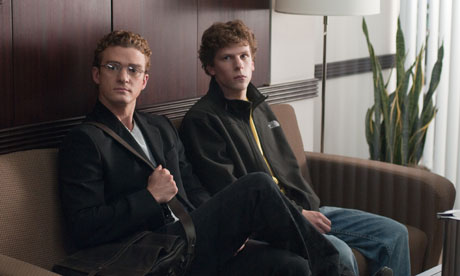
Justin Timberlake as Sean Parker and Jesse Eisenberg as Mark Zuckerberg


( I did this review in 2010. I am posting it here to commemorate Facebook's first IPO on the Nasdaq stock exchange. This film remains relevant because it explains the origins of this global soft ware empire)


The Social Network (2010) is a good film. The taglines for the film which interested me were 'Punk, Genius, Billionaire'. I was expecting the film to explain all three particularly why he is a genius. It's because he is supposed to be a genius why the facebook server can maintain so much traffic on the web (500 million). The film does explain to an extent why he is a genius although years will have to pass before we can see the true significance of his breakthrough i.e. how it can be applied to other fields of computer science and how this will encourage the development of new programming techniques. It is clear however that this is one of the year's best films: good writing, editing, musical score and, most importantly, good acting and direction are all there. The film centres on the development of the popular social networking site facebook. Whereas the film speaks of how it grew into existence it is more concerned with the developments at the top i.e. with those who founded it and issues relating to copyright or whose idea it really is.  There are two civil lawsuit cases in the film. One is very insignificant (he is being sued by he Winkle voss twins. This is a good performance from Armie Hammer Jr.) Although it does explain certain issues whereas the other civil suit provides the catalyst for the film's dramatic moments (Zuckerberg is being sued by his best friend and business partner Eduardo Severin(Andrew Garfield) ). It is from the court cases that we get glimpses, through flashbacks, of the process of facebook's development. The majority of the story is not told from Zuckerberg's (Jesse Eisenberg) perspective but by those who either testified against him or are suing. As the civil suits are against Zuckerberg he does not say much and instead demonstrates his unwillingness to answer questions. He tries to be clever by trying to evade the questions thrown at him. This is a source of clever jabs etc but that does not distinguish him as a genius. Some of the dialogue is typical sarcasm and intellectual snobbery nothing elevating.

The film begins with Zuckerberg as the typical undergraduate punk at Harvard who wants to do well. He is also an intellectual snob and this affects how he interacts with people in the film. Doing well at Harvard means being accepted to one of the elite clubs. Zuckerberg has his eye on the phoenix club. It is, as is always the case, elitist and quite exclusive. In order to be initiated one has to go through several grueling rituals as Eduardo discovers when he is given the call. It is worth a digression here to say that Eduardo's acceptance seems to become a source of ire between him and Zuckerberg. In order to get accepted you have to gain the attention of the club. Zuckerberg gets the motivation after he breaks with his girl in the opening scene and trashes her on the internet and creates a site (no spoilers here only to say that the site revolves around the women on the campus) on the internet through the Harvard network that gets people's attention. The film does explain why Zuckerberg feels he has to get accepted to these clubs. Not only because they are exclusive but because the people in those clubs normally end up in the top positions in American society. As the club is presented in the film it is not clear why he would want to get accepted as it is the typical bourgeois set up which is prone to libertine excesses that border on sodomy. It's no wonder corruption is acceptable or seen as the norm in the great United States of America. Zuckerberg's fanaticism about getting into the club eventually leads him to get involved with the WInklevoss twins who approach him with the idea of developing a site for social networking. Zuckerberg takes up the idea as his own, along with Severin, (the facebook) and this becomes the source of the lawsuit filed by the Winklevoss twins. This case is significant in the film for it highlights Zuckerberg's genius as a programmer.

Genius is hard to grasp nowadays it seems. Whereas the Winklevoss twins may have come up with a basic idea of what the site was to be about they never developed the actual program that Zuckerberg used to get facebook started. The Winklevoss twins are intellectual hacks with no real sense of originality. Their behavior is characteristic of the typical sycophantic bourgeois who give the proletariat the impression that they are smart and worthy to be their rulers when in fact their thoughts are based on existing facts. If they have any original thoughts it is baseless. Harvard however has a high intellectual standard and they must have been able to engross the existing facts pretty well like the rest who are there, not because of their connections, but their intellectual abilities. They would perhaps stand out in spheres with a low intellectual standard where the man who can master the existing knowledge is the genius and is praised highly for his intellect. This man however will never make any real breakthroughs of his own.   The development of a site like facebook with its unique program could not have developed from such sycophantic personalities as the film highlights to its credit. The basic genius of facebook is its ability to manage such a large flow of traffic on the internet and this distinguishes it from other social networking sites such as MySpace.  It seems the Winklevoss twins were determined to follow the similar lines of those sites. The only difference was that they wanted it restricted to Harvard only. Only those with the Harvard server address could enlist.  Also the breakthrough by Zuckerberg makes one understand why he would not need to finish Harvard in the first place. A cameo by Bill Gates probably illustrates the point well. With Zuckerberg's breakthrough, which opened many doors and created a new soft ware empire, he would not need a degree from Harvard to validate how smart he is. There are the average people who use the degree as a crutch to advance in society for they will never possess that idea that will have them soar over the heads of the PHDs etc; or the idea that will fuel an entrepreneurial venture that inevitably leads to a fortune. In this case it's the multibillion dollar empire of facebook.

Zuckerberg best friend Eduardo is portrayed as the unceasing social climber who is prepared to be the typical sycophant who rises by kissing asses and would perhaps prefer to contribute to the value of another man company rather than having the insight and determination to form his own path. This is where the billionaire factor of facebook comes from and why Sean parker (Timberlake), founder of the now defunct napster, comes in. He is the idealist who contrasts with Severin's realism and kiss ass philosophy. His idealism, although reckless at times, does contribute to Facebook's growth into a multibillion dollar empire. This is a good performance by Timberlake as he is able to reveal all the nuances of the character as delineated by the screen writers. His paranoia is the negative feature of his character. If Severin had not pointed it out in his testimony on the character it would be hard for viewers to see beyond the veneer of his suave calculating persona. His paranoia obviously becomes more evident by the end but it cannot be denied that when you first see him he is probably the coolest person on earth.  You then get to understand how he is able to weave his web around Zuckerberg.  People might be glad to see Parker in his less than stellar moments but it is clear that his idealism catapulted facebook into the great tomorrow which is now: 500million users. He is the one who takes Zuckerberg to meet new investors so that he can expand his business. He and Zuckerberg do share a common belief, which contrasts with the short sighted Severin, that in its initial stages facebook is just a fad and that you should not be in too much of a hurry to be demanding money from the consumers. Eduardo, who tries to contend with Parker, naively tries to freeze his initial investment of $18000 (which kept the company going initially) to try and teach Zuckerberg a lesson. In fact when Eduardo is forced out of the company because of his kiss ass philosophy, which allows him to be taken advantage of, it is then we see him seizing the moment and suing Zuckerberg for 600 million. It is even probable that Severin by freezing the account in which the initial capital of the company lay could actually be seen as the motivating factor for Zuckerberg and parker to alienate him. The film illustrates his kiss ass philosophy well in a scene that involves his Asian girlfriend (Brenda Song). It is clear that she is determined to control him and it's only after she burns a gift that he gives her because his relationship status is single that he has the courage to be assertive with her. If it was a different man who was more in control she could not speak down to him as she does. The filmmakers used that scene well without it seeming superfluous. It is an important scene that highlights the weakness of Severin's character. It is only after that scene that he starts to take charge. By showing his weaknesses the screenwriters were able to effectively demonstrate that with him facebook would not have gone very far.  The film, therefore, cannot be called bias. Yes it was unfair of Zuckerberg and Sean, who was president at the time, to do what they did but the film does demonstrate why they did it. Don't be too quick to cast judgment.

All in all everything is on point in this film. This is one of the year's best films. It should do well at the Oscars. The reason why it is good is because it's not biased for as was said before the civil lawsuits are where the film is centred; the rest is just primarily flashbacks. As a judge in a civil suit you have to be objective and listen to both sides and determine who was right or wrong. Yes you should not be surprised by the outcome as it's supposed to be based on fact but the screenwriters gave you the opportunity to judge on your own because the motivation of each character is clear and is conveyed well by each actor. There is no clear cut means of determining who was right or wrong. Where the characters erred was in their inherent personality. Sean Parker is paranoid, Zuckerberg is an intellectual snob and Severin is a sycophant. That is the source of the drama in the film: how these personalities collide not only with each other but with others. It is the credit to the filmmakers that they were able to convey this without being biased in favour of any individual. It still remains to be seen the extent of his genius i.e. how far the programme used to create facebook can be applied to other spheres of life. The filmmakers have, however, given you the basic reasons for his individual achievements which  should be enough as only time can tell what are Facebook's limits however its still 500 million and going.

Again this is one the year's best films.

Monday, May 14, 2012

Delay

To all those that read my blog the rate at which i post on this site will be affected because I am currently writing a dissertation for my phd. I will still post but at a slower rate.