Thursday, December 1, 2011

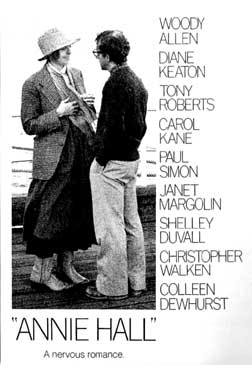
Modes of Urban Alienation, part 1: Annie Hall (1977)


Annie Hall (1977)

Introduction

Annie Hall is the great modern romantic comedy along with Eternal Sunshine of the Spotless Mind (2004). This film is great not merely for its comedic tone but for its psychedelic templates that evoke a sense of the metaphysical dimensions of human behavior. This is done within the context of urban alienation where humans in this particular setting are forced to compete for space in the cities which are the hub of commerce. In this film the action takes place mainly in New York City. City life promises the possibility of exploring a variety of options and this applies to the concept of romantic relationships. There is also the need to stand out individually in the urban setting for in the sea of humanity that greets you upon your arrival you can be absorbed and be forgotten and there is the urge to reassert your individuality. This is opposed to the countryside where the populations are smaller and everyone is easily identifiable. These two elements of city life feature prominently in this film through the relationship between Alvy Singer (Woody Allen) and Annie Hall (Diane Keaton). The relationship developed in this film is significant from a philosophical point of view because it questions the logical possibility of romantic relationships within this urban setting especially as this need to assert one’s individuality renders the romantic notion that humans can forge a union under god pretentious. There still remains the urge for one to come together with another but in the city this will always be undermined simply because the city promises endless possibilities where one can express a certain idealized notion however futile. The city is the place to shine and it is the place where stars are born as this film so accurately portrays. When one becomes a star you have risen above the multitude suggesting that you have made a considerable impression. There are several transitions in this film suggesting that individuals are more likely to come together before they eventually pursue their own paths of success in the city. The romantic relationship in this film is the basis for this existential theme of urban alienation. In this film we arrive at this conclusion by the techniques utilized by Woody Allen, the director, which involve a constant portrayal of separation or a sense of dichotomy which suggests that one is never at peace in the city simply because it is difficult to unify these various elements that comprise an individual. We are, therefore, sometimes incapable of resolving the many elements that comprise our city experience into a recognizable entity. In Alvy’s case the unifying force for all these distinct elements is the presence of Annie; she represents the one element that Alvy tries to conceive as an idealistic notion. The other elements in his life are too disjointed and chaotic and so he converts these chaotic elements into comedy which is the only way he can understand them. These chaotic elements come in the form of his family, his socialization as a Jew and his inability to resolve the paranoia brought about by urban alienation which says you must stand on your own.  This is why the techniques applied in the film, which can be called the deconstruction method, seems to befuddle the average critic. The technique used in this film is essential in getting at the core of the psyche of Alvy Singer. This technique was also employed successfully in Eternal Sunshine of the Spotless Mind (2004). The Deconstruction method simply means laying everything bare and sifting through the pieces. It normally involves a reconstruction at the end where everything fits together. In Alvy’s case the deconstruction reflects his own paranoia for he was in love and had not been before and so he is at odds when trying to find the reason for the end of their relationship.  Annie Hall (Diane Keaton) evokes various psychedelic elements which the rational Alvy Singer cannot seem to control. These elements are supposed to run counter to his perception of rational behaviour.  The spirituality exuded by Annie will haunt Alvy forever for it is in the plane of city life where spirituality does not seem to exist. Annie’s  roots associated with her family in the country suggest that she was not one from the city in the first place..

This film is primarily about Alvy Singer, the jewish comedian, trying to come to grips with the loss of Annie Hall with whom he had a year long relationship. The film traces the origins of the relationship where Annie was an obscure individual from Wisconsin who tries to make it as a singer (the stand out element) to the point where she is able to become a success and moves to California to pursue her dreams. Alvy is unable to reconcile the fact that he was unable to influence her any longer for when they first met he was the star (a comedian) and she broke out of his shadowy obsessions with mortality. The contrast is that Alvy is fascinated by death and Annie is fascinated by Life. It is why they come together and why they separate. After the break up when Annie moves to California Alvy is forced to leave his comfort zone for one last chance at love/redemption.   It brilliantly invites you, the viewer, to come to your conclusions about the relationship and this is done as Alvy speaks directly into the camera. The film has become the template for modern romantic films and the techniques used in this film has been famously been used in comedies such as Eternal Sunshine of the Spotless Mind.  Annie Hall won 4 Academy Awards including Best Film which was one of the few handed out to a romantic comedy. Examples of other such romantic comedies that won this prize are: It Happened One Night (1934) and Shakespeare in Love (1998). The other awards for Annie Hall include: Best Director (Woody Allen), Best actress (Diane Keaton) and, most importantly, Best Original Screenplay. This film defeated the likes of Star Wars Episode 4: A New Hope, the first entry in one of the most popular franchises in history, which was the highest grossing film of that year and marked a significant cultural shift regarding how movies would be viewed in the future. In 1977 it was seen as a light space opera adventure and films like Annie Hall still had a voice in the mainstream cinema (the age of the blockbuster/epic tales had come). A film like Annie Hall nowadays would be mostly ignored by the mainstream audience although Allen seems to have scored a hit recently with Midnight in Paris (2011). This was the first film where the validity of romantic relationships is challenged. This came about because of urban alienation which renders romantic notions as something absurd. The bittersweet conclusions arrived at in this film was replaced in his later feelings with some sense of optimism. In Manhattan (1979) the protagonist finds hope in a 17 year old girl and in Hannah and her Sisters (1986) where the protagonist by the end is expecting a child. This is Woody Allen’s best film from a philosophical point of view for his later films on relationships have not escaped its influence especially with regard to technical craftsmanship. This is not to say they are not as good from a dramatic point of view. Of all of his films Annie Hall seems to resonate with audiences who encounter Allen’s cynical views on life for the first time and certain expressions still seem to endure having entered the lexicon of Americans and those influenced by American culture. For instance I, here in Jamaica, recently heard a girl say ‘la- de- dah’ (or whatever. It is similar to Scarlett in Gone with the Wind saying fiddle-dee-dee) which is an expression used famously by the character Annie. There are other famous quotes such as ‘Honey there is a spider in your bathtub the size of a Buick.’ The character Annie Hall imbues the film with such life that it is difficult not to be moved by the end considering the morbid views on life offered by Alvy Singer.

In this critique I will discuss Allen’s use of the Deconstruction method which removes the pieces in the hope of putting them together again. This is important for this technique allows the viewer to get to the root of romantic relationships. I will also discuss the relationship between Annie Hall and Alvy singer and the sense of unity and dichotomy that emerges. I will discuss how their personalities contrast: Annie represents the bloom of life whereas Alvy represents the decay and gloom of death. They, not surprisingly, complement each other at first but eventually are forced to separate as a result of these complementary ideals. I will also discuss the struggle of city life and the concept of urban alienations within the context of New York vs. Los Angeles,California as presented in this film.

Life in New York: The Deconstruction Method

I will here discuss the deconstruction method employed by Woody Allen in crafting the film and so will explore the root of relationships in the urban setting of New York which is based on an individualist basis. In the second section I will focus on the reconstruction where Alvy tries to place all the pieces together.  These relationships apply not only to the romantic relationship between Annie and Alvy but also to the familial setting of both characters; particularly Alvy’s for he is the protagonist.  The action of the film takes place primarily in Alvy’s mind or is based on his own recollections. This would explain why he speaks directly to you the viewer. In his recollections some of the statements of the other characters seem ordained so as to provide some element of humour since Alvy is mocking the individuals in question from a present day perspective.  This is discernible because of his opening statements where he basically sums up the premise of the film. Here is what he says:

 ‘ There’s an old joke. Two elderly women are at a Catskill mountain resort. One of them says , “The food at this place is really terrible.” The other one says, “I know, and such small portions. “ Well that’s essentially how I feel about life: full of loneliness, misery, suffering and unhappiness and it’s all over much too quickly. The other important joke for me is one that is usually attributed to Groucho Marx but I think it appears originally in Freud’s Wit and Its Relation to the Unconscious. It goes like this, I’m paraphrasing, : I would never want to belong to any club that would have someone like me as a member. That’s the key joke of my adult life in terms of my relationships with women. Lately the strangest things have been going through my mind because I turned 40, and I guess I’m going through a life crisis. I’m not worried about aging. I’m not one of those characters. But I’m balding slightly on top. That’s about the worst you can say about me. I think I’m going to get better as I get older. I think I’m going to be the balding virile type as opposed to the distinguished grey. Unless I’m neither of those two. Unless I’m one of those guys with saliva dribbling out of his mouth who wanders into a cafeteria with a shopping bag, screaming about socialism. Annie and I broke up, and I still can’t get my mind around that. I keep sifting the pieces of the relationship through my mind and examining my life and trying to figure out where did the screw up come. A year ago, y’ know, we were in love. It’s funny. I’m not a morose type. I’m not a depressive character. I was a reasonably happy kid. I was brought up in Brooklyn  during World War 2.’ (Reasonably happy being brought up in Brooklyn? Really)

There are a few things we can take from this monologue. Firstly it is clear that the sense of urban alienation experienced by Alvy while growing up contributed to his negative outlook on existence. We gather this from the Groucho Marx Joke that he quotes which says ‘’I would never want to be belong to any club that would have someone like me for a member.’ This sense of urban alienation would have certainly influenced the telling of such a joke. This is not to say that the concept of alienation is specific to the industrial age or city life. In the more archaic forms of economic development the individual’s sense of alienation stems from his or her lack of conformity with society’s guidelines. In this case I am not looking only at simple law breaking but at decorum and etiquette. The earlier forms of economic development are communal and so you are forced to tolerate others invading your private space whether it be your family, friends or special guests. You are therefore constantly under scrutiny however in the urban setting the individualist tendencies emerge where people compete for space and selfish urges tend to come to the surface. You are so proud of your own achievement (getting your own space in a great city like New York) that for others to come and share your space seems unthinkable. Sharing your own personal space does not necessarily mean having friends over and then seeing them to the door when the party is over; it simply means that a certain individual will assume your characteristics and become like you simply because they are in your space. For instance if a woman moves in with you  she will come to adapt to your lifestyle and eventually what makes you so distinctive becomes lost. In time you are sharing space with someone like you and so you estrange yourself from her so that you can remain distinctive. We will see later why Alvy could not discover the reason for the failure of his relationship with Annie.  Secondly it is clear that Alvy is not as upbeat as he appears to sound; his view of life being one that emphasizes the loneliness and despair of it all. This is probably why he became a comedian for comedians are not necessarily happy people; they have developed ways of seeing the world through a misanthropic lens by trivializing the efforts of humanity. This is why this mocking tone can appear offensive to some; a joke is always made at another’s expense. He is a morose, depressive type and is not as reasonably happy as he supposes for he is conditioned by the harsh realities of existence. Some comics try and convert this harsh existence into a comical viewpoint so as to lessen the emotional impact. As we will discover later on there are some things you cannot trivialize in the form of a joke and the pain becomes ever so clear. This is why he is unable to come to terms with the loss of Annie.  Lastly, Alvy reveals that he is a conservative ‘getting better as I get older’ therefore as he gets older the values that have become his guiding force become increasingly entrenched. He will be unable to accept change and we shall see how this affects his relationship with Annie.

 Following this opening monologue we get a sense of his upbringing in Brooklyn, a borough of New York City. Alvy has always had a negative outlook on life since he was a child we see this in the scene where he is taken to the doctor by his mother because he is depressed after reading something (probably a newspaper or pulp magazine) and it affects his ability to do anything, particularly his homework, with the reason being that the universe is expanding. After his doctor asks him why he is depressed he responds, ‘The universe is expanding. The universe is everything and if it’s expanding someday it will break apart and that will be the end of everything.’ The doctor responds to Alvy positively after his mother briefly interjects, ‘It won’t be expanding for billions of years. We’ve got to try and enjoy ourselves while we’re here uh?’ Alvy continues speaking about his childhood ‘My analyst says I exaggerate my childhood memories but I swear I was brought up underneath the roller coaster in the Coney Island section of Brooklyn. Maybe that accounts for my personality which is a little nervous’ This makes reference to one of the primary concepts of urban alienation where people scramble for a space in the city. In Alvy’s case he was brought up ‘underneath a roller coaster’ and this suggests that many people in the city are negatively affected by this scramble for physical space which induces a sense of loneliness and emptiness. The scramble induces such a sense of desperation that people are willing to settle in any nook and cranny to be a part of the great city life which promises such a wealth of opportunities. In this case even under a roller coaster which is sure to affect your nerves or your grip on reality or induce a sense of paranoia due to the regular tremors as the roller coaster passes over head. It is this sort of situation that has affected Alvy’s upbringing. Alvy’s narration continues: ‘I have a hyperactive imagination. My mind tends to jump around a little. I have some trouble between fantasy and reality. My father ran the bumper-car concession.  I used to get my aggression out through those cars.’ When he says that he needed to get his aggression out through those bumper cars that represents an old fashioned symptom of urban alienation where there seems to be a desperate need to connect with others in this great sea of humanity. This individuality isolates everyone despite the overwhelming population numbers and so there is this need to connect with others. It might be expressed through aggression or pitiful expressions to evoke feelings of sympathy (begging etc). Here it is aggression. He continues, ‘I remember the staff at our public school. Y’ know we had a saying, “those who can’t do, teach and those that can’t teach, teach gym” And, of course, those who couldn’t do anything, I think, were assigned to our school.’ This is a pass at the education system in the city where the state of education is poor in public schools and as a result of the division of labour and the decreasing need higher education among the poorer groups  for the possibility of earning money is right around the corner.  The students therefore are socialized in such a manner that they resist formal education on some level since it is can be dogmatic at times and does not seem interesting since the main drive is money; and if you can get money an education does not necessarily make the grade. The only crucial subject matter that one must learn in city life is arithmetic, proficiency in reading and writing and technology associated with computers etc. You therefore learn the basics and get a move on. This is why Alvy ridicules the intellectuals which we shall see later on. He continues:  ‘I must say, I always thought my schoolmates were idiots. Melvyn Greenglass and his fat little face. And Henrietta Farrell, Miss perfect all the time. And Ivan Ackerman, always the wrong answer. Always! “Seven and three is nine”. In 1942 I had already discovered women (young Alvy kisses one of his female classmates)’ the fact that he discovered women suggests a condescending view of people for he suggests here that he has leapt beyond everyone hence why he calls them idiots stuck in the system.  After the girl complains that Alvy kisses her we see an older Alvy in the class room defending himself against the accusatory teacher from an adult perspective. This is the deconstruction method here as we journey with Alvy through his mind. After  the teacher calls young Alvy (saying What’d I do?) up to the front of the class the adult version steps in and says, after the teacher says he should be ashamed of himself, ‘Why? I was just expressing a healthy sexual curiosity.’ ‘Six year old boys don’t have girls on their minds.’ ‘I did.’ The girl intervenes speaking from a mature perspective and we must bear in mind that this all takes place in Alvy’s mind. ‘For god sakes Alvy, ‘she says, ‘even Freud speaks of a latency period.’ ‘Well I never had a latency period. I can’t help it.’ The fact that he did not have a latency period is a feature of urban alienation where the urge to lash out is ever present (in this case aggression) i.e. strike out on your own. Freud must have been speaking from a middle class perspective where the parents involve the child in a range of activities which is supposed to make it grow gradually. Freud was not at all practical in this scenario. The conversation switches to the fate of Alvy’s classmates after the teacher says that he should have been more like the model student Donald. Donald is asked where he is today and he says, ‘ I run a profitable dress company.’ Alvy says ‘Sometimes I wonder where my classmates are today.’ The students respond accordingly ‘I’m President of Pinkus Plumbing Company.’’ I sell talliths’  ‘I used to be a heroin addict now I’m a methadone addict.’ ‘I’m into leather.’ Alvy continues ‘I lost track of my old school mates but I wound up a comedian.’ It is clear though that Alvy assumed that most of the students ended up in some form of business or in some form of drug addiction which is tied into business based on consumption. It is that urge to be successful regardless how strange it may sound that is at the centre of city life. As his mother says ‘ You always saw the worst in people you never could get along in school. You were always out of step with the world. Even when you got famous you still distrusted the world.’ This is a reference to Alvy’s misanthropic tendencies. Alvy has therefore become paranoid and this is a feature associated with urban alienation since your individualist tendencies drives you to disregard others.

There are other examples of the deconstruction method that take place in Alvy’s mind although not directly related to his upbringing. It relates more to how people interact in New York. When he takes Annie to see The Sorrow and the Pity (again), a documentary about the holocaust,  he has to tolerate a critic spewing his views about Federico Fellini, an Italian director who is one of Allen’s influences, Samuel Beckett and Marshall Mcluhan. The critic is speaking of his dissatisfaction with the works of these three directors which he feels are too indulgent or ‘it lacks a cohesive structure’ or ‘it doesn’t hit me on a gut level.’ He also speaks of the influence of television. Alvy speaks directly to the viewer saying ‘what do you do when you get stuck in a movie line with a guy like this?’The man comes forward to debate Alvy ‘Wait. Why can’t I give my own opinion? It’s a free country.’ ‘Do you have to give it so loud? ‘Aren’t you ashamed to pontificate like that? The funny part of it is you don’t know anything about Marshall Mcluhan.’ The man says he qualifies to speak on Mcluhan because he teaches a class at Colombia university called ‘TV , Media and Culture’. Woody Allen draws for Mcluhan who says ‘I heard what you were saying. You know nothing of my work. You mean my whole fallacy is wrong. How you ever got to teach a course in anything is totally amazing!’ Alvy says ‘Boy if life were only like this.’ This exchange highlights that we are still in Alvy’s mind. Allen uses episodes  like this to constantly remind the viewer that it is in Alvy’s mind that the action takes place. The critic spews his views regardless of anyone because it is a free country. The individualist mentality of urban life makes it clear that you do things your way for no one has the right to interfere with you unless you are in a fraternity. This is why Alvy would be unable to argue with him in real time for the understanding is that it is a free country and you are free to say what you wish regardless of others. He would have to stomach it. In real time Alvy probably did not say anything but had ideas of how he would shut him up by simply calling on Mcluhan himself to defend his own work.  ‘If life were only like this.’

The last element is when Alvy along with his best friend Rob and Annie go to visit the old neighbourhood in Brooklyn. When they do arrive here is what Rob says, after seeing that Alvy’s old house under the rollercoaster has been preserved, ‘You’re lucky Max. Where I used to live is now a pornographic  equipment store.’ This suggests the commercial aspects of city life and that you are lucky if you’re able to preserve your personal history as the capitalists continue to seek new avenues of investment. This increases the feeling of alienation amongst individuals. Alvy tries to be cheerful about his memories although it is clear that his mother and father fought all the time over trivial matters such as a black maid who stole.  He also recollects the coming home party for his cousin Herbie. It reveals how annoyed Alvy is with his family especially his Uncle Joey Nichols who always used to give Alvy new ways to remember his name such as actual nickels. This need to stand out even within the family is a striking aspect of city life. The fact that Alvy’s life can be so maligned by his upbringing and his dissatisfaction with his family supports the concept of urban alienation. This urge to be far removed from them is a clear sign of his alienation for no matter how comic the memories may seem it belies the melancholy beneath the surface.


‘Old Times’: The relationship between Alvy singer and Annie Hall and the sense of unity and 
dichotomy

Here I will focus on the relationship between Alvy and Annie and why the two are irreconcilable. This is established by the sense of dichotomy that pervades the film. This sense of dichotomy reinforces why these two characters are incompatible yet important to one another hence the concept of unity. The only way to establish is this is to assess one of the important elements of urban alienation: the urge to stand out. When Alvy first meets Annie she is a relatively obscure nightclub singer and he actually provides her with a suitable platform where she can branch out and be recognized by the head of a record label. It is when she decides to pursue a career in California that the relationship disintegrates (I will discuss this further in the final section). The character of Annie is full of life and is therefore imbued with a libertine type of personality. She is a pretty casual individual and this is manifest in her style of dress and her resistance to Alvy’s depressing lifestyle. His lifestyle however gave her flighty thoughts a sense of structure. Alvy’s negative outlook acts as a form of restraint to Annie and this is necessary when she lacks confidence in her abilities. In order to determine how unique the relationship between these two is one must contrast them with the other relationships featured in the film. This is necessary to establish why Annie is such a distinct character in Alvy’s life and why he is also a necessary element in her life. The personalities of the two are irreconcilable however and this is brought to the fore in the techniques used in the film to evoke this sense of separation. It seems that it is inevitable that the relationship will end although there are elements that bring them together

Firstly let us look at Alvy’s relationships prior to his meeting with Annie. He does go on a date with another woman while he and Annie are briefly separated. Firstly, Alvy marries Allison Portchnik a grad student doing a Phd. Alvy is one of the comedian acts at a political rally and he greets Allison with his usual paranoid, nervous approach for she is responsible for making sure that all the presenters follow the timetable. He does not want to go on right after the act in progress which is  stand up comedy like himself and tries to win her over to his line of reasoning. He asks her name and what she is doing, which is a thesis entitled ‘Political Commitment in 20th century Literature’. Here is what Alvy says, ‘You’re like New York Jewish, left wing, intellectual, Central Park West, Brandeis University, socialist summer camps, and the father of the Ben Shahn drawings, really strike oriented. Stop me before I make a complete imbecile of myself.’ ‘That was wonderful,’ she responds, ‘I like being reduced to a cultural stereotype.’ ‘Right. I’m a bigot but for the left.’ She is entranced by him particularly as his description of her was close to accurate and the fact that Alvy is always on the other side of things i.e. he goes against anything that is established or is known as the set tradition that everyone must abide by. They are both similar individuals with rational inclinations for when we next see them they are married and Alvy is discussing the findings of the Warren Commission whose responsibility it was to investigate the assassination of J.F.K. Allison is trying to make love to him but Alvy makes an excuse by saying that the findings of the Warren Commission are obsessing him. He delves into a conspiracy theory: ‘But it doesn’t make any sense. He drove past the book depository and the police said conclusively that it was an exit wound. So how is it possible for Oswald to have fired from two angles at once? It doesn’t make sense. I’ll tell you this. He was not marksman enough to hit a moving target at that range. But if there was a second assassin…That’s it. They recovered the shells from the rifle.’ ‘What are you saying now that everybody on the warren commission is in on the conspiracy, right?’ ‘Why not?’ Earl Warren?’ ‘Honey I don’t know Earl Warren?’ ‘Lyndon Johnson?’ ‘Lyndon Johnson is a politician. You know the ethics those guys have. It’s a notch above child molester.’ ‘Then everyone is in on the conspiracy? The FBI and the CIA and J. Edgar Hoover, the oil companies and the pentagon, the men’s room attendant at the White House?’ ‘I would leave out the men’s room attendant.’ ‘You’re using this conspiracy theory as an excuse to avoid sex with me.’  Alvy speaks directly to the viewer (reminding us that the action takes place in his mind) ‘Oh my god! She’s right. Why did I turn off Allison Portchnik. She was beautiful. She was willing. She was real intelligent. Is it the old Groucho Marx that I don’t want to belong to any club that would have someone like for a member?’ This is exactly it especially when you look at it from the perspective of urban alienation and the urge to assert one’s individuality. It is clear that Allison was becoming too much like him and so he had to strike out and divorce her.  I discussed this element in the previous section.

He next marries Robin a career oriented female who is very ambitious. This ambitious characteristic is shared by Alvy as well who had to break out on his own to be a comedian. We first meet her at a dinner party where she was invited to by her publisher amidst a host of intellectuals with chairs in Princeton and Cornel. There are also several prominent commentators. Alvy says he is uncomfortable because he wants to watch the Knicks game on television. In reality he is being surrounded by people like himself who base their lives on the criticism of others. He is a comedian with a misanthropic attitude and belittles his subjects by trivializing the activities of society. Remember the old Groucho Marx joke. He retreats to an empty room to watch the Knicks game and he is discovered by Robin. After expressing his disgust with the Knicks here is what she says as she belittles the sport of basketball, ‘Alvy what is so fascinating about a group of pituitary cases trying to stuff a ball through a hoop?’ ‘What is fascinating is that it’s physical. That’s one thing about intellectuals: They’ve proved you can be brilliant and have no idea what’s going on (similar to his conspiracy theory regarding J. F.K’s assassination). But on the other hand the body doesn’t lie as we now know.’ He tries to make love to her right there in the room (no latency period. Discussed in the previous section). ‘Stop acting out,’ she says.  ‘It’ll be great,’ says Alvy, ‘because all those Ph. D’s are in there discussing modes of alienation and we’ll be in here quietly humping.’ ‘Alvy you’re using sex to express hostility.’ ‘“Why do you always reduce my animal urges to psychoanalytic categories,” (he does the same thing in the subject of his stand up routine where he reduces people to stereotypes) he said as he removed her brassier. We next see them having sex and a siren has denied robin the possibility of having an orgasm. She is upset and obviously uses sex, like Alvy, to express her hostility. She stops the act immediately. ‘Last night it was a guy honking his car horn. The city can’t close down. You want them close the airport so we can have sex?’ ‘I’m too tense. I need a valium. My analyst says I should live in the country and not in New York.’ ‘We can’t have this discussion all the time. The country makes me nervous. You’ve got crickets. It’s quiet. There’s no place to walk after dinner. There’s the screens with the dead moths behind them. You got the Manson Family possibly. You got dick and Perry. ‘She refuses to continue. The old Groucho Marx kicks in again since Robin is just as tense, paranoid and condescending towards certain elements of mankind which are not intellectual in nature.  It is the same with Alvy who is a misanthrope who expresses his dislike for the country but that is what he needs as well. It is the city life that has influenced his paranoia since it is always so busy as Robin finds out when trying to have an orgasm. It denies one the possibility of being relaxed.  This constant busy pace associated with money making negatively influence some individuals since you always have to be on the move to fight for your space.
Well Annie never had relationships with intellectuals. She associated with the overly emotional, artistic and casual individuals who were more relaxed than the tense intellectual type Alvy would associate with. Alvy asks Annie ‘Am I your first big romance?’ She says no and elaborates, ‘there was Dennis from Chippewa falls high schools.’ There is a cut to Alvy’s belittling interpretation of the individual where he says, ‘ Dennis right. Local kid who’d meet you in front of the movie house on Saturday night?’  ‘you should have seen what I looked like then.’ ‘I can imagine. Probably the wife of an astronaut.’ ‘Then there was Jerry the actor.’ Alvy belittles again as they traverse through his mind and re-imagines Jerry the actor. Alvy says she looks like a clown with the man ‘I look pretty.’ ‘Yeah you always do (he corrects himself). But that guy with you!’ Here is what Jerry says about acting: ‘Acting is like an exploration of the soul. It’s very religious. Like a kind of liberating consciousness. It’s like a visual poem. (‘Is he kidding with that crap?’)’ Annie responds to him in the flashback, ‘Right. I think I know exactly what you mean when you say religious.’ ‘You do?’ asks Alvy ‘Oh come on I was younger,’ says an older Annie. ‘That was last year.’ Jerry the actor continues, ‘It’s like when I think of dying. You know how I’d like to die? I’d like to get torn apart by wild animals.’ ‘Heavy! Eaten by some squirrels,’ says Alvy deridingly. The older Annie defends him by saying, ‘He’s neat looking and he was emotional. I don’t think you like emotion too much.’ Jerry intervenes and says to the young Annie ‘Touch my heart with my foot.’ (If that is not an expression of excessive emotion then what is) ‘I may throw up, says Alvy. Annie finally realizes ‘Yeah he was creepy.’  ‘You’re pretty lucky I came along.’

II

This where the two characters come together: Alvy is interested in intellectual debate whereas Annie is more in tune with emotional expression. If you rely too much on intellectual savvy to carry the relationship it will be a soulless relationship and likewise if there is too much emotion involved in a relationship then it is likely that it will be a bit loose and variable with no set standard of expression. There will be too many leaps of faith. When the two combine there is a balance however there can be conflict. The intellectual rigour of Alvy will place Annie’s life in some perspective which she would not have gotten with Jerry the actor; on the other hand  the high level of emotions expressed by Annie will shed some light on the dark recesses of Alvy’s soul (Say ‘Kiss from a Rose’ by Seal). We see examples of this in the film where Annie taunts Alvy with the live lobster thereby encouraging him to loosen up or when she tells him that instead of going to the psychiatrist, which he has been going to for 15 years, he should smoke some marijuana and relax his nerves. There is also a scene where Annie and Alvy's friends encourage him to snort some coke and in Annie's mind this will make him relax. This would get him off the couch in no time. When he first meets Annie she tries to get his attention with several illogical statements which Alvy picks up on immediately. ‘If you have a car why did you say “do you have a car” like you wanted a lift?’  When he drives with Annie it is clear that she is an erratic driver who does not keep her eyes on the road etc. She loves smoking marijuana before she has sex so that it can be a transcendent experience. She also laughs at stories that sound dreadful which shows she looks on the bright side most of the time. This is evident when she tells the tale of her uncle who had narcolepsy and suddenly falls dead. In her mind that is funny; whereas for Alvy it is a serious matter.  She likes to go with the feel of things and she is a singer. Singing is supposed to express emotions.

Alvy gives Annie encouragement after she does her first stint as a nightclub singer which does not go down well with noisy atmosphere; the song she sings is ‘It had to be you’. It is a sign that she does not stand out significantly for the audience to take notice. Alvy calms her after the performance where she is getting a bit hysterical and tells her that the crowd was a ‘tad restless’. He makes her know that her performance was great and that eventually the audience in the club will take notice, which they do when she performs the songs ‘Old Times’. He also tries to encourage Annie to sign up for college courses and meet interesting professors; she does this and enrolls doing courses in English Literature (most emotionally driven women take up courses in English Literature). Alvy just makes it clear ‘Don’t do any courses where they make you read Beowulf’.  When he just meets her and goes through the books on her shelf and picks one saying ‘Sylvia Plath. Interesting poetess whose tragic suicide was misinterpreted as romantic by the college girl mentality.’ Alvy also tries to correct her girl like expressions when he says ‘This is 1975. “Neat” went out at the turn of the century.’ When Annie uses her famous trademark la-de dah;  Alvy says, ‘If anyone had ever told me that I’d be taking out a girl who used expressions like “la-de-dah”’. ‘That’s right you really like those New York girls.’ (the ones devoid of emotion such as Robin).  He also surrounds her with his philosophy of life which involves the motif of death. He says, ‘I’m going to buy you these books (books on the death motif in philosophy and literature) because I think you should read them instead of that cat book (mocking her casual interest).’ ‘That’s pretty serious stuff.’ ‘I’m obsessed I with death I think (his conspiracy theory regarding J. F. K). I have a very pessimistic view of life. You should know that about me if we’re going to go out. I feel that life is divided up between the horrible and miserable. The horrible would be the people like terminal cases and blind people, cripples. I don’t know how they get through life. The miserable is everyone else. So when you look at life you should be thankful you’re miserable.’ He also drags her to The Sorrow and the Pity countless times to make her feel guilty.The film speaks about the holocaust during World War 2. This from the man who says he is not a depressive character.Anytime Annie is upset Alvy say's she must be seeing her period. In a clever animated scene he says the same thing to Evil queen from the animated film Snow White and the Dwarves who he dates after he and Annie briefly separate.

A sense of unity appears between the two characters when emotions are evoked. Alvy is a comedian and so he is able to make her laugh and this element is quite important for a character such as Annie who is quite emotional. There is the scene where he comes over at 3 in the morning to kill a spider in her bathtub. They were briefly separated at this point however Annie's vulnerability evokes tender feelings within Alvy and they agree to give the relationship a second chance. We see this when the two are in the park and Alvy discuss the various characters that pass by their bench such as the Italian mafia representative, residents from Miami south beach,  a male homosexual couple and a Truman Capote look alike. These are tender moments full of laughter. When they are on Brooklyn Bridge when he makes the joke: ‘You’re exceptional in bed because you get pleasure in every part of your body when I touch it. Like the tip of your nose, and if I stroke your teeth or your knee caps you certainly get excited.’ This implies that she is very sensitive and every touch on reserved areas gets her excited. This is the first time where she admits that she really likes him and  he asks if she loves him. She might think it is too soon for that but Alvy so desperately wants to unite with her. She admits under a slight bit of pressure and she asks in turn if he loves her as well.  ‘Love is too weak a word for what …,’ says Alvy, ‘I “lurve” you. I “loave” you, I “luff” you, with two “f”s.’ He must ‘luff’ her because her relaxed and sensitive nature contrasts with the tense women he has met before. There is also the element where Annie tries at first to conform to Alvy’s lifestyle as she probably sees it as a means to expand her horizon. When they first meet they have sex constantly until they eventually slow down and it is then alvy starts to complain because no one ever did at that kind of rate with him before.  Eventually when she has reached her limit with Alvy she has to move on and expand her (emotional) horizons.

The sense of dichotomy occurs when the two modes of life are irreconcilable i.e. one tries to correct the other. We see this for the first time when the two just meet and they have an insightful conversation at Annie’s apartment on the balcony (It is very clever use of dialogue by Woody Allen). We see that the personalities are quiet distinct. They are discussing the photographs taken by Annie which are hanging on her wall. I will show what they said and contrast them with what they thought of each response in parenthesis. ‘So did you do those photographs in there?’ asks Alvy. ‘Yeah, I sort of dabble around, you know.’  (‘I dabble? Listen to me. What a jerk.’); ‘They’re wonderful. They have a quality.’ (‘You’re a great looking girl’); ‘Well I would like to take a serious photography course.’ (‘He probably thinks I’m a yo-yo’); ‘Photography’s interesting because it’s a new art form. A set of aesthetic criteria have not emerged yet.’ (‘I wonder what she looks like naked’); ‘A set of criteria. You mean whether it’s a good photo or not?’ (‘I’m not smart enough for him, Hang in there.’); ‘The medium enters in as a condition of the art form itself. (‘I don’t know what I’m saying. She senses I’m shallow.’); ‘Well to me-I mean- it’s all instinctive. I just try to feel it, to get a sense of it and not think about it so much.’ (‘God. I hope he does not turn out to be a schmuck like the others (like jerry the actor)); ‘Still you need a set of aesthetic guidelines to put it in social perspective.’ (‘Christ I sound like F.M radio. Relax.’). The conversation ends here. This dichotomy shows the divide between the two despite the fact that each counters and therefore balances the views of the other. The second instance is the idea of making love where Annie must be stimulated by marijuana before she engages and this affects Alvy. The sense of dichotomy as it relates to this particular issue arises when they are out in the Hamptons. Alvy is in the mood to have sex (or make love) however Annie is not and so she has to get high by smoking marijuana. Alvy dissuades her from taking the marijuana and then proceeds to initiate the lovemaking process however he senses that she is going through the motions and seems distant. We see the essence of Annie arise from her body and take a seat and then ask Alvy for the clipboard to do continue drawing. ‘See that is what I call removed.’ ‘Oh you have my body.’ ‘But I want the whole thing!’ ‘Well I need grass.’ ‘It ruins it for me if you have grass. I’m like a comedian, so if I get a laugh from a person who’s high it doesn’t count ‘cause they’re always laughing.’ The rational side of Alvy cannot seem to understand artificial stimulation for when he and Annie separate for the first time because he constantly follows her around he wanders and ask strangers about the nature of relationships. ‘Is it something I did?’ ‘It’s not something you do. That‘s how people are. Love fades,’ says the old lady. Alvy continues to the next person: ‘With your wife, in bed, does she need some kind of artificial stimulation like marijuana?’ ‘We use a large vibrating egg.’ He encounters a couple ‘You seem like a very happy couple. So how do you account for it?’ The lady responds, ‘I’m very shallow and empty and have no ideas and nothing interesting to say.’ ‘I’m exactly the same way,’ says the man. This basically means that they do not have a distinct way of living. Annie needs artificial stimulation because she simply cannot keep up with Alvy who uses sex to express his emotions. Another instance of dichotomy occurs when Alvy resists having Annie give up her apartment for him. ‘You don’t want it to be like we’re married.’ ‘You don’t think I’m smart enough to be serious about,’ says Annie. ‘Don’t be ridiculous.’ ‘Then why are you always pushing me to take college courses like I was dumb or something?’  He is pushing her because he is trying to win her over to his side but he cannot understand that Annie cannot be changed for she is a particular type of emotional character.

There are other instances of dichotomy emphasized by Allen with the use of split screens. We see this when Alvy goes to visit Annie’s family in the country. Alvy tries to contrast the calm personalities of her family at the dinner table with the intense, flippant conversations at his own family’s dinner table. The contrast with families represents the contrast between country and city. City life is very intense whereas country life is more serene. In city life Alvy’s family were never at peace because of the constant need for money whereas Annie’s family is more serene having earned enough money and therefore withdrawing to enjoy the comforts or they simply live off the land like most country folk. Annie country background would also explain why Annie represents such a break for Alvy especially as she is not bound by city life and arrives in New York with the carefree attitude of the country with its more relaxed atmosphere. She is emotional and artistic for country life is not regulated by industry and finance which requires some measure of logic when reasoning with someone.  Lastly the psychiatric sessions that Alvy encourages Annie to attend reveals that she feels trapped by him. With her sort of emotional consciousness that requires freedom or continual expansion even if by artificial means such as drugs. Her emotional state does not take well to being trapped.  The most important dichotomy occurs between New York and Los Angeles, California. Alvy prefers New York whereas Annie is lured to the prospects in Los Angeles especially as she is offered a recording contract by producer Tony Lacy. I will now speak of this dichotomy in detail for it is the cause for the end of the relationship. The other elements do not necessarily mean that the relationship has to end however when another physical space is involved all of these elements now come to the fore and the separation becomes imminent.

New York vs. California or Conservative vs. Liberal or  Death vs. Life

The issues discussed above are not enough to end a relationship for some couples still persist with the relationship despite the differences as is shown in this film however when different physical spaces are involved it is likely that the relationship will dissolve. In Annie Hall these physical spaces are two different cities: Los Angeles, California and New York City. The two cities are representative of a way of life for the two main protagonists in the film. Alvy as a conservative prefers the hustle and bustle of New York City. It is a city getting as old as he and so he has grown accustomed to its habits. Whereas in Los Angeles, California with its open spaces and new opportunities for artistic expression appeals more to Annie. It is also convenient that the two are far apart. Alvy eventually loses Annie for their two different ways of living come to the fore with the New York California situation. It is similar to the theatre in New York and Hollywood in California. I discussed this in my review of All About EVE (1950) where Hollywood represents new opportunities and a greater chance at stardom where New York is home to the old theatre traditions that take place on stage. Hollywood represents new investments in technology that is responsible for the production of movies or moving images. The debate about New York vs. California takes place prior to Alvy meeting Annie. He and his best friend Rob are discussing New York and the argument goes as follows:  Alvy says with his usual paranoia that has a grain of truth, ‘The failure of the country to get behind New York City is anti-Semitism.’ ‘Max,’ Rob exclaims, 'The city is terribly run.’ ‘I’m not talking about politics and economics. This is foreskin.’ ‘That’s a convenient way out. When some group disagrees with you, it’s anti Semitism.’ ‘Don’t you see the rest of the country looks upon New York like we’re left wing, communist, Jewish, homosexual pornographers. I think of it that way sometimes and I live here.’ ‘Max, if we lived in California, we could play outdoors everyday in the sun.’ ‘Sun is bad for you. Everything our parents said was good is bad: Sun, milk, red meat, college.’ We next here of the New York/California debate when Annie is approached by music producer Tony Lacy (Paul Simon). He invites her to come out to California to see if she likes it. 

Firstly let me say something about Annie and her rise to the top. In New York City she is an obscure nightclub singer. Her first attempt ‘It Had to be you ’ is a near disaster because of the crowd that does not pay attention to her. She continues as a result of Alvy’s insistence and we see that she has grown accustomed to the atmosphere and now has the crowd’s attention when she performs ‘Old Times’. We see that she has finally managed to stand out amongst the hustle and bustle and so command the attention of New York’s denizens but it seems that her growth stagnates in New York because the opportunities for her to showcase her talent on a wider scale seem limited in the city. This all conforms with life in New York where the place has become so crowded that there are probably thousands of females engaged in the same activity. The arts become second nature in New York where it is more of a sideshow rather than a primary interest of the populace. This does not seem to be the case in California where the arts seem to be at the forefront albeit commercialized. When Annie and Alvy do go out to California Rob, who moved out there earlier seems to have made it good as an actor. It is the first time that Alvy sees fake laughs generated on a prompter for television when Rob shows him about. Alvy says to Rob, ‘You’re an actor. You should be doing Shakespeare in the Park.’ ‘I did Shakespeare in the Park And I got mugged. I was playing Richard II. Two guys with leather jackets stole my leotards.’ After he says this he puts on a special type of shades to keep out the alpha rays ‘It’s so you don’t get old.’ This is what California is supposed to represent: perpetual youth/forever young. Allen portrays the individuals in L.A as extremely shallow with no intellectual substance in keeping with the artistic tradition (Annie’s crowd).  At Tony Lacey’s party we get his views on New York where he says after convincing them of the wide open space and the luxurious mansion where Annie could cut her album in 6 weeks. After the banter he says 'So you’re still New Yorkers uh?’ ‘Yeah I love it there,’ says Alvy. ‘I used to live there for years but it’s so dirty now.’ ‘I’m into garbage. It’s my thing.’ ‘This is a nice screening room,’ says Annie. ‘That’s another thing about New York,’ says Tony, ‘If you want to see a movie you have to stand on line. It could be freezing it could be raining. And here …’ He does not finish but he means that in California there is such open space you can have your own custom made cinema. This wins Annie over and Alvy misses that she has developed an attraction for Tony when she asks him ‘Do you think his girlfriend is pretty?’ which shows that she is partly jealous.

On the flight back from California they  both agree that their relationship is a dead shark and agree to be friends. Listen to how Annie gives a sigh of relief when Alvy takes back his books about death and she keeps her books on poetry; for her a burden has been lifted. Annie now goes to California and leaves Alvy behind in New York. He knows now that he truly loves her for in this case the old Groucho Marx joke does not apply. Annie is distinct from him and he was unable to win her over with his lifestyle and so she was able to always assert her distinct identity. She never became like  him. He goes back to L.A. even renting a car and driving (an activity he avoids because he has such pent up hostility associated with his upbringing in Brooklyn ) and meets Annie at a restaurant. He asks her to marry him but she stubbornly refuses saying that she wishes to remain friends.  After he asks her if she doesn’t want to go back with him to New York here is what she says ‘what’s so great about New York? It’s a dying city. You read Death in Venice…  You’re incapable of enjoying life. You’re like New York City. You’re just this person. You’re like this island unto yourself.  He has now lost her for good although she does acknowledge that he was the one responsible for getting her out of her room and instilling the confidence she needed to sing. He goes to jail after their meeting by failing to respond to the queries of a police officer and tearing his license the officer’s presence after creating havoc with his car in a another bumper car scenario from his child hood. He is eventually freed by Rob and that is where they have the conversation about Shakespeare in the park.

Alvy tries to reenact his final meeting with Annie in his first play and here is what he says after it is clear he made the end more positive than it really was. In his play the character modeled off Annie accepts to go back with the character modeled off Alvy, to New York. Here is what he says after the skit: ‘What do you want? It was my first play. You know how you’re always trying to get things to come out perfect in art because it’s real difficult in life. Interestingly however, I did run into Annie again. It was on the upper West side of Manhattan. She had moved back to New York and was living in Soho with some guy. When I met her she was dragging him in to see The Sorrow and the Pity which I counted as a personal triumph. Annie and I we had lunch sometime after that and just kicked around old times (reference to the song sung by Annie playing in the background “Old Times’)’ There is a cut and we are reminded of the good times that Alvy and Annie had. ‘After that, it got pretty late and we both had to go. But it was great seeing Annie again. I realize what a terrific person she was and how much fun it was just knowing her (because she is full of life). And I thought of that old joke. This guy goes to see a psychiatrist and says “Doc, my brother’s crazy. He thinks he’s a chicken.” The doctor says “Why don’t you turn him in?” The guy says “I would, but I need the eggs.” Well, I guess that’s now how I feel about relationships. They’re totally irrational, crazy and absurd. But I guess we keep going through it because we need the eggs.’

The final scene is masterful because while he is speaking about relationships being absurd we can contrast his views with Annie’s evocative song ‘Old times’ being played in the background. This suggests that the irrational side is the emotional outlet offered by the relationship which we continually need to express as human beings. Also while he recalls his final meeting with Annie we see them departing through a window, as would a casual viewer, which suggests how impersonal a relationship can become (hence urban alienation) after it is all over. It is all over when that person can no longer allow you to express your emotions in an endearing way. New York needs characters like Annie to breath some life into it once in awhile.



Friday, November 18, 2011

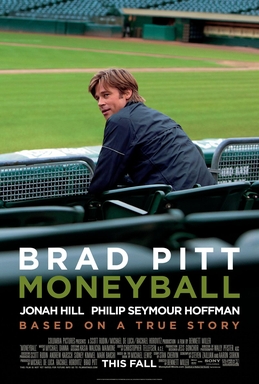
MoneyBall (2011) ***½ /5: Good film however the loopholes denied it the chance of being a great sports epic.


MoneyBall (2011)

Introduction

Moneyball is a surprisingly good film full of poignant insights about the world of sport and is one of the year’s best. The focus on baseball does not limit the film to any great extent because of the statements that can be applied to the world of sport in general. The film surprised me because I thought it was travelling along a predictable path however by the end, because the filmmakers made the right choices, the film has contributed to the existing sport filmography in its own small way. It is based on the true story about the General Manager (GM) of the Oakland Athletics baseball team, Billy Beane (Brad Pitt), who resorts to unconventional methods to secure a team for the 2001-2002 season following the departure of key players in the previous season. He has to resort to these unconventional methods because he simply does not have the money to recruit the top players and it is this lack of money which would explain why certain teams remain at the bottom of the various sporting leagues around the world. The film highlights this from the start where OA (Oakland Athletics) are competing against the New York Yankees in an elimination game which they lose. The Yankees have a roster of players valued at 114 million when compared with the OA budget of 39 million. He then recruits an unknown apprentice at the Cleveland Indians, Peter Brand (Jonah Hill), who has devised a system of computations to determine the appropriate position for players regardless of the fact that they might not be the first choice of the traditional scouting teams. This is unconventional because it goes against the established tradition where scouts would agonize about getting that intuitive feeling about a player which could positively influence the direction of the team to which they are attached.  The scouts are not usually accurate for some players they choose were never meant to be in the major leagues regardless of the talent they demonstrate in their youth. The computations made by Peter Brand targets the undesirables who are rejected by the major clubs and even the clubs lower down in the scale simply because they cannot capture the eyes of the scouts who rely on the gut feeling. If they are nearing 40, had a severe injury which rendered them inactive for awhile or their all round abilities cannot make them distinguishable they are routinely ignored by the scouts. The method used by Peter Brand, which is borrowed from a fellow who believed in using statistics to assess the proper value of a player, would be able to fulfill the potential of a player regardless of how undesirable they are in the eyes of the scout; therefore if they can steal first base expertly despite being designated a hitter or can effect a strike out despite having a physical disability then the computers would have seen something that the scouts, with their gut feeling, would have missed. The team he assembles in this film based on these computations (although the film is not entirely clear whether or not all the players are recruited through this means and does not speak of players that would have carried over from the previous season) equals a baseball record of 20 wins in a row.  The importance of the computations is determined primarily by their cost effective measure, as the Red Sox discover, which allows managers to save money on players by identifying undesirables. The film has clear weaknesses such as its emphasis on the managerial perspective as opposed to on the field play and so we are not entirely clear whether or not this method actually does work as they say it does. It is not also clear whether this technique does do away without the traditional scouting technique. It still adheres to most truthful premise about sporting ‘All glory is fleeting.’

The concept is based on the capitalist concept of division of labour which allows the owners of the means of production to cheapen the wages they pay to the individual worker.

What’s good about this film?

The best thing about this film was that it avoided the clichés of lesser sport films which believe that sport is defined by the final championship game where there can be only one on top of the world.  Lesser films like Angels in the Outfield, which dealt with the same issue, actually emphasize that the turning point comes when angels intervene and give players, who are not traditionally doing well, the impetus they so badly needed to take on the big boys. Moneyball provides a more sombre outlook by emphasizing the material element which is money and statistics stored on a computer database.  Billy Beane has good reason for thinking that traditional scouting methods of intuition do not work in this case because of his own history but it is not clear whether or not this method of computation can actually do away with this particular tradition. The filmmakers tried to clarify his use of the computation method by doing away with his scouting team and taking on Brand. At the beginning of the season his scouting team are seen as old fashioned as they scramble to try and find players to replace the top three in their squad who left at the end of the season.  Beane is frustrated that their methods do not work although he is not entirely clear why especially after he fires his head scout and decides to work solely with Brand; he just knows that something is wrong and it has to do with the fact that he has no money.  He disregards everyone in applying these new methods in building the team and eventually isolates all but a loyal few especially the coach (Philip Seymour Hoffman) whose character is sidelined here. In traditional sporting films it was always the coach that took on the primary role of motivating the players but in this film he too is at a loss with regards to the new method.  It is up to the general manager in the form of Beane to play the coaching role. I was a bit confused as I tried to determine whether or not he was the coach or not at times. He does have some conflicts with the coach early on in the film but this is resolved as the coach seems resigned to his fate rather than be enthused about the entire project. Beane’s coaching staff, like the scouting staff, is also portrayed as old and incapable of embracing the new method and this seems to be the trend nowadays.

It was good that the film realized that you cannot do away with the traditional baseball methods as simply as you think for motivation of the players is essential. The graduate from Yale with a degree in economics cannot seem to see that because you crunch some numbers together and assemble a team does not mean that team chemistry will suddenly evolve. It takes Beane awhile to realize this (maybe because he is not a coach) and is forced to confront the issue when the team was losing 11 in a row and the method was obviously not working. He does this in a scene where he goes down to the locker and throws a couple stuff around to emphasize that when you lose there is no time to party. You have to focus and set your foot on that worn path of success. This is why he should not have alienated the coach in his decision making but the youth from Yale acts a bit too smug at times for my liking. He seems to be one of those scientists in their labs that have been isolated from humanity, whom he has little or no feelings toward. It is good that the film emphasized this point and this is why Beane has to make him aware of the realities of professional baseball. Players have to be traded regardless of emotional attachment for it has to be done to improve the team in some respects. Beane contradicts himself saying that Billy must not be emotional and listen to reason yet he does not have the guts to fire a player and does not realize that he is asking Billy to take a leap of faith with his method. The film stresses all these points effectively and there are scenes where Billy and Peter must let the players know what they expect of them and so motivate them to do better. It is here that Beane seems to take on the coaching role. They normally speak of the manager who is incapable of interacting with the players, for that is supposed to be the job of the coach; however Billy seems to earn respect by emphasizing that he too was a player.

The film also accurately stated that sport is always about the last game regardless of winning streaks etc for all glory is fleeting. There is a sobering element in this film that invites you to acknowledge that sport is not always so rosy. This element surprised me for I thought film was prepared to take the optimistic route of most films which offer a fairly narrow minded point of view. Most optimism is narrow minded for optimism is normally followed by a crash of some sort that was not readily visible since people are flying high with no regards to the crumbling edifice (check my review of Some Like it Hot (1959)). The film makes it clear towards the end that regardless of the record equaling winning streak which is what the fans want to see, the fact that the team is eliminated in the play off round means that they have to start all over again. The winning streak therefore meant nothing. When the team is eliminated the critics who were once in the sidelines tracking the success of Billy’s team resurface by saying ‘It was a good run but the team lacked the basic foundational principles to ensure continued success. You don’t punch numbers and hope to be a success.’ (not exact quote) The critic seems to have missed the boat for it is a new principle that will not disregard completely established tradition but will make one step further as the Boston Red Sox proved when they won the World Series 2 years later in 2004 using the same method. When Billy is offered a lucrative contract by the Red Sox he breaks the cycle by not making a decision based on money and the concluding statements of the film make clear that his team has still not progressed beyond the elimination round despite his unique method. The Boston red sox that used his method still have more money regardless and the cycle continues in this regard but it does not excuse the fact that once you are on top and your sole motivation becomes consumption as opposed to innovation you will be outpaced by those coming from down low with a new method of success. Billy has a crucial if only rudimentary relationship with his daughter who tells him to look on the bright side of life. Baseball might be a business but there is fun to be had.

The pacing of the film and the direction of all the elements by Bennett Miller (Capote (2005)) is solid.

What is bad about this film?

The screenplay might be smart but it is not perfect. Firstly, it does not mention the roles of the undesired, cheap players themselves and how they feel about their selection by Billy (the goat) and Peter (the great).  The players are selected but initially we do not get a sense of who they are and their views on the game of baseball. Most of the action takes place at the top and so the players become commodities. Even when Billy and Peter start informing the players of what they really expect of them there are still no references to the views of the players regarding this new system since they are the ones that will put it into practice. The only time we see the players on screen is through the expressions associated with loss or victory on the pitch. If I consider myself a hitter and am told to simply try and walk (4 no balls) how will I then see myself? This is not how I conceived or envisioned myself as a baseball player so that means I too must undergo a transition. The presentation in the film is too glib for Billy tells a player something and then he does it like a slave. The film might have tried to be sympathetic towards Billy’s plight as a player but it really is not about him it is about those players on the pitch in the here and now.  We therefore do not get a sense of their skills and how they act on the pitch in the heat of battle. Peter does have recordings but that is mostly for prospective players or the ones with potential. It seems more like fun at times and not as serious as one would expect. The comedic elements in this film are related more to the entertainment value at the cinema since it will be viewed by a motley audience with differing expectations. This crucial perspective of the players therefore does not alter the viewpoints considerably for it is not only the fans that share in the joys and the sorrows but the players who have decided to make this sport a living. The players are the ones that will have to embrace the new philosophy not the manager and his advisor from Yale. Unless you can reach the ground level with your philosophy it is almost meaningless for the tides at the bottom only change when the winds do; if a player is interviewed for instance and is asked what position do you think you’re about to play in this new Billy outfit? ‘I don’t know I think of myself as a hitter but they might think I’m better at something else.’ It is true that they help a pitcher fulfill his potential despite his disability but we rarely see him in action. It seems that the screenwriters focused more on the concept to ignore the complications on the ground level that would make it a truly great film. This would mean at least an extra half hour etc but how good would it be to have a sports epic about baseball in its totality. The screenplay therefore sacrifices  its own potential by glossing over the main issues. When the OA are on their winning streak they try and include, alongside, some historical footage of the New York Yankees with Babe Ruth who set the previous record. This is good but this is not the issue. It is about the players.

The coach, Art Howe, is also largely ignored and does not seem to have embraced the philosophy of the concept completely. He is portrayed as traditional and is not given enough screen time apart from when he hangs his head low. When the teams goes on its winning streak it is surprising that the coach does not get in on the action by trying to motivate the players or try to come more to terms with the concept.  His most significant moment comes when he takes a leap of faith with a player. His role is completely sidelined by the screenwriters. The scouting staff is likewise dismissed outright and do not seem to know what they are doing. This is erroneous for if they were so bad how was it that they were able to discover the players that left at the beginning of the season. They were still able to find the players to take them to the same spot where the unique method took Billy. Billy and his team might have got a winning streak going but it did not alter the team’s fortune in any other way. Scouting cannot be all that bad then and the unique method does not seem to be any better. It is true though that the unique method is important for assembling a cheap team but you still need a game changer in your squad and that is where individual talent comes in. The unique method seems to derive from the economic concept developed under capitalism called division of labour. Therefore one person steals a base. One person learns to walk; one person hits the ball in the centre between fielders so that those on the bases can run etc. This would keep the scoreboard ticking in this case. It cheapens the value of a player as a result and makes more money for the club. The concept therefore is not new it is based on the capitalist doctrine. The critics have conveniently missed this point.  The concept reaches a stumbling block when the scores are level and you need a individual like a Babe Ruth/Barry Bonds to hit that winning home run. There is a scene where an individual makes a difference but this is based on a leap of faith itself and not necessarily on computations. Maybe this is the struggle at the heart of the film. It is not that single winning home run that will make you a star however but the fact that you can now be turned to when the scores are level to make that difference. In this film it is a one off occurrence.  The individual can make a difference in the squad although it is a team sport. Star players know how to seize opportunities that will immortalize them as their method becomes the norm.

The concept makes baseball seem pretty simple and it would be good to see it applied to other sports. Coaches have been making these computations for awhile now in cricket for example. You know that this player is a good fielder although he is an average batsman and bowler; you put him at backward point and whenever a batsman cuts it is a surety that he will catch it. So are these computations necessary or is it that a good coach after working with a player will be able to make a decision and determine where best to put you. That is not made clear for the coach is dismissed in this film. His intuition pays off and not that of the manager; Billy chose the person who hit the winning home run to simply steal first base. Billy’s life as a player collapsed because no one seemed to be able to pinpoint a specific role he could be an expert at for he was an all rounder. Barry Bonds for instance is good at hitting home runs (steroids and all) that is all. Could this concept be applied to other team sports? Can you really disregard traditional scouting since most teams use it successfully? Scouts do get it wrong sometimes and so does the computations. The Red Sox, who won the first world series for the first time since 1918, utilized the method because they were not attracting star players like the OA and were able to use this concept of the division of labour effectively because they had more money. It is actually not clear if the Red Sox is a wealthy club. After they won the World Series they probably attracted the star players so would you still use the method of computation once the star players start coming. If the concept worked does it mean what is called a star player might no longer remain. This was worth exploring or it was not developed significantly.

All in all it is a good film but there were issues that were not clearly resolved for the sake of general entertainment.

Monday, November 14, 2011

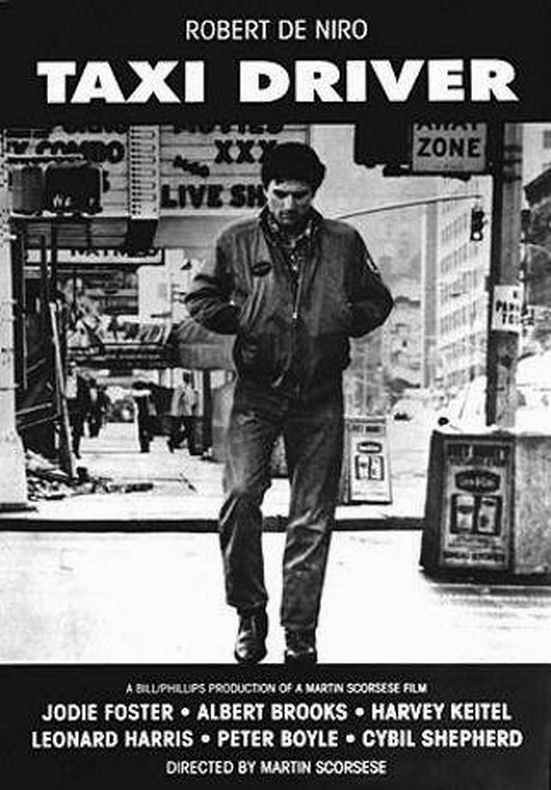
Introduction to the 'Modes of Urban Alienation' series: Annie Hall (1977); Midnight Cowboy (1969); Mean Streets (1973); Taxi Driver (1976)


 ‘Modes of Urban Alienation’

Welcome to the ‘Modes of Urban Alienation series’ which will feature four films: Annie Hall (1977), Midnight Cowboy (1969) and Taxi Driver (1976) and Mean Streets (1973).  Modes of urban Alienation refer to the various ways that individuals become isolated within urban areas which in this case is represented by New York City which is now one of the top three cities in the world along with London in the United Kingdom and Tokyo in Japan.  In a city the concept of urban alienation is significant for it is the only concept that explains how individuals interact despite the overwhelming population numbers that normally prevail in such an environment. Urban alienation refers to individualist tendencies associated with the growth of capital. In the city it is every man for himself despite the high population numbers. The communal element is lost with the dissolution of religion and the agrarian base and the subjection of every feature of life to money. Money becomes the source of everyman’s aspiration. If you choose some other form of aspiration you will perish.  Cities are highly industrialized areas or centres of commerce and this allows it to absorb such large population numbers by compartmentalizing the land space. The allotment to each individual is restricted to a few metres or is relatively small when compared with the open space of the country side. There is a scramble for space especially as the high levels of productivity in industry, which are represented by the cities, force individuals from the country side to seek some form of enrichment in these great areas of commerce. They also force immigrants from the poorer nations of the world to seek solace in the great metropolitan centres. The influx of migrants from the country, or the poorer nations of the world who also have a large agrarian base, results in a culture shock for some since these individuals cannot cope with the ceaseless struggle to attain money and the competition that goes along with it. Those who cannot cope either become destitute or go insane. Urban alienation thus goes along with this concept that money is your lord and savior. The same thing occurred when religion was the centre of the universe; individuals would aspire to become attached to the institutions that were said to be the only way to god. Elaborate structures were built in the name of god although it only added to the prestige of the church, the masjid/mosque and the Buddhist and Hindu temples that grew fat on subventions of the state and its members despite failing to actually deliver salvation or fulfill any of its warped prophecies. When industrial capital takes over these religious orders crumble and money becomes the savior of man. Concepts of god become irrelevant and religion becomes yet another means to make money; salvation now has a literal cost. People become increasingly removed from each other despite the efforts of the idealists who clamour for unity. The irony of the situation is that an individual in the city is confronted with seemingly endless opportunities which involve interactions with a host of people and many activities to participate in to make money or enjoy oneself. It is an irony because everyone has his or her own agenda regardless of their efforts to become a part in the lives of others. If their agenda does not comply with the others who they seek to embrace one or the other will be relegated or forsaken or disposed of. It will inevitably reach the stage when man and woman will be so far removed from each other they only come together to have sex or when money is involved. The man or woman (a woman might not need a man to insert his penis for she can simply go to the sperm bank seeking a donor. The man seems to need the woman more than she does him) will perhaps need a child or children. This urge to come together through sex is the only means that people come together apart from social activities such as work (for the capitalist class or the government), clubbing, going to the cinema or the theatre or other such amusements and going shopping to enrich the bourgeois class. After these activities one must return to his or her own little space.  Urban alienation is therefore associated with these individual tendencies which involve the scramble for money. The concept of the family will alter drastically by the 22nd century although it still remains necessary when rites of succession come into play; the issue of debt, however, might make a person regret that he or she was tied to a particular family.

Cities like most forms of social organization are constructed on the basis of class divisions. There are affluent sections of the cities and there are the average settings and then there are the poor underdeveloped areas where humans and rats fight for space. These divisions only serve to reinforce the concept for should you be able to survive the scramble for money you will more than likely be able to ascend the social ladder since money is what people respect most in the cities. Your background does not play such an important role if you are able to ascend by earning money. The corrupt bourgeois class and their lackeys, that exploit the proletariat or working classes, remain safe in their havens (Wall Street) due to cooperation since they realize that the possibility of revolt from the proletariat is ever present. Members of this class can fall simply when extravagant amounts of debt are accumulated. This class is merely transitory (I am here agreeing with Marx based on present observations). Only the police and the soldiers can save them since they provide security for their property. The poorer elements or those caught in the scramble for a place in the sun are exposed to the cruelty associated with Urban alienation and while some are able to rise by doing something extraordinary others fall and never recover. In the rat race individuals become indifferent to the plight of others unless you are not concerned with advancing in this particular society or are tied to a fraternity.

These films that I will assess more or less capture this essence of urban alienation from various perspectives. Annie Hall captures the almost futile nature of so called romantic relationships since inevitably both man and woman will separate. The romantic concept will become increasingly irrelevant although this does not rule out the possibility that two people cannot feel deeply for each other. The only way this deep feeling can be solidified is through marriage and this too becomes increasingly irrelevant when industry increasingly forces people to compete for their own little space. In Annie Hall comedian Alvy Singer (Woody Allen) is caught up in this system of urban alienation and cannot be tied to this concept of romantic behavior although he is almost saved by Annie Hall (Diane Keaton). The relationship they have suggests that there is still hope for humans to come together although Alvy refuses to stop clinging to these values of New York and cannot hope to follow Annie to California where she hopes to pursue her dreams. This is what undermines their relationship. I will discuss themes related to the mode of alienation particularly the techniques used by director Woody Allen to create a sense of dichotomy that renders Alvy’s attempts to stay whole futile. This reinforces the concept of urban alienation that is a unique condition of city life.  Midnight Cowboy reinforces this concept from an economic perspective where a country boy, Joe Buck (Jon Voight) who hopes to make his fortune in New York, by being a gigolo for old women, is forced to confront the harsh realities of city life and his only solace is in a con named Ratso (Dustin Hoffman) with whom he shares a room within a soon to be demolished building. The need to break free of the shackles of city life proves to be ultimately futile especially as Ratso’s illness is life threatening. It is told from a basic economic perspective and the unlikely union of these two males who try to combat the hardships of city life. It still hints that despite urban alienation people are still forced to come together to try and survive. This hints at the impending proletariat revolution that will come once capital has exhausted its capabilities. Taxi Driver, along with Mean Streets, also reinforces the concept of urban alienation from the perspective of trying to break free from the cutthroat nature of city life. In Mean Streets the compassion exhibited by Charlie (Harvey Keitel) is incompatible with the selfish traits of city life. He tries to break out but is thwarted in his quest to escape with the two undesirables, his best friend the hot head Johnny Boy (Robert De Niro) and his epileptic girlfriend Teresa (Amy Robinson).  The overriding theme here is that compassion which is here reflected through Charlie’s catholic faith is becoming increasingly irrelevant as vice now reigns supreme in the city. In Taxi Driver Travis Bickle is an alienated individual in New York who cannot cope with this way of life and so tries to gain attention. This need to stand out is a complex of city life where people resort to eccentric behaviors to gain recognition by the populace. This eccentric behavior can land you in jail or it can see you exalted by the populace. In the countryside, for instance, those behaviours would characterize you as crazy since everyone knows everyone. In the city you are alienated and are nothing more than a speck in this great sea of humanity. There are some like Travis who resort to drastic measures to gain attention. He tries to attack a presidential candidate, rescue a twelve year old prostitute, Iris (Jodie Foster), from gangbangers and tries to gain the attention of the beautiful  Betsy (Cybill Shepherd).  
I will review the films in the following order: Annie Hall, Midnight Cowboy, Mean Streets and Taxi Driver. All of the films are set in New York City and could be simply be called ‘Visions of New York’. I have opted for the ‘Modes of Urban Alienation’ concept.

Tuesday, November 8, 2011

The Decline of the Old South, part 2: A Streetcar Named Desire (1951)


A Streetcar Named Desire (1951)


Introduction


A Streetcar Named Desire (1951) is greatly influential for it is one of few films released in the mainstream to address within a philosophical context the notions associated with sexual desire devoid of all its romantic pretensions and genteel ideals. This film also discusses the decline of the values of the Old South which prided itself on the romantic tradition and its notions of chivalry. This ultimate review is the concluding part of my two part series on the decline of the Old South. Part 1 featured Gone with the Wind (1939) where I spoke of the decline of the slave based economy which formed the basis of the ideals of the Old South. A Streetcar Named Desire takes place in the post World War 2 era  and this is significant for America has assumed a position of dominance in the global economy especially as it is the world’s leading creditor and manufacturer. The industrial sector of America has also advanced considerably since the Great Depression of the 1930s which began in 1929. This would mean that the economic mode of development associated with capitalism has taken hold of American ideals and values which are now dictated by the rapid advance of technology and increasing levels of productivity amongst the working classes. All of this generates a significant amount of relative surplus value which extends the amount of absolute surplus value or unpaid labour time gained by the capitalist.  This was not the case with the slave based economies where the exact opposite occurred: Low levels of innovation in technology and   the labour base associated with slavery. In this film the slave based economy has all but disappeared however the remnants of the Old south still persist in the form of legislation associated with Jim Crow which segregated the former slave holding states along racial lines or between white and colored. The concept of master and slave therefore still persisted in this nominal form where the whites enjoyed the prestige of wealth and power and the blacks enjoyed the prestige of the ignominy of poverty, lynching by the KKK and sycophantic ideals that relished worshiping the white populace.

In the post war era  however the industrial proletariat character emerged and its primary characteristics are ones linked with wage labour and the growth of the technological apparatus which became a sign of wealth for Americans. In A Streetcar Named Desire that character is represented by Stanley Kowalski (Marlon Brando). Other features include a dogmatic approach to the high ideals of the past. The past seems far behind for this sort of character since it is absorbed in the machinations of its own society. This character does not care much for the ideals of civilizations gone with the wind since their features are incompatible with his or her mode of economic development which is capitalism. The legends of a bygone era associated with romanticism appear somewhat pompous and idyllic and yet have no bearings on the new mode of economic development. The history of these old civilizations will be taught in school however they cannot have a bearing on capitalism since this mode of development is the most productive economic system in history and the other systems appear archaic and simple yet bloated with legendary tales. Everything becomes mass produced under capitalism and even virtue can be attained for a price and so this character cannot fathom why characters cling to the ideals of a society that prided itself exclusively on luxury which would imply low productivity. A single luxurious item of the Old South system would represent the cost of the same product multiplied by 100 in the industrial age.   This character represented by Stanley Kowalski contrasts with the character of Blanche Dubois who relishes the stagnant economic period of the Old South where genteel virtues associated with chivalry were the order of the day. Blanche is portrayed as a fragile character unable to maintain the essence of these virtues in light of the rapid advance of industry where these ideals largely do not matter and so instead of romance there is primal desire since  people are driven more by sexual needs than lofty ideals associated with love. This is characteristic of the industrial age where sex between individuals is almost soulless and is done primarily for pleasure as opposed to forming a bond that will sustain the two lovers. As soon as the act is over the two lovers  part ways and the relationship only lasts as long as the sexual desire remains strong. It is no longer determined by the joys of courtship and the long pursuit of the female which would culminate in marriage and the beginning of a new life. In the industrial age pleasure is the sole determinant and love is more difficult to find amongst these motley expressions of desire specifically as the industrial age commodifies sex to such a great extent in the form of mass media (pornography on the internet etc). It will probably reach a stage where marriage itself becomes redundant and it is no surprise that divorce rates have spiked in the last few decades. In the tradition of Blanche Dubois marriage was supposed to last literally until death. You could not divorce as easily as you could now since the social restrictions were too great as individuals were bound by the romantic tradition and the great legends of religion. The industrial age dismisses all of that because it embraces the new found openness of sexual expression. Women are no longer bound by patriarchal ideals and are free to experiment sexually. This trend is encouraged and it should now be relatively easy in the industrial age to have sex with someone of the opposite or the same sex. The boundaries on sex are only limited by the romantic ideals of preceding economic modes of development such as the Old South in the United States.  This film is great not only for the ensemble acting on display but because it reflects a change in the sexual expression of society which is no longer dictated by romantic ideals but by pure, instinctual desire.

A Streetcar Named Desire was one of few films of its time to push the boundaries of censorship regulated by the Legion of Decency. The production team was still forced to lessen the sexual references on screen by cutting three minutes of footage that was considered inappropriate by the Legion. These three minutes have since been restored in the director’s cut and it is this version of the film that I will be reviewing. The screenwriter Tennessee Williams also had to lessen the amount of references to Blanche’s dead husband who was a homosexual who committed suicide. In the film version this unseen character is portrayed as weak instead. The film version does capture the essence of the play for the majority of its running time and so extensive references to the textual version of the play will be redundant. The screenplay was written by Tennessee Williams who also authored the play. The Broadway version of the play was directed by Elia Kazan who also directed the film version. These interpretations of the play therefore remain essentially the same when transferred to the big screen and so it will not affect my critique of the film by not mentioning either the dramatic literary work to any great extent or how it was acted on stage. The film, like the play that won the Pulitzer Prize for Williams, was a commercial and critical success despite the restrictions of the censors. It was nominated for 12 Academy Awards including Best Film and Best director and won for four: Best Actress (Vivien Leigh in a masterful performance), Best supporting actor (Karl Malden), Best Supporting Actress (Kim Hunter) and  B&W Art Direction/Set Decoration (this is not surprising since the elements of the stage performance must have been simply transferred to the movie set although expanded in some considerable degree. This is pretty evident from the set design however film requires a more expansive set and a less reliance on symbolism). Other notable nominations were for Marlon Brando as Stanley Kowalski (which is memorable for his brutal, hyper realistic portrayal of Stanley. Brando’s portrayal of Stanley influenced other great performances such as Robert De Niro in Raging Bull (1980). When I discuss Raging Bull I will give due attention to this performance by Brando), Tennessee Williams for the adapted screenplay of his based of his own play of the same name and Black and White cinematography which is essential to the film because of lighting. Blanche always dulls the lights to create a illusion about her actual physical features. The Musical score is also significant for its themes drive home the oomph in desire with the use of jazz music which had its birth in New Orleans. The use of the saxophone is particularly prominent in the production. The film has been traditionally well received by critics and so I am not here to challenge anyone in particular. They see the film as a primarily good piece of ensemble acting (which indeed it is) and for pushing the boundaries of censorship. As usual they focus primarily on the film’s production values without assessing its theoretical basis.  One wonders how the Legion of Deceny would react to the present situation where censorship is almost pointless and can be only limited by age appropriateness.  The internet does not help also.

In this review I discuss the concept of a street car named desire, the industrial character of Stanley vs. the Old Southern values of Blanche and how Blanche’s tragedy is truly one to be compared with a shattered glass. She cannot come to term with the tarnished concept of romance which is dramatized when she is raped by Stanley towards the end and loses control of her mental faculties. I also look at how the tensions between Stanley and Blanche are internalized within the society and this is reflected in the roles of Karl Malden as the tender hearted gentlemanly figure named Mitch, who still possesses the gentlemanly qualities and tries to court Blanche based on her own lofty ideals; and Kim Hunter as Stella Kowalski, Stanley’s wife and Blanche’s sister, who is torn between the raw desire of Stanley and the lofty ideals of Blanche. I also discuss the final decline of the Old South which is associated with the loss of Blanche’s and Stella’s family plantation Belle Reve which was confiscated because it was swamped with mortgage debt. This loss of the property took place under Blanche’s supervision and she is forced forced her to flee from her hometown, Auriol, in Mississippi after she, as a teacher, seduced a 17 year old student and was involved in several other seductions of other males  at the Flamingo Hotel still searching for that elusive romance. After the loss of her landed property she is forced to compromise her station in life and now clings to the lofty romantic ideals of the Old South (fantasy) while at the same time indulging in forbidden desire (reality) or vice. Stanley counteracts Blanche so effectively because he is the only one not impressed with her glories of the past and so sets out to discover the truth about her situation.  Blanche’s demise suggests that there is now no chance of going back to the ideals of the Old South although the film does maintain that the romantic tradition is the only barrier preventing the full outbreak of vice/desire which would ruin the basis of matrimony.  The trend is already in full flow.


Stella (Kim Hunter) embracing Stanley (Marlon Brando) in the throes of desire


 A Streetcar Named Desire

This film is quiet symbolic for it takes place in an abstract environment which does not seem to correspond to everyday living. The symbols are carried over from the play and so seem a bit excessive in the film version from a dramatic point of view if you consider the realistic element of the play. Which streetcars do you know that are actually called desire?  The symbols therefore heighten the dramatic element of the movie primarily because it deals with this abstract of desire that is diffused throughout the populace of the community by the name of the Elysian Fields where the majority of the action takes place. In Greek myth the Elysian Fields were synonymous with paradise and paradise implies that once you are there you are free to indulge in your joys or thrills. The characters themselves have to be seen within the context of desire/lust i.e. how they respond to this notion of desire.  Blanche is the only character who tries in vain to stave off the encroachment of this dreaded element that is the basis of man’s corruption although it is already too late for her and her views appear somewhat hypocritical and contradictory. The characters therefore are caught up within this notion of desire. Most discussions and actions centres on this concept of desire and this is not necessarily a fault for  before the practical,  day to day activity can be understood one must first grapple with the theoretical/ subjective notions that place these activities within a context. It is one thing to indulge in the world’s fancies but you can be so caught up that you cannot account for the mishaps that occur. It is then that you try and form some theoretical justification for this particular mishap. This film therefore should be looked at primarily as a theoretical interpretation as opposed to a reflection of day to day living for it is not necessarily a realistic film to a great extent because of the symbolism which implies some form of abstract. The day to day living elements are shunned to a great extent and we only get involved when the characters grapple with this abstract notion called desire. The sexual tension between Blanche and Stanley and Stanley and Stella is the basis of the dramatic action that takes place in the Elysian Fields. Questions to be asked are: What are the boundaries to desire? Or Should we indulge completely in our desires without heeding our conscience? If there are boundaries what are they and how effective are they?

This bracketed section is not necessary reading.
(The Streetcar named Desire is a one way ticket to freedom as Blanche is about to find out especially as desire implies selfish ambition for you basically cater to your own needs and wants regardless of the consequence for others. This is characteristic of the industrial age where profit is the sole driving force.  When we first meet Blanche in the opening scene she informs a stranger that she must take the streetcar named desire to the Elysian fields. This is the essence of desire for we expect the vehicle that represents our desires to take us to places of ecstasy where pleasure is at the forefront. When Blanche  arrives in the Elysian fields it is not portrayed as the paradise of lore where individuals frisk about with lambs amidst a white haze all dressed in white; the space known as the Elysian fields is a teeming area of commerce where the sole motive of desire is what we can attain with money. With money it is presumed that most of our problems are solved for we can buy anything we want and fulfill our desires without any hiccups. The concept of lust is at the forefront as well since human relationships are no longer determined by romantic quests and notions of chivalry but by raw sexual desire. This sexual desire is a feature of the industrial age because money is the sole driving force i.e. an individual is determined by the money he can make. In the modes of economic development that preceded capitalism individuals were more or less characterized by the class of their parents. It is a brand that would remain with you for life. If you were a peasant then be sure you would have the stamp of a peasant on you for life and likewise if you were born into the royal family this would be your station for life unless you were in the military. The room for expansion was limited until the bourgeois class broke the feudal bonds, a process which began during 15th century and culminated in the 18th century where the shackles of feudalism were finally broken in Europe. The bourgeois class was truly revolutionary since it implemented radical reforms in the economic structure with unlimited expansion as its goal. This expansion was achieved by first dispossessing members of the yeomanry or peasant class and then expanding their landholdings. There also occurred the dissolution of the guilds and the notions of apprenticeship of the journeymen. All these activities are subsumed under capital in the form of wage labour. The dispossessed workers would then become wage earners who would generate surplus value or unpaid labour time for the capitalist and this would be regulated by the rate of surplus value which is determined by the amount of numbers under his command. At this time however in the early years of capitalist production the bourgeois class was still slightly subservient to the wealthy landowner who would live off the rent although now the bourgeois class is now in full control with every sector under its control particularly the unproductive sectors which profits from the taxes charged against this class and their workers and the revenues that are spent for consumptive reasons.

               The sole driving force of the bourgeois class is profit and should it ever reach the stage where it cannot earn these profits due to overproduction or high levels of debt associated with excessive consumption then there is the inevitable crash. This drive for profit is characterized by the removal of any moral boundaries to attain that goal. These moral boundaries are associated with the modes of economic production that preceded capitalist production such as the medieval centres of the middle ages in Europe, the monopolistic tendencies of the mercantilists involved in the activities of colonialism where it became a matter of profit on expropriation or a surcharge and a tendency to concentrate wealth into large joint stock firms which became a means of accumulation; and the slave economies such as  those that existed in the United States south and throughout the Americas (the Caribbean, Central and South America). These slave states were highly moral with their notions of subservience to god when in fact it was subservience to the church. The church was instrumental as a means of social control since the idea of the colonies implied an area of wild lands and in fact when colonies were initially founded that was the case as debauchery prevailed since there was no sense of security. There was also the perception that the slaves from West Africa would run wild without some recourse to morality. With the arrival of the church some level of moral high ground was achieved and slave economies became constrained or bound by the virtues of the various churches (Protestant and Catholic). The church was also a large landowner where they too owned slaves but concealed it by calling it a humanitarian measure. With the disbandment of the colonial system and with it the demise of the mercantilist school of thought the bourgeois class proceeded to remove the shackles or vestiges of these archaic modes of economic development by expanding the wage labour force and the amount of capitalists engaged in production. This would inevitably raise the levels of productivity to magnificent levels and with the increase of productivity there is the growth of the technological apparatus, through scientific innovation and the maintenance of this machinery by the groups called engineers, which is known as constant capital or objectified labour or the accumulated labour from the surplus value generated by the variable capital or the wage earning class. This massive accumulation of stock means a decline in the rate of profit etc and then with this decline in the rate of profit and increase of the  levels of debt associated with credit to continue expansion even while the goods are on the market unsold the crash looms as the demand for the goods is way below the supply and the concept of sale and purchase become forcibly removed. Then CRASH and the cycle begins again once all deficits are cleared. In any case when the drive for profit becomes the sole determining force morals are cast aside and the bourgeois class removes these difficulties by first increasing its middle class base with the expansion of various sectors within the industrial, commercial and money dealing sectors  which ensures that their goods will be continually consumed since these middle class occupations imply some level of high education which will ensure that the advanced elements of capital keep rotating (the unproductive sectors such as those in the judiciary, legal or medical professions also fall within this group  since their salaries are determined by the capitalist and their workers who pay the majority of the taxes or who eventually form their client base when capitalist production takes complete control) and by removing all sectors that preach the moral high ground since the driving force of capitalism is expropriation then expansion. Expropriation implies some form of theft and murder of individuals in order to get what they want. Once the act of expropriation is carried through then there is expansion. The moral high ground of the church is dissolved in all but name as their lands are converted into means of production for the capitalist and  yet the church still preaches although everyone knows its livelihood is determined not by faith in god but in the bourgeois class who pay their rents and absolve their debts. It is this that keeps the major religions functioning since there was a time when governments chose to no longer  support their excesses and luxurious lifestyle. It is to the bourgeois class that they must turn. In any case the church loses a moral high ground and with the decline of the church notions of ascetic morality vanish since everyone is driven by the urge to make money even the church. God cannot ensure your survival here only money. When the moral high ground is lost and everyone becomes absorbed by making money then selfish motives come to the fore and the sense of community or communal living is eroded. With the erosion of community boundaries it becomes the ideal of every man for himself.  I mention the Christian church primarily because the European powers were responsible for the expansion of capital through imperialist means by destroying the social fabric of other nations who were not so economically developed. The Islamic empires such as the Abbasid and Umayyad that conquered sections of Europe particularly the Iberian peninsula were also pioneers in technological advances and it was all done under the guise of religion and low levels of productivity and so advancement was still slow but influential.)

When this individualist tendency is developed with the advance of the industrial capacities of a nation then everyone seeks out the things that make him or her happy regardless of others. Your pleasure or satisfaction comes first. This then resolves itself into every sort of vice imaginable: gambling, drinking, sex and drugs. The capitalist expands his market into these territories of vice providing that it is legalized by the state which is also indebted to it and then proceeds to encourage every man to act out his fantasy by first putting down some cash. If the vice is considered illegal then the smugglers take up this calling and so everyone profits. Every vice becomes acceptable since it is seen as a profit making venture for the capitalist and this simply means that every commodity or service associated with these vices becomes cheaper with the increase in the productive levels. The vice is tolerated and exalted and the moral high ground established in the romantic era becomes lost. Sex for instance is cheap where before, due to moral constraints, one had to engage in an elaborate form of courtship to land a woman and the woman would be bound to her husband since she was supposed to be dependent on him for her upkeep. This was all ensured by the moral authority of the church which instituted the bonds of matrimony which was supposed to be a union sanctioned by god. Marriage was originally founded on the basis of landed property. The church thrived on these doctrines since there were low levels of productivity and people became caught up with mythical tales of the land (which most times had its basis in the divine or religious deities. This is how the church maintained control) or pastoral elements/landed property that had its basis in subsistence farming when man only catered to satisfy his own needs and those of the community. The community would be headed by a chief or king or emperor who would demand some form of tribute called a tax so as to maintain the boundaries of the community. This element still exists however it is from the capitalist and wage earning class that these funds must now come There was no real concept of surplus value (unless you consider it in the form of rents paid by the peasants to the aristocratic landowners) until the usurers emerged in the middle ages and started to exact exorbitant interest rates in the towns and rural areas thereby becoming a dominant economic force until the bourgeois class eventually curbed their appetites and drove interest rates down when productive levels increased exponentially; the credit system emerged under the capitalist class which is only a means to facilitate industrial production. The church and other modes of production linked to them become indebted to capital and so lose their moral high ground. Without a moral high ground everything is laid bare and ones needs become the sole driving force at the expense of community values. This is where desire runs wild and vice becomes exalted since the once exemplary figures that represented morality have declined in stature. Vice has always been in existence in the days of the ancient empires however following the dissolution of the Roman Empire and the emergence of the European powers such as Britain, Spain, France and Holland that eventually shaped the world in their image; the concept of morality borrowed from ancient religions is subsumed under the guise of Christendom in the West. If other religions do not conform to the dictates of Christendom they are annihilated ( the Roman Catholic Inquisition) and with it the foundation of the cultures of other independent nations outside of Europe such as those in ASIA. Asia has now become a major force in Global affairs and no European country can make a China subservient like they once did. Islam is also on the rise so the war on terror is futile. Under entrenched Christendom vice did exist however it was more downcast and dared not show its face for the church was responsible for maintaining social order particularly in the colonial sphere and could have people, practicing these vices, annihilated. The end of the church’s claim to morality after it has been indebted to the bourgeois class now leaves the way free for vice to reign. In order to cover their sins the bourgeois class still uses the church as a pretentious means to claim the moral high ground. Any smart person knows that it is a façade and that as soon as they leave the church they start organizing the death of other world leaders or by indirectly killing people by impoverishing nations whose industrial potential becomes eroded and by making them dependent on money with no way to receive it apart from loans that increase their debt levels to astronomical proportions.

 This is the sort of corrupt environment that Blanche encounters when she is transported by the Streetcar named desire to the elysian fields of Paradise.

The Romantic Old South is no more in the face of Industrial Expansion

The Elysian Fields is an abstract town in New Orleans where vice reigns and the drive for profit surmounts everything. When Blanche first arrives in New Orleans she is confronted by a bustling urban setting and when we first see her she has just arrived at a the train station and we see her make her  appearance through the steam vapours exuded by the train. This image is important in singling her out or making her instantly identifiable to the audience. She is asked if she needs help and she responds  ‘well they told me to take the streetcar named desire and then transfer to one called cemeteries and ride six blocks and get off at the Elysian Fields’   where she is going to visit her sister and this is important since she has always depended on the kindness of stranger. She enters with the help of a stranger and leaves with the help of a stranger. She eventually hops onto the street car named desire towards her destination where vice is prominent. She has just fled Auriol in Mississippi after having been thrown out of her teaching post for seducing a 17 year old student. She also engaged in a number of illicit affairs at the flamingo hotel in that area. The symbolism here is rife since for after the street car named desire she is to transfer to one called cemeteries and then get off at the Elysian fields;  this implies or suggests that one lives life by their desires and then after we die we are transported to paradise which in this case is the Elysian Fields. The Elysian Fields in this case is a thriving district where vice is rampant.  When Blanche arrives to this teeming district of the Elysian Fields she appears to be coy and timid and this is in keeping with her fragile nature. She acts this way because she is mindful of maintaining appearances. After she meets up with her sister at the bowling alley she sees Stanley for the first time ‘raising all the rhubarb (ruckus)’ but delays meeting him until she’ s 'bathed and rested’. She does not reveal to Stella why she has come to visit her in the middle of the school term and says that after the events that took place she was ‘on the verge of lunacy’ and was supposedly told to take a break.  The important element however with reference to the decline of the Old South is the landed property of Belle Reve. This element is more significant than Blanche putting on airs (‘daylight never exposed so total a ruin’) despite it being unnecessary for it is here that she reveals that she is an alcoholic and so she seems right at home in the Elysian Fields.  The property like all properties of the Old South was the family home and here is what Blanche says happened to the property. She tries to ease into the discussion of Belle Reve with Stella by first stating, I want you to look at my figure y’know? I haven’t put on one ounce in ten years. I weigh now what I weighed the summer you left Belle Reve. The summer Dad died and you left us.’ Her weight contrasts with Stella who has gained weight since arriving ten years ago in New Orleans and this element of weight gain is a common feature among the populace of urban centres. After the two leave the bowling alley and Blanche gets acquainted with  her new living conditions which is cramped compared to the spacious environment associated with the great house on a plantation. She eventually makes Stella know she has something to tell her about Belle Reve: ‘You’re going to reproach me. I know you’re bound to reproach me but before you do take into consideration you left, I stayed and struggled. You came to New Orleans and looked out for yourself (individualist element associated with the urban centres characterized by industry which means leaving behind the communal element of the Belle Reve plantation. Stella therefore has adjusted to the new mode of economic development), I stayed at Belle Reve and tried to hold it together (Blanche stayed behind yet that mode of economic development associated with master and slave has been eroded; and her failure to adjust through expansion of the property by adopting capitalist means or the use of wage labour means that the property will decline). Oh I’m not meaning this in any reproachful way. But all the burden descended on my shoulders.’ Best I could do was make my own living,’ says Stella. ‘ But you are the one that abandoned Belle Reve, not I. I stayed and fought for it, bled for it, almost died for it.’ (much like how Scarlett stayed and fought for Tara) Stella asks her to tell her what happened and the tone that she uses startles Blanche who feels she is being accusatory. Stella is not being accusatory but Blanche exaggerates because her mental state is fragile and she is one step away from complete lunacy. She eventually says that Belle Reve is lost. Stella is stunned, ‘Belle Reve? Lost is it?’ Blanche gets hysterical, after Stella asks anxiously what happened but eventually calms down somewhat ‘I, I, I took the blows on my face and body. All of those deaths the long parade to the graveyard. Father, Mother, Margaret that dreadful way…you just came home in time for funerals, Stella. And funerals are pretty compared to deaths. How do you think all that sickness and death was paid for? Death is expensive Miss Stella.  And I, with my pitiful salary at the school….Yes accuse me. Stand there and stare at me thinking I let the place go . I let the place go? Where were you? In there with your Polack (Stanley). After Stella hurriedly moves away having been moved to tears the conversation of Belle Reve ends with the arrival of Stanley from the bowling alley. In this instance it is clear that she mortgaged the property and accumulated large amounts of debt which she was unable to pay for and so she lost the property. With the loss of this property Blanche would eventually be driven to attempt the seduction of a 17 year old boy.  The memories of the lost property of Belle Reve would have still resonated and so she at her age would try to recapture the glory days when she was a young southern belle promised to a certain youth of her own age who would build a life together. The husband that she married when she was young would be one of her motivating factors to seduce a 17 year old boy and engage in repeated sexual liaisons  with strangers is a sign that she became tossed into a void following the loss of her property of Belle Reve. She was eventually seeking some form of solace in the eyes of these many men not knowing that the days of chivalry could not be recovered in such a pathetic fashion. She never seemed to realize that she lost all prestige as a lady in this fashion having offered herself up so easily with the hope that she could recover the security she once had in her youth.

The Napoleonic Code: The Industrial Character of Stanley Kowalski

Before I focus on the culture clash between Stanley and Blanche first we must get to the source of the conflict which is the property of Belle Reve which Blanche lost when the property became insolvent because of her inability to pay back the mortgagee against the property. Stanley’s interest in the property stems from the Napoleonic Code which claims that whatever belongs to the wife belongs to the husband. ‘We have here in the state of Louisiana what is known as the Napoleonic Code, where what belongs to the wife belongs to the husband and vice versa,’ he says. This concept of the Napoleonic code is in keeping with the Industrial lifestyle of profit gain. Stanley’s interest stems from the fact that he probably hoped he could earn some money off the property. The Napoleonic code is a principle utilized significantly by Williams (Tennessee) for it gives some sense of character to the state of Louisiana and to the conflict that fuels Stanley’s dislike for Blanche. He tosses the term around the household in a dogmatic fashion and this highlights that it is a cultural manifestation although he  does not grasp completely the  provisions apart from the one that stipulates that the property of the wife belongs to the husband (hence why it is dogmatic). The Napoleonic Code emerged during the Napoleonic era in France, 1804, under Emperor Napoleon who sought to implement the ideals of the revolution into law. This civil code unified the provinces of France where previously they adhered to the numerous archaic feudal laws which did not cater to the entire populace and were applied to the functions of a particular class or province as opposed to France as a whole for instance the northern states embraced roman law and the southern states would embrace what is known as the common law; judges also intervened heavily in the creation of laws in favour of the nobles and royal class. The feudal basis where there were separate laws based on class distinctions or locations of a particular province was now removed following the French Revolution and everyone had to abide by a single code although the code was divided into the following: persons, property, acquisition of property and civil procedure; civil procedure became its own basis in 1806. Equality before the law. The provisions of the law were borrowed from the provisions of 6th century Roman Emperor Justinian under his civil code Corpus Juris Civilis which also placed the law on more unified legal basis for all. The precedent for the corpus juris civilis was the Theodosian code (429-38) developed by Theodosius II. Justinian ‘revised and expanded the code twice’. The other basis for his law was ‘the juristic literature of the second and third centuries excerpted and systematized in the Digest in 530-33.’ (Chris Wickham).  The Napoleonic code was important for the imperial policies of Napoleon and that is how the Theodosian and Justinian codes were traditionally used by the Romans.   This important civil code (Napoleonic Code) was adopted in many countries all over Europe following Napoleons invasion into other territories on Continental Europe. The code facilitated a centralized form of government. It was also adopted by French colonies in the Americas such as Louisiana and Quebec. Louisiana, where New Orleans is located, still adhered to these principles of the French despite the Anglo Saxon values that were imposed following the expulsion of the French by the British. It is stated by Wikipedia that they adhere more to Roman and Spanish practices despite the influence of this civil code. It still does not matter for the Napoleonic Code borrowed heavily from the Romans. It still explains why the laws in the state of Louisiana differ from other states throughout America. The fact that Stanley adheres to this code highlights that this is a feature of its unique social character. Blanche, from Mississippi, would therefore be at odds with him from the start.  The removal of the feudal boundaries by this code would pave the way for the bourgeois class and their capitalist base. I already spoke of the moral boundaries that would be removed which would now mean everyman for himself and individualist tendencies as opposed to communal bonds. Communal bonds still exist however but in more closely knit spaces of the nuclear family. When capitalist production reaches overwhelming heights bonds of matrimony will be eroded completely and the family will be more like an ad hoc arrangement.  

When Stanley discovers that Blanche has lost the property he becomes taken with her from a negative point of view. He always makes clear that he is not taken with the aristocratic airs that she inherited from the Old South although that way of life has faded. He becomes fed up with her luxurious lifestyle despite it taking place in far from luxurious conditions. After he discovers that Blanche has lost the property he rummages through her luggage, having arranged to have it taken up from Mississippi, while she is taking one of her long hot baths and discovers her expensive clothing that includes furs. He does this because he feels that Blanche has swindled his wife by piling up mortgage debt to meet her luxurious lifestyle. He has a point when considering the point of view of the industrial character where anything that does not increase profit is wasteful. This concept belongs not only to the capitalist but to the wage earner who has to find means to save or increase his earnings. If a character such as Stanley had Belle Reve he would have invested in reaping crops of some sort and thereby benefitting  in terms of value from the improvements to the land which is in the form of differential rent where productive levels would increase based on the standards set by the worst type of soil. We see that he is serious about improving his earnings when he gets enraged after losing his poker game and physically attacks Stella. It is in this scene that we see vice all on display for while playing poker he is drinking heavily. When he discovers that he has lost money he takes it seriously and that is why he goes berserk. This is the industrial age where earning as much money as possible is the ultimate goal regardless of consequences for others. In Blanche’s case she mortgaged the land not to increase the value of the land but to consume luxury products which is wasteful from a capitalist perspective. Blanche therefore was not in keeping with the industrial age and that is why she lost Belle Reve. Here is what he says about her luxury products, ‘What she got this out of a teacher’s pay?...Will you look at these fine feathers and fur that she comes to preen herself in here? (as he rummages through her belongings) What is this article? That’s a solid gold dress I believe. This one here. What is that a fox piece? A genuine fur fox half a mile long.’ He asks his wife ‘Where are your fox pieces? This is bushy snow white ones, no less. Where are your white fox furs?’ ‘ Those are inexpensive summer furs that  Blanche has had a long time,’ his wife responds. ‘ I have an acquaintance who deals in this sort of merchandise and he’s coming in here to make an appraisal.’ ‘Don’t be such an idiot Stanley.’ ‘Listen I’m gonna be you there’s a thousand dollars invested in this stuff. Well now what is that? That’s the treasure chest of a pirate? That’s pearls Stella. Ropes of them. What is this sister of yours, a deep sea diver? Bracelets, solid gold? Where are your pearls and gold bracelets? And here diamonds. A crown for a princess.’ ‘ A rhinestone tiara she wore to a costume ball.’ ‘What is rhinestone?’ ‘ Next door to glass.’ He eventually concludes that ‘the Kowalskis and the Dubois got a different notion on this.’ He is right for he, as descended from Polish immigrants who came here as wage earners under the throes of capitalism would be opposed to the ideals of the Dubois family whose economic base was the inherited traditions of a plantation of a slave economy where luxury was the only way to live. Luxury which equates with wasteful living and the increase of consumer debt in the industrial age is opposed to an increase in profits. Blanche indulged in consumption without production and so ran into debt which she could not repay. This was one of the causes for the recession in 2008.

On the left Blanche Dubois (Vivien Leigh) and Stanley Kowalski (Marlon Brando) on the right


  Blanche vs. Stanley and its repercussions for Stella and Mitch (the concept of human tragedy)

I have established the root for the conflict now it only remains to assess the conflict itself between the two based on the Napoleonic code. This conflict is at the centre of this film and affects the supporting characters Stella and Mitch. Firstly let me emphasize that the romanticism associated with Blanche is not necessarily a sign of decline as it is a sign of stagnation or lack of growth or the pinnacle of a civilization or the values embraced by its members. It becomes a feature of decline when the individuals, or in this case a particular individual, fail to adjust to the new system of social organization by clinging incessantly to these high minded values which become more and  more irrelevant. The romantic notions developed in the slave economies or societies developed on the basis of necessary subsistence, i.e. societies prior to the capitalist mode of production, still prevail to this day although in nominal forms for the goal to attain money is now the sole driving force of most societies apart from those who cling to old forms of economic organization. It still represents a barrier to the rampant vice that will engulf major capitalist based economies which largely centres on the concept of everyman for himself or the concept of alienation. These values are embraced largely by the bourgeois class and their lackeys in the middle class who cling to the old values of matrimony and the sycophantic worship of religious divinities; they pretentiously claim to lead a high cultured lifestyle built on the foundations of exploitation of the working classes as other ruling classes associated with other modes of production did before. The bourgeois class will collapse like all other ruling classes in history; when they cease to produce and base their lives solely on consumption or lofty ideals that become increasingly irrelevant. They will then be replaced by a new order of society and, according to Marx, this will emerge with the rise of the proletariat. The main point here is that the romantic notion associated with a luxurious lifestyle has persisted for centuries and is yet to change however with the bourgeois class it appears merely as a contradiction simply because vice  is meant to reign supreme in their society i.e. it takes new forms under this class since it is openly encouraged whereas previously it was openly denounced. The capitalist system therefore encourages alienation or a sharpening of individual differences as a result of the division of wage labour as well as the increasing numbers of individuals being brought within the wage bracket (particularly women) and profit  bracket (emerging capitalists). The more individuals are able to earn without the needs of communal organization, as previously in the former modes of social organization, the more the concepts associated with the old forms of morality built around communal grounds disappear. When I discuss the final scene in this film what I am saying  becomes even more clear.
The defeat of the masters of the Old South, who were not prepared to expand their economies in line with capitalist development,  faced the same dilemma as most ruling class groups in history that have been overthrown however the supposedly high notions of civility and respect for property was common in this mode of development. This is the basis for Blanche’s critique of Stanley. Stanley does not appear to be civil despite, supposedly, being bound by the bonds of matrimony.  The basis for Stanley’s critique of Blanche is simply that she is excessively indulgent and this is as a result of a luxurious lifestyle associated with ruling classes however in this case it represents  decadence (how do you go from being a high minded aristocrat to being a high school English teacher). In Blanche’s case her luxury is based on a figment of her imagination or a past life she cannot hope to possibly recover. The beauty of the conflict in  this film is that it is never really resolved by the end and both of these characters appear to have achieved, simultaneously,  some form of victory or defeat. By the end the flaws of both characters are brought to the fore and so it seems that there could not have been a resolution. The flaws I just mentioned which are the basis for the critique of each character. In support of the two characters this is what I have to say: 1. In Blanche’s case everyone wants to live a luxurious lifestyle and have the ability to indulge in the highest form of cultural expression in a society. It is no surprise that she teaches English and knows French etc.  2. Stanley’s disdain for Blanche is merited when considering that she is unwilling to let go of the past and seems quite pathetic at times. The success for either  Blanche and Stanley depends on the extent they are able to influence the supporting characters Mitch and Stella. Stella is Blanche’s sister and so Blanche tries to persuade her  with her line of reasoning with regards to Stanley’s brutish nature whereas Mitch, as Stanley’s close friend, who tries to court Blanche is warned by Stanley about Blanche’s shortcomings. The conflict is diffused amongst these two supporting characters.

It now remains to be seen how the conflict plays out based on the interactions between Blanche and Stanley and with the interactions of these two with Stella and Stanley. The interactions between Blanche and Stanley that I will include take place after he discovers that she has lost the Belle Reve property and believes it is his right to discover her history based on the Napoleonic code which says that he had some right to the property in the Old South. One important interaction between the two which sets up the division occurs after Blanche emerges from the bath and sees that the belongings in her trunk. She calls Stanley over  into her room to help her button the back of her dress. She asks him this while Stella is outside and hints at Blanche showing some form of disregard for Old Southern values where a woman could not be left alone with a man unless he is her husband.  Blanche says after he buttons, or tries to, the dress  ‘It looks like my trunk has exploded.’ ‘Me and Stella was helping you unpack.’ ‘ You certainly did a fast and thorough job of it.’ ‘ Well, it certainly looks like you raided some stylish shops in paris Blanche.’ ‘ Clothes are my passion.’ ‘How much does it cost for a string of furs like that?’ ‘Why these were a tribute from an admirer of mine (a beau who was trying to court her. The onus was on the man to demonstrate that he had  a secure material base).’ ‘ He must have had a lot of admiration.’ ‘In my youth I excited some admiration , but look at me now. Would you think it possible that I was once considered  to be attractive? (Blanche is flirting and seems to be toying with Stanley) ‘Your looks are ok.’ ‘I was fishing for a compliment Stanley.’ ‘ I don’t go for that stuff …compliments to a woman about their looks. I never met a dame yet didn’t know if she was good looking or not without being told. And some of them give themselves credit for more than they’ve got (referring to Blanche). I once went out with a dame who told me, “I’m the glamorous type.”  I says, “So what?”’ ‘And what did she say then?’ ‘She didn’t say nothing. That shut her up like a clam.’ ‘Did it end the Romance? (Blanche sees that as unromantic since the man must always act chivalrous towards the female)’ ‘well it ended the conversation that was all (Stanley is not romantic. He has been absorbed into the industrial system). There’s some men that are took in by this Hollywood glamour stuff and there’s some men just aren’t.’ ‘I’m sure you belong in the second category.’ ‘That’s right.’ ‘ I cannot imagine any witch of a woman casting a spell over you.’ ‘That’s right.’ ‘You’re simple, straightforward and honest. A little bit on the uh primitive side ( she sees him as one clinging to a low form of culture),  I should think. To interest you a woman would have to…’ ‘To lay her cards on the table.’ ‘Well I never did care for wishy washy people (Blanche believes that a woman should manipulate men to get what she wants). That was why when you walked in last night I said to myself:  “My sister has married a man”. Of course that was all I could tell…’ ‘How about cutting the rebop!’ Stanley shouts her down. Stella intervenes but Blanche tells her to leave and go buy something so that she and Stanley can finish their conversation. Blanche continues , ‘Poor little thing was outside listening to us. And I have an idea she doesn’t understand you as well as I do. All right now Mr. Kowalski let us proceed without any more digression. I’m ready to answer all questions. I have nothing to hide.’ He again refers to the Napoleonic Code in the state of Louisiana and blanche mocks him by saying, ‘My, but you have an impressive judicial air.’ She also sprays perfume on him and he grabs her saying, ‘ You know, if I didn’t know you was my wife’s sister, I would get ideas about you.’ ‘ Such as what?’ (Blanche starts to flirt again as she asks this with a particular look although Stanley is really referring to her sanity) ‘Don’t  play so dumb. You know what.’  ‘All right. Cards on the table. I know I fib a good deal. After all a woman’s charm is 50% illusion. But when a thing is important I tell the truth. And this is the truth: I never cheated my sister, or you (Napoleonic code), or anyone else on earth for as long as I lived (despite just saying that a woman’s charm is 50% illusion).’  He asks for the papers and she gets it for him while going through the trunk Stanley discovers unknowingly love letters from a boy (her young husband) that Blanche states are now ‘yellowing with antiquity’.  This lay the basis for the conflict where Blanche mocks Stanley’s airs which she feels is akin to a caveman or some primal character and Stanley mocks Blanche for her exaggerated aristocratic airs and her deceitful methods.

This is the first conversation where we get a sense of the different ideals of these characters and this is how they try and convince Stella and Mitch. Blanche tries to work on Stella especially after the gambling incident where Stanley goes berserk having discovered he has lost money at the poker game. He first throws the radio, which he feels is the cause of the problem, out of the window (Blanche and Stella returned early from their outing and were confined to the room where Blanche proceeded to turn on the radio while the men were playing poker). This is why they say women should not be present at a poker game. Stella tries to throw the men out however Stanley attacks her and hits her. After he is doused with the shower (friends realizing that he is drunk) he realized the error of his ways and seeks Stella, who fled upstairs with Blanche to her neighbour’s house, in the film’s most famous scene where he calls loudly and repeatedly ‘Stella’. Despite Blanche’s warning not to go Stella responds to Stanley’s calls and she walks seductively down the stairs into his arms and he carries her to the bed so that they can revel in passion. After seeing this Blanche goes to Stella the following morning and says after Stella reveals that she is turned on by Stanley’s aggressive manner (or when he smashes things), ‘In my opinion you’re married to a madman. I’ve got a plan to get us both out of here.’ ‘I wish you’d stop taking it for granted I’m in something I want to get out of,’ says Stella. ‘ I take it for granted that you have sufficient memory of Belle Reve to find this place and these poker players impossible to live with.’ ‘ You take too much for granted.’ ‘ I can’t believe you’re in earnest.’ ‘No?’ ‘I understand what happened a little. You saw him first in uniform, an officer, not here.’ ‘I’m not sure it makes any difference where I saw him.’ ‘What you’re talking about is desire, just brutal desire. The name of that rattletrap streetcar that bangs through the quarter. Up one old narrow street and down another (suggesting that pursuing  solely our desires leads to a narrow minded perception.) ‘Haven’t you ever ridden on that streetcar?’ ‘It brought me here. Where I’m not wanted and where I’m ashamed to be.’ Don’t you think your superior attitude is a little out of place?’ After a little more banter Blanche asks ‘May I speak plainly?...Well if you’ll forgive me he’s common.’ ‘Yes I suppose he is.’ ‘Suppose? Surely you can’t have forgotten that much of your upbringing , Stella that you suppose there’s any part of a gentleman in his nature (romantic notions of chivalry). Oh you’re hating me saying this aren’t you? He’s like an animal. Has an animal’s habits. There’s even something subhuman about him. Thousands of years have passed him right by and there is Stanley Kowalski survivor of the Stone Age. Bearing the raw meat home from the kill in the jungle. And you here waiting for him. Maybe he’ll strike you or maybe grunt and kiss you. That’s if kisses have been discovered yet. His “poker night” you call it. His party of Apes? Maybe we are  a long way from being made in god’s image. But Stella my sister there’s been some progress since then. Such things as art, as poetry, as music. In some kinds of people some tenderer feelings have had some little beginning at we have got to make grow and to cling to and to hold as our flag in this dark  march toward whatever it is we’re approaching. Don’t, don’t hang back with the brutes, ‘ Blanche pleads. It seems that her high minded values have penetrated Stella who embraces her . Stanley has overheard all that Blanche has said and makes an entrance and his usual banging of things, which was previously considered normal by Stella, reverberates tremulously among both women. He calls Stella to him and makes her smile and that is enough to win the battle for she rushes to embrace him. All of Blanche’s condescension towards him has evaporated in an instant. There are certain people that do not gravitate to a certain high minded mentality for this high mindedness normally means that you are setting yourself up for a fall or isolation. This is what has occurred to Blanche because of her superior attitudes in this film however as Stanley is considered ‘common’ and does not put on superior airs he does not stand much to lose. After he hits Stella following the row of the poker he can abase himself without shame like a baby so that she will come back to him. Blanche on the other hand would die before she acts so desperate. It is these superior airs that account for the tragedy of man or instills this idea of what is called tragedy which is associated with decline. When a group of individuals cling to their old traditions and refuse to mingle with the lower orders that they pride themselves on exploiting they set themselves up for embarrassment when things come crashing down. This is why Stella asks Blanche if she doesn’t think her ‘superior attitude’  is out of place considering her station in life. This is the primary reason why the concept of tragedy emerges and in history this concept of tragedy becomes epoch making for it normally involves a dramatic fall of a once great empire or state or a set of individuals in the ruling classes. There are individual tragedies as well and this occurs when people stick to something that initiates a decline in stature. This is the universal notion of tragedy. In this case it is Blanche from the Old South. There are other instances where she tries to reach Stella and Stella does respond to her concerns particularly in the scene where they are eating at the table, while celebrating Blanche’s birthday, and Stella says to Stanley about his eating habits as he eats  with his hands, ‘ Mr. Kowalski is too busy  making a pig of himself to think of anything else. Your face and your fingers are disgustingly greasy. Go wash up and then help me clear the table.’ He smashes his plate saying that is how he intends to clear the table. ‘Don’t you ever talk that way to me,’ he says ‘Pig , Polack, disgusting, vulgar, greasy. Those kind of words have been on your tongue and your sisters tongue just too much around here. Who do you think you are a pair of queens? Well just remember what  Huey Long said: that every man’s a king and I’m the king around here. And don’t you forget it.’ He smashes another cup to emphasize his point.

With regards to Blanche and her courtship with Mitch it is Stanley that undermines this relationship by revealing the details about Blanche’s checkered past to him. A man like Mitch is interested in Blanche because he still has traces of the gentleman type in him. The gentleman type normally buys into the illusion cast by the ladies fair such as Blanche. A character such as he believes in keeping up appearances just like Blanche and cannot seem to handle when all cards are laid on the table. He cannot accept honesty. He still reaches the stage however where he feels he must settle down and this is due primarily to the influence of his mother who clearly clings to these old values. He may have these values but he still embraces the money making values of the industrial age which is why he gambles etc. He is only reminded of these values when he encounters Blanche under her hazy red light that conceals her aging features. The poor man did not realize that prior to his arrival for their date Blanche’s nymphomaniac qualities came to the fore when she tried to seduce a youthful newspaper delivery boy who she fancied to be an Arabian prince which revealed how she was incapable of letting go of her days as a young dashing southern belle. They eventually engage in a courtship and there is one scene where they are on a date and Mitch begins to suspect that Blanche may be hiding things. Firstly he notices that she never wishes to dance with him under the bright lights too long and will only talk to him under a dim light, such as the moon, so as to conceal her aging features. When he attempts to make love or have sex with her Blanche shrugs him off and tells him to be patient. In this case she clings to the old values where courtship is an elaborate process that leads to marriage which is why she holds back however in the new industrial age women can no longer afford to engage in such an elaborate courtship since it is easy to bed a woman in this era especially as the moral foundations of religion are not as oppressive they once were. Blanche still believes that  the 50% of her charm, which is a mere illusion, will land Mitch as a husband. ‘In fact I was a little bit flattered that you desired me, ‘ she says, ‘But, honey you know as well as I do that single girl, a girl alone in the world, has got to keep a firm hold on her emotions or she’ll be lost…. ‘I guess you’re used to the type of girl that likes to be lost (the women who give it up easily)…I guess I have old fashioned ideals.’ ‘I like you to be exactly the way you are because in all my experience I have never known anyone quite like you (this would be echoed in Taxi Driver (1976) when the Cybil Shepherd character says the same exact thing to Travis Bickle played famously by Robert De Niro) This frustrates Mitch and he senses that she is troubled as Blanche speaks of her timid husband who was a homosexual and felt humiliated by Blanche who referred to him as weak and that she lost respect for him and despised him.’. She believes it is this that drove her young lover to commit suicide. This is the main reason why she tries to seduce young boys. Stanley however tells Mitch about Blanche’s past and he becomes upset and stands her up on her birthday which sends her over the edge since she has never been stood up before. Mitch could not bear to have the cards laid on the table; Stanley also informs Stella of what he has learned about Blanche’s sexual liaisons. Mitch then comes to her when Stanley and Stella have already left for the hospital for Stella went into labour. He confronts her and in a shocking scene Blanche lays bare her ladylike charm when she says ‘Straight? A line can be straight or a street but the heart of a human being?’ Mitch tells her all that he has learnt about her dealings at the hotel flamingo and then she lets him have it, ‘I stayed at a hotel called tarantula arms. (?)…Yes a big spider that’s where I brought my victims. Yes I have had many meetings with strangers. After the death of allan metting with strangers was all I seemed able to fill my empty heart with. I think it was panic, panic that drove me from one to another searching for protection. Here, there, and then in the most unlikely places. Even at last in a 17 year old boy. ..I was played out. You know what played out is. My youth was gone up the waterspout then I met you.’  Mitch had the gentleman ideals she searched for so earnestly in strangers. After she is tormented by a spiritual incarnation of a woman that knocks on the door who is selling flowers for the dead (which is a hallucination) she reveals at last the nature of decline of the old south from ‘I lived in a house where dying old women remembered their dead men (this contrasts with Scarlett who seeks to break that sort of archaic tradition where women would become widows dressed in black). Crumble then fade. Regrets, recriminations “If you’d done this it wouldn’t cost me that.” Legacies  and other things such as bloodstained pillowslips. I used to sit here and she used to sit there and death was as close as you are. Death. The opposite is desire (or life which is why she sought comfort in soldiers). Not far from Belle Reve, before we lost Belle Reve was a camp where they trained young soldiers. On Saturday nights they would go in town to get drunk and on the way back, they would stagger onto my lawn and call: “Blanche”.’ This suggests that they had her too and Blanche would douse her self with desire since she so wanted to be loved. When the debts started piling up on Belle Reve and her way of life slowly faded she started to lose a grip on her way of life and found herself in the void of lust. Without the security of her property what was she to do. This at least Scarlett had. Mitch, after hearing her tales, tries to get a piece of the action since he feels she is not as clean as she claims to be but is turned on nevertheless. She threatens to scream and chases him out (she did scream  in the form of a tragic wail). With Mitch gone that was Blanche’s last chance of redemption and so her defeat seems inevitable.

The Shattered Glass (The final Demise of Blanche and her Old Southern values with a hint of hope)

I will here summarise Blanche’s final moments where she is raped by Stanley. With the loss of Mitch Blanche loses her senses. Stanley returns home, leaving Stella at the hospital, and sees Blanche adorning herself with jewels as she awaits a mysterious gentleman caller. He cows her down saying that her façade is now gone and it makes no sense in trying to keep up appearances. When he exits and remerges in his special pajamas Blanche becomes fearful  being alone with him. Stanley eventually discovers ‘Do you think I want to interfere with you? Maybe you won’t be so bad to interfere with.’ After a brief struggle he rapes her and this is symbolized by a glass being shattered which means that Blanche’s façade is truly gone. The rape sends her completely over the edge and she is, tragically, taken to a mental hospital. Before this however it is clear that both Stanley and Mitch, who are sympathetic towards her, believe that Stanley did rape her thereby sending her over the edge.  Mitch tries to attack him and forces Stanley to lie and say ‘I never once touched her.’ It is not only Stella and Mitch but the other minor characters that suspect him and this pushes him to lie. It still lingers in the backs of everyone’s minds and so his reputation would still sink despite him having Blanche carted off to the hospital. After Blanche departs, having been escorted by yet another stranger (a medical official who understands her situation), Stanley never really won for when he calls Stella, who has the baby with her, she refuses to respond and runs upstairs to her neighbour vowing never to return although that remains to be seen. The love for her baby might see her wish to protect it from Stanley’s aggressive nature that brought about the the ruin of her sister. When Blanche is escorted to the mental institution it is clear that the once lofty ideals of the Old South are being escorted with her in a state of tragedy. All hope is not lost however for her notions of morality have left its stamp on Mitch and Stella in some form.