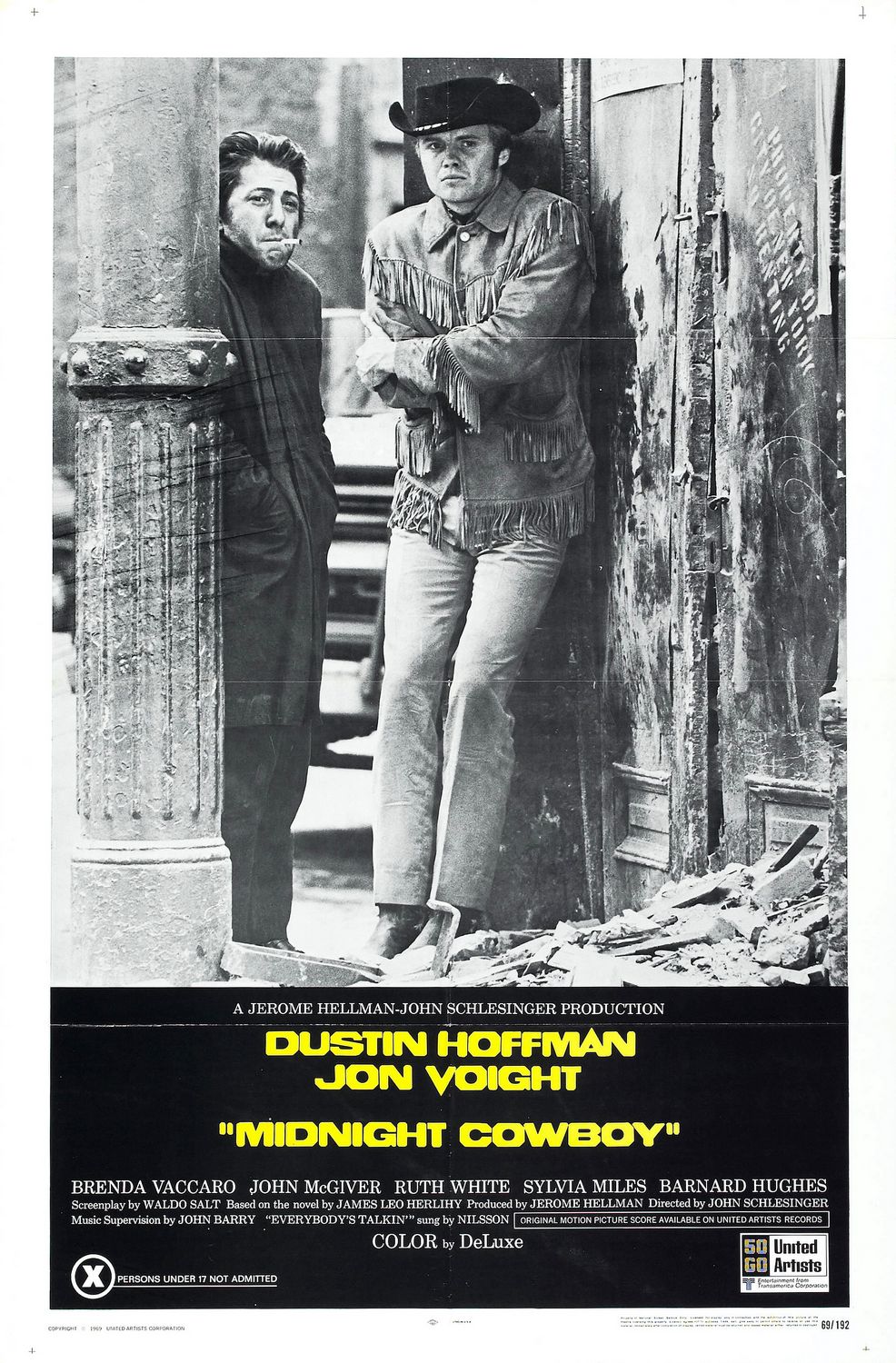
Midnight Cowboy
(1969)
Midnight Cowboy
is a great illustration about the perils of life in the great urban centres of
the world. This film captures the essence of urban alienation particularly from
the perspective of the underclass that is caught up in the scramble for
space. The illustration of urban life
however does not go as in depth as other films such as Taxi Driver (1976) because it is not limited to that particular
setting. There is also the presence of the southern states such as Florida and
Texas. New York City is at the centre of the film however it is portrayed as a
means of entry and exit when compared with the other two territories. The film
opens in Texas which does not seem to have many opportunities for the young Joe
Buck and then the journey is made by him to New York City where opportunities
are supposed to abound; the culture shock is apparently too much for Joe Buck
and so he accompanies a dying Rizzo, his only friend, to Florida to escape the
perils of city life. New York therefore contrasts with two states in the film
for different reasons. The city therefore represents two things to the main
characters: success and failure.
This film does contribute to the filmography associated with
urban alienation because it does emphasize the sex trade from the perspective
of a male prostitute which was hardly ever addressed in such a gritty manner.
This idea of the male prostitute is reinforced by the concept of the surplus
population and the underclass caught in the scramble. This film preceded the cynical decade of the
70s style of filmmaking which sought to expose the underbelly of American
society and the power structures that are associated with capital gain with no
recourse to morality. It is in this film where we see the dissolution of
censorship control.
The editing in this
film is superb and it captures another feature of urban life: constant
movement. When you become a member of the underclass you have to constantly be
on the move seeking means to earn money simply to survive. This is the hustle
(‘struggling man has got to move,’ says Jimmy Cliff, ‘ struggling man no time
to lose.’). This film also captures the life of the drifter since the young Joe
Buck will never be settled although he hoped to be settled in the city by earning
money as a cowboy stud for older females. This dream never materializes due to
the unexpected harsh climate of the city and the deterioration in Rizzo’s
health. This forces him to move to Florida in an effort to give Rizzo some
peace. Rizzo is also conditioned by the constant hustle in New York City since
he can never settle because of his position in the underclass. This forces him
to be a ruthless con. He sees Florida as a means to settle down however as the
final scene suggests he will always be on the move even in death.
The film captures
the essential nature of drift through these characters magnificently. The two
individuals are conditioned by their personal histories. Joe Buck for instance
was actually settled in Texas with his philandering grandmother and his onetime
love Annie. These two individuals were removed from his life and so he was cast
into the void and so he suddenly had an urge to join in the glories of city
life. Rizzo ( I called him Ratso in my introduction to this series but he will
be referred to here as Rizzo, his surname) likewise appears to have lost the
security of his family particularly his father, a struggling shoe shiner, who
seems to have been the mainstay of his childhood. He tries to break free from
this legacy however that is not forthcoming because he is conditioned by an
existence devoid of reason apart from money. He will never be able to establish
a reasonable legacy however his encounter with Joe Buck gave him a chance at
doing this especially as he becomes his manager for a time. His dreams of
Florida remain stuck in his mind and are his only saving grace from city life
however this is undermined by his health. Joe Buck also has to grapple with the
issue of his sexuality. In the city as a midnight cowboy he has to attract both
male and female customers and with no solid moral foundation or conscience
guide, such as a heterosexual partner, he is forced to question it. This is
reflective of his position as a drifter. Money has no scruples once you can get
your hands on it so as to spend or to invest. Capital has crippled the moral
foundation of the working classes who were once tied to communal living in the
countryside. The theoretical reason for Rizzo and Joe being members of the
underclass is the concept of the surplus population created by capital. When
capital advances constant capital grows to overwhelming proportions in the form
of technical applications utilized through machinery and this forces the workers onto the market looking for a
buyer of their labour power as the machine absorbs their high levels of
productivity. The surplus population released by the machinery can either find
jobs in other sectors or be forced to wait until new investment opportunities
are created for work to be available. If investment opportunities do not
materialize for capital to expand then this surplus population become relegated
to a class of so called criminals (drug traders and thieves. Murder is mixed in
the process when the underclass compete for space that can derive some economic
benefit (gangs)or simply to form shelter), beggars or seekers of welfare and
prostitutes. This is done to compensate for the position created for them by
capital. The most crafty ones can become unproductive servants of the bourgeois
class either as housekeepers or security guards. These elements represent the
corrupt values of this bourgeois system where the only basis is profit without
any recourse to morality. The bourgeois class only gets taken aback by the
violence when the proletariat threatens to revolt having been denied a share in
the spoils which they have created by generating surplus value or unpaid labour
time for the capitalist class. It is as a result of this surplus value that profit
is generated on the objective capital advanced.
Midnight Cowboy
was the first film to receive an X rating due to its explicit sexual content.
It was well received by critics and audiences when released and went on to win
academy awards for Best Film, Best Adapted Screenplay and Best Director. It was
rightfully nominated for Best editing and the performances by Jon Voight as Joe Buck and Dustin Hoffman as Rizzo for
Best Actor. There was a nomination for Sylvia Miles as Cass, a brief role, who
cons Joe Buck when he believes that he may have found his first old female
customer. I was disappointed by some of the reviews of this film, particularly
that of Roger Ebert, for the philosophical dimension is entirely missing from
these critiques and so this undermines their analysis of the material. Ebert
says that instead of focusing on the relationship between Rizzo and Joe buck
the film ‘reaches outside the relationship for a string of melodramatic scenes
that will not do.’ This analysis is not complete for it cannot ‘reach outside
of the relationship’ when their existence is conditioned by the urban
experience. It is necessary to have the main character(s) engage in several
encounters to add some form of panache to the setting. If they were to focus
solely on the relationship then one would never be allowed to understand the
circumstances that brought the two together and what actually keeps them
together. In that sense the film had to highlight the material circumstances
despite the relationship at its core or momentum will be lost and the
relationship itself would become melodramatic, speculative and redundant. In
the city there is not much time for introspection based on the constant hustle
and the squalid living conditions in which Rizzo and Joe Buck find themselves.
It is a miracle that these two characters are able to come together especially
as there is an individualist mentality when it comes to the hustle or when the
workers compete to sell their labour power to the capitalist. This is what
makes the relationship special on its own without any of the characters
themselves coming to overly dramatic conclusions. It is clear that a character
such as Rizzo wants to matter to someone and he eventually discovers this in
Joe Buck who is almost childlike in his naïve charm. Rizzo adopts a more
parental role whereas Buck assumes a childlike stance. This is enhanced by the
fact that Rizzo is crippled (walks with a limp) and has a debilitating illness.
What could have been made clearer is that Rizzo is probably older than Joe Buck
and this is the cause for their dichotomy and unity. Rizzo is more concerned
about his legacy since he wants to be more than what his father was: a simple
shoe shiner. He therefore assumes a big brother sort of role. It is clear that
by the end he may have succeeded in doing that since he actually mattered to
someone. Joe Buck on the other hand is more concerned about earning money. The
time has not come for him to worry about his legacy for he simply wants to
enjoy his youth and this is reflected in his naïve approach to money making:
being a stud for old women. The fact that Ebert, or other critics along his
line of argument, could not highlight these elements undermines his arguments
significantly. Ebert also made the mistake of comparing the context of the film
to later periods without establishing that the film is actually influential in
its approach to city life regardless of the fact that others might have built
on its premise and surpassed it. Ebert mentions that it is influential while at
the same disregarding this influence on later generations of film and that is
absurd to a certain degree. Any film that is not influential is not worth
speaking about and the film does not need to be rewritten only some elements
elaborated on. The influence of this film is undeniable and its approach must
be discussed seriously which is why it is included in this series on ‘Modes of
Urban Alienation’.
In this review I will discuss the concept of urban
alienation along the lines of the relationship between Buck and Rizzo, life as
a midnight cowboy and the drifter elements in the film associated with the
displacement in rural and city life. I will also discuss the relationship
between New York and the other two states featured in this film Texas and Florida
and the relationship between Urban and rural areas. This relationship between
rural and urban areas is significant for the concept does not apply only to the
country side in America but to the immigrants of the poorer countries entering
America. Many immigrants have similar experiences when the American dream
begins to fade before their very eyes.
The poorer countries of the world have an agrarian base where the
development of industrial capital is slow in coming as a result of low levels
of productivity and small scale capital investment or the Government, which is
a bastion of the small productive base revels in corruption, and resorts to begging to stay afloat. The most dominant economic force are the merchants or the commercial and money dealing capitalists. Petty commodity production through avenues such as the artisans and small peasant farmers precludes the possibility of increasing the productive powers of social labour under capital. The patriarchal conditions of production are part and parcel of this tradition of small isolated producers. As a result of the low levels of productivity high tax and interest rates are the norm and usury rears its ugly head. Poverty is
glorified through religion/high handed morality, rabid political movements, a
warrior class in the form of police, soldiers and the henchmen of the
warlords/gangleaders.There are also various spheres of entertainment where entertainers and sportsmen are deified. It is a mere
scramble for spoils in such a setting and so it compels many individuals to
seek living outside of their shores. The intellectual class is equally
impoverished by the surroundings and resorts to penchant idealism in order to
counter the destitution at hand. The ‘poverty of philosophy’ is clear for all
to see as the intellectuals resort to hollow ideological rhetoric in order to
gain some measure of prestige in the society and so ingratiate themselves with
the authorities as their main struggle becomes one with the bloated government bureaucracy. The lack of serious scientific inquiry impoverishes
the intellectual capabilities of the poor nation and any possibility of serious
innovation within that country is woefully small. Physical posturing becomes
the norm of excellence as opposed to progressive improvements through
scientific inquiry. This posturing is sold as a cultural accompaniment as the
impoverished nation seeks the means to fascinate the world and thereby
encourage the wealthier nations to make grants or capital based loans so as to
provide relief for the rampant destitution. It is no wonder that Joe Buck in
this film is proud of his sexual prowess. It is this physical element that he
hopes to sell as a means to earn large sums of cash. It is a reflection of his
poverty within the context of capital as the film correctly demonstrates.
Physical prowess counts as nothing unless it can appropriate the various sources of revenue
as what occurs with prostitution in this case. If your physical
prowess cannot garner any attention you might need to ship yourself back to the
land of the ancients where poverty is enshrined and glorified as a means of
salvation as is done here in Jamaica for instance, and there you can utilize
your physical skills and charge exorbitant amounts just to make a physical
appearance as what some doctors and lawyers trained abroad do. This is not to blame the poor nations of the world because it is
clear that capital from the developed
nations has denuded, raped and pillaged the frontiers of the world creating the
class of beggars that exist throughout the world. The buffoons remain safe from
harm as a result of their corrupt lackeys in the various poor governments and try their hand
at philanthropy so as to assuage their guilt as world pollutants; a testament
to their waste as they feed people's illusions about their glory. It is this
environment which forces individuals to resort to physical posturing with the
hope that their eccentricities or physical practical skills will stand out.
The Journey
Begins: Exiting the Country and entering the City
The beginning of the journey in Midnight Cowboy is one that most people in similar situations can
identify with: exiting the country and entering the city. The film makes clear
in these early moments that the countryside represents a binding emotion link
firstly because the population numbers are so low and this encourages
individuals to reach out with more intense emotion as the particularity of
individuals becomes more prominent and seems more eccentric. These eccentricities
are however conditioned by the destitute material circumstances on display in
the countryside particularly the idea of the cowboy who is one that is expected
to grapple with the many facets of the land. The cowboy factor is therefore a
product of the vast expanse of land on display in those areas and the women, therefore, are more inclined to favour the man who is physically endowed. When
Joe Buck has flashbacks of his grandmother we see why he is conditioned to be a
stud or a physical accompaniment or servant to the female. In the flashbacks
there are moments where we see a young Joe Buck massaging his grandmother or we
see her cowboy lovers with a young Joe caught in the midst; particularly in one
scene where he lays in the bed with her and her cowboy lover. The said cowboy
lover takes him to rodeos and so on and while on the national bus on the
journey to the city Buck is reminded of the his grandma saying that he is going
to the best cowboy on show.
We also get
to understand that his idea of servicing older women sexually was conditioned
by this experience especially as he doted on her so obsessively in such an
intense manner and this would explain why he made the decision to leave Texas
for good, after hearing of his grandmother’s death, to the city where there
would be a plenitude of such older females to service; however before he could
make this break for the city he had to have the original experience with his
own grandmother. In a moving scene we see a young Joe being shepherded to his
grandmother’s house by two females and it can be presumed that one of them most
be his philandering mother who could not manage the so called burden of raising
a child. As is customary in the countryside she dumps him on the grandmother as
she is either conditioned by poverty and is incapable of raising him as she too
bought into the physical prowess of the cowboy producing on the land over the wage
earner who can carry in money regularly under the domination of the capitalist.
It could be seen as immaturity on the part of the mother but it is more a
result of her poverty and the fact that the grandmother would be a more stable
source of emotional support for a child ( as she would have acquired a significant amount of property whether landed
or money). The daughter, as a result of
her poverty, either squanders her body through prostitution thus giving birth
to Joe Buck or moves to the city to seek a fortune and thereby become settled
after dumping the child on her mother.
The cowboy is a mere circus clown in the modern day as opposed to the
famous robbers and gunslingers in the Wild West during the nineteenth century
which was reflective of the poverty of the locale and therefore
glorified/deified by the populace. This is just one reason why the film is
masterful by highlighting the cowboy as a mere figure head in the times of
advanced capitalism. The mother is
therefore poor and as the basis of landed property becomes eroded she too will
be caught up in the scramble for money. Joe says in one scene that the only thing he
has ever been good for is loving. The legacy of poverty is here expressed in a
poignant fashion.
Joe Buck’s perchance for loving is reinforced by flashbacks
which reveal that he was involved romantically with a girl only referred to as
Crazy Annie. She seems to have been the only girl that Joe Buck has been with
in life which would explain why it is so resonant. Joe’s liaisons with her and
his constant reference to her as he enters the city seems to suggest that he is
a romantic by nature who aspires to those ideals of the south where one should
act like a gentleman. It seems from Joe’s flashbacks that she was something of
a prostitute or a sexually promiscuous woman living in a dingy old house broken
by many years of decline in the south where landed property was once the basis
of all wealth prior to the advent of capitalism. This also reminds one of
characters such as Blanche Du bois in
A
Streetcar Named Desire (
The Decline of the Old South part 2: A Streetcar Named Desire (1951)) who prided
themselves on the legacy of landed property and slowly wasted away beneath the
burden of acquiring money and resorted to sexual outlets which would represent
the essence of their beauty or their desperation in hopefully landing a husband
who will be taken in by her beauty. In
the glorious days of the south great physical beauty reinforced by virginity
could land you a husband however in the times of decline your beauty is only
good for sexual reasons for women are now expected to earn a livelihood in the
advanced capitalist economies as money
becomes the basis of wealth. A sap like Joe Buck seems to have naively assumed
from Annie’s pronouncements while they have sex
such as ‘You’re the only one Joe’ that he was in the act of lovemaking
or some form of transcendent experience. One of his flashbacks reveal one of
the males of the town saying that kissing Crazy Annie ‘you better drink a whole
drugstore.’ kissing the whole drugstore. The flashbacks also reveal that she
was gang raped on several occasions or
that she slept with most of the men in the town through prostitution or simply
in desperation to land a husband. This is made even more clear by the fact that
she appears lost without the usual guardians or chaperones who would constantly
implore her to preserve her virtuous virginity for her husband. This is the
ultimate manifestation of the decline of her way of life i.e. landed property
in the south. It must have been a great relief for her when she could attract
someone as naïve as Joe so that he will commit to marrying her because he would
naively believe that he is the only one. We therefore understand by his
numerous flashbacks throughout the film that this romance was exposed when
there was an invasion by the boys from the neighbourhood who would scribble on
the water towers that ‘crazy Annie loves Joe Buck’. We see her carted away to a
mental institution perhaps as she is so
enamored by constantly saying that he is the only one. It never had to refer
solely to Joe Buck but to the many men she hoped to ensnare into marriage with
the same phrase. Love or the ideal that it represents eventually becomes eroded
with the realization of the domination of material forces as opposed to grand
spiritual revelations normally associated with religion. Joe Buck is also seen
in a comprising position where his legs are splayed by the males. This suggests
that he too was possibly gang raped because he is a nancy. It is soft hearted
characters like Joe Buck that the queens target in prison. This act would have
thoroughly shattered any romantic pretensions he might have had about Crazy
Annie. Crazy Annie is a product of the
poverty in the south and Joe Buck’s love for her seems increasingly absurd and
is brought down to reality by the defeat of the romance through the invasion of
the town’s populace in the form of the frisky, sexual robust juveniles into the
sanctity of the broken down old house on the prairie. These juveniles have no
occupation as poverty becomes the norm and so the sex drive or physical
posturing becomes the standard form of expression. This is why these
experiences of Joe Buck reveal that in the countryside the family unit is more
pronounced as well as the romantic relationships that are tied into notions of
landed property are more pronounced.
Landed property is
therefore the basis of glory/wealth in the south however land in all its
abundance, uncultivated, represents stagnation and destitution. Individuals in
the countryside only become aware of this with the rapid advances of capital
where the basis of exchange values is through the purchasing power of money as
opposed to barter or communal sharing. This reveals the extent of poverty in
the countryside and so some individuals are compelled to seek money outside of
the prevailing destitution in the countryside; the money that is being sought
is located mainly within the major cities.
Joe Buck from the outset does work at a Diner as a dishwasher and it
seems as if Texas has some semblance of a business environment but obviously
not as extensive as one would find in New York city which has more variety. In
the agrarian based economy of Texas at the time there would be not much avenues
for employment in productive based enterprises. A diner seems the most logical
outcome in an agrarian based economy that is trying to make a transition to a
capitalist mode of development for food production along with the production of
raw material is the basis of agriculture which is given shape by capital in the
form of the manufacturing process under the factory system. When Joe Buck steps
out of the bath, packs his suitcase and dons his cowboy outfit to exit the
turkey town we have a brief illustration of the poverty on display where beyond
the district one can glimpse the large swaths of land undeveloped in the
distance which implies poverty on a large scale particularly where the centre
of commerce i.e. the town is quite small in comparison. It is clear that some
of the citizens aspire to a life in the diner and when the film opens we see
Joe buck envisioning them asking ‘Where’s that Joe Buck?’ because he knows that
he is late for work as a dishwasher when in fact he is going there on that
particular day to collect his wages so that he may begin his journey to the
city. He will soon come to realize that aspirations to become a dishwasher in a diner in a agrarian economy is the same
aspirations for the underclass, that exist on the fringes in a state of
destitution, that have been thoroughly exploited by capital in the cities. Joe
Buck’s career as a dishwasher in a impoverished town in Texas does lay claim to
the few avenues of employment however his aspirations towards the city seem to
be motivated by his military experience. This is also not so clear but we
glimpse, in a flashback, Joe in military outfit returning to the now derelict
house which once belonged to his grandmother’s house. She had passed away while
he was away. If he was in the military it is not clear if he fought in a war
however his recourse to join the military is also a reflection of the physical
posturing that seems to be the norm in poverty stricken districts. Returning as
a veteran does not usually guarantee employment as is seen in The Best Years of our Lives (1946) and
this would explain why Buck ends up as a glorified dishwasher. Physical
posturing only belies your incapacity to earn riches apart from your glorious
physical attributes. Without physical posturing poverty would be more visible
to the naked eye for the lowly position of the proletariat and the petty
bourgeois class would be on full display. For instance entertainers, the media
fraternity, police officers, soldiers, priests, high ranking domestic servants
and sportsmen/women merely provide an illusion with their riches as they are
mere wage earners (directly or indirectly) of the capitalists who are now in
full control of the means of production; they could not earn their riches any
other way apart from their physical posturing which can be equated with
prostitution in some cases. It is a testament to their poverty or the enduring
legacy of their poverty as a class where the only way to survive is through
selling your body or what your body
represents. Rich capitalists and elitist landowners do the physical posturing
also but it is only testament to their inability to do anything else or produce
productively and they eventually become symbols of decadence as exploiters of
wage labour without the physical posturing which dazzles the eye of the
proletariat or the petty bourgeois with their riches.
Joe Buck is about to become a part of the great migration as
he takes the journey to the city from the impoverished countryside with his
last payment in wages as a dishwasher. We hear the famous song ‘Everybody’s talkin’ The important lyrics go
as follows: ‘Everybody’s talking at me I can’t hear what they’re saying. All I
hear are the echoes of my mind. People stop and stare, I can’t see their faces only the shadow of
their eyes. I’m going where the sun keeps shining through the pouring rain.
Going where the weather suits my clothes (testament to Joe’s idealism). Banking
off of the north east wind sailing on summer breeze, skipping over the ocean
like a storm ’ These statements remind
me of Blanche in A Streetcar Named
Desire as she took the street car named desire to the Elysian fields and
thereafter was introduced to the dissolution of the morals associated with
religion and the dictates of capital with the accumulation of profit and wage
earning being the main drive of the
citizens of New Orleans. The drive on the national bus is well constructed and
is testament to the superb editing for it highlights the passage and the
reflections that take place as we leave the heart of darkness or the vestiges
of poverty behind. We see a hopeful Joe Buck get into the bus and we get a
sense of his rapport with some of the passengers and his reliance on his trusty
radio. During the ride however we get a sense of his pain for on such a long
journey all one can do is reflect (or sleep) and the memories of his
grandmother and crazy Annie who are the two women he ever loved and made him
believe in his ability to love. The superb editing comes to the fore for while
reflecting we get the sense of the passage of time during the journey and how
he lost track with some of the passengers as he became so engrossed by his
flashbacks. There is also a haunting choral arrangement or one low note as the memories of those two
women come to the fore in his mind or the echoes of his mind. There is also a haunting lullaby sung by his
grandmother ‘Grandma is going to buy you a mocking bird.’ He is reminded of
this lullaby after the old woman he sits next to on the bus almost commands him to keep the light on
after he switches it off when she says ‘I want it on.’ After he switches it back
on we are made aware of the deep respect
he has for old women as a result of his grandmother. When he enters the city and gives a typical yahoo or yee haw we
become aware that he has arrived and is now fully prepared to make the riches
that are supposedly so abundant in New
York City. The passage of time is well documented through the radio as it is
through that instrument that the signal of the radio stations of New York is
transmitted through the FM frequency on Buck’s trusty material friend.
The Journey
continues: Joe becomes a member of the surplus population of New York City
This section is optional for the average reader
(Before I continue with Joe Buck’s story and his first
interaction with Rizzo it is necessary to discuss the context within which Joe
finds himself. He immediately becomes a member of the surplus population
sometimes by choice and sometimes by factors external to his being. As
mentioned before the relative/artificial surplus population arises when there
is overproduction of capital in the form of commodities and the elements
utilized in the production process such as machinery and the means of
subsistence in the form of wages for the workers. This overproduction occurs
when capital absorbs the large levels of productivity of the productive wage
earning class by driving down the necessary labour time and increasing the
surplus labour time which becomes surplus value which is afterwards translated
into profit for the capitalist. When the labour power of the wage earner
becomes devalued (this devaluation is also conditioned by competition among the
workers themselves as they scramble to land jobs with the capitalist. Some
workers deliberately accept lower wages in order to secure a job) and becomes
redundant he is disposed of by the capitalist who invests further in the means
of production such as machinery. The devaluation of the workers’ labour power
corresponds with the overproduction of capital for this implies a magnificent mass
of surplus value which implies a reduction of the necessary labour time to keep
the workers alive. The growth in relative surplus value also implies
the phenomenal growth in the goods produced by capital and so the workers are
forced to contend with the fact that the capitalist would not be able to employ
the capital he has accumulated in order to continue production on the same
scale as the rate of profit declines
with a large concentration of capital and a plethora of goods on the market
which are not sold (depressions in trade). With the large concentration of capital the capitalist
class employs, increasingly, machinery or constant capital to replace the
workers who are disposed of however this is relative for smaller capitals will
emerge who will eventually absorb
this relative surplus population however
these smaller capitals are sometimes offshoots or subsidiaries of the larger
capitals who extend their investment opportunities into these offshoots so as
to occupy their capital. There is also the situation that occurs where with the
decline in the rate of profit the larger capitals will resort to investment
overseas so as to ensure a higher rate of profit which cannot be afforded at
home where capital has expanded rapidly and with the high levels of
accumulation laid on reserve this capital is sent overseas to ensure higher
returns. With overproduction at home capital goes through a process of
devaluation and sometimes capitalists do not get the necessary returns on their
investments and so they are forced to look elsewhere to be assured of a certain
profit rate particularly in countries that are labour intensive. At home, where
capital has rapidly expanded, therefore according to Karl Marx in Capital Vol.
3, who is speaking about the consequences that occur when the rate of profit
declines: ‘ This plethora of capital arises from the same causes that produce a
relative surplus population and is therefore a phenomenon that complements the
latter, even though the two things stand at opposite poles –unoccupied capital
on the one hand and an unemployed working population on the other.’ Marx
continues:
‘Stagnation in production makes part of the
working class idle and hence places the employed workers in conditions where
they have to accept a fall in wages, even beneath the average; an operation that
has exactly the same effect for capital as if relative or absolute surplus
value had been increased while wages remained at the average. Periods of
prosperity facilitate marriage among the workers and reduce the decimation of
their offspring, factors which, however much they might involve a real increase
in population, do not involve any increase in the population actually working,
but do have the same effect on the relationship between the workers and capital
as if the number of workers actually active had increased. The fall in prices
(high levels of productivity)and the competitive struggle, on the other hand,
impel each capitalist to reduce the individual value of his total product below
its general value by employing new machinery, new and improved methods of
labour and new forms of combination. That is, they impel him to raise the
productivity of a given quantity of labour, to reduce the proportion of
variable capital to constant and thereby to dismiss workers, in short to create
an artificial surplus population (occupy wall street). The devaluation of the
elements of constant capital, moreover, itself involves a rise in the profit
rate. The mass of constant capital applied grows as against the variable, but
the value of this mass may have fallen. The stagnation in production that has
intervened prepares the ground for a later expansion of production.’
This passage explains the occupy Wall Street movement of
last year (2011) and why the jobs now must move to China (China grew between 8 &9% in 2011 when compared to
the US that grew on average 2-3%. This is a clear sign that the rate of profit
is higher in China than the US. This is why American capitalists are moving
overseas and the members of Government are still exclaiming America for
Americans as they raise the tariff barriers which only delay the inevitable)
and other developing nations enjoying high rates of profit where there is a
high demand for labour (particularly skilled). The world market here comes into
play and one cannot keep looking to America in times such as this for capital will
move overseas to new markets where labour is in demand and therefore new
avenues to generate absolute and relative surplus value so as to keep the rate
of profit high. ‘ If capital is sent abroad, this is not because it absolutely
could not be employed at home. It is rather because it can be employed abroad
at a higher rate of profit. But this capital is absolutely surplus capital for
the employed working population and for the country in question. It exists as
such alongside the relative surplus population, and this is an example of how
the two things exist side by side and reciprocally condition one another.’
(Marx Capital Vol. 3)
The smaller capitals that emerge as an offshoot of the larger capitals cannot compensate for this decline of the rate of profit and so:
'The
mass of small fragmented capitals are thereby forced onto adventurous paths: speculation,
credit swindles, share swindles, crises. The so called plethora of capital is
always basically reducible to a plethora of that capital for which the fall in
the profit rate is not outweighed by its mass-and this is always the case with
fresh offshoots of capital that are newly formed- or to the plethora in which
these capitals, which are incapable of acting by themselves, are available to
to the leaders of great branches of business in the form of credit.'
This surplus population grows to overwhelming proportions
and capital is not capable of absorbing all these numbers. The most viable
alternative for the surplus population is in the service industry because with
regards to productive employments the members of this group do not have much
opportunities to contribute to the growth in the rise of the general rate of
profit. ‘What is produced is firstly too great a section of the population
which is in fact incapable of work, which owing to its situation is dependent on
the exploitation of the labour of others or on kinds of work that can only count as such within a miserable mode of production (small
business owner and peasant). Secondly, not enough means of production are
produced to allow the whole potential working population to work under the most
productive conditions, so that their absolute labour time curtailed by the mass
and effectiveness of the constant capital applied during this labour time.’
Marx was way ahead of his time in his assessment of the situation that is in
occurrence today as well as what poor Joe Buck encounters in New York City. The
service industry therefore remains the most viable productive alternative in
this case and so members of the surplus population try and upgrade their skills
through additional education so that they can apply for the higher skill level
occupations; some become domestic servants, independent artisans, policemen, soldiers,
government workers, intellectuals/impoverished philosophers (not speaking about
money. I mean the fantasy laden analyses delivered by this group which
compensates for their own inadequacies), lawyers, doctors, parsons,
nuns and monks, entertainers/media personalities, sportsmen/women and
prostitutes (they prostitute either image or body. Image in the case of the
entertainers or those who appear through various media formats and sportsmen/women). It is this growth in the service industry
that has allowed the harmonizing economists to make erroneous conclusions that
the growth in the service industry has accounted for the majority of growth in
the economies of Europe and America and therefore these two territories have
entered a post industrial phase. The service industry is a result of the
increased division of labour that occurs among the productive sectors under
capital and so they become revenue based enterprises fishing for money. The
service industry only appropriates revenue and when it appropriates all that
revenue what does it do with it but invest either in its infrastructure or in
stocks that are tied into production somehow. The absence of productive outlets
will create an enormous accumulation of capital with no outlets for investment
which results in devaluation.
Other members of the surplus population that are born into
this cycle of poverty, as a result of them being disposable, are driven into a
downward spiral and become permanent members of the underclass. This class
resorts to criminal behavior as it preys on those that are able to earn an
income, whether productive or unproductive. Gangs are formed, as this
underclass settles in the least hospitable conditions, which compete for space
or territories where they can exact tribute. A tribal base of economy
originates here with drugs, gambling, usury, con men/petty thieves, petty
commodity production, as what occurs in small
businesses or among the members of the peasantry, and illicit services being the
predominant offerings which generate an income. This exists in small quarters in the rich cities of the world but it is more dominant in the poorer nations of the world. The legacy of poverty is
perpetuated in such conditions as a certain section of individuals become
permanent representatives of the underclass and keep competition for employment
in menial jobs high thereby allowing for continuous exploitation of the least
desired jobs or a high mass of surplus value. Democracy becomes a pipe dream
and this underclass is always wooed by the possibility of riches only to have their
dreams shattered time and time again. There are some who do make it but only to
a limited extent and here the eccentric personality comes into play. Not
everyone can be assured of the desired positions that ensure some measure of
prosperity but the carrot is always dangled in front of them like lambs being
led to the abattoir. The family becomes important here through inheritance
because it ensures that the money accumulated through productive labour is kept
within certain circles thereby downplaying the risk or possibility of
additional investments from outside. This eventually results in monopolies that
are shattered ignominiously by competition. The underclass is where Rizzo finds
himself from birth.)
Joe Buck goes to the city seeking to become a prostitute for
older women however he ends up as a streetwalker ( A Midnight Cowboy) as his
ideals crumple in the face of reality.
ii
Now that the economic framework is out of the way it is now
possible to focus on how Joe Buck makes the transition from idealist cowboy to
a realistic city dweller caught up in the scramble for gratification. When Joe
Buck first enters the city we see an individual with his last wages from the
diner believing that he will fulfill his dreams of becoming a stud for older
women in the city. When he does arrive we see his naiveté on full display as he rents a room at a
fairly pricy hotel instead of a motel which would have afforded him more
opportunities for consumption. It is clear however that the media, the main
organ of propaganda for the bourgeois class, also contributes to Joe Buck’s
idealistic fantasies and we get an example where he continuously has the radio
at his ears. When he eventually loses the radio the reality is made even more
apparent. One episode that contributed to his idealized version of New York
City occurs when the bus is just about to arrive and the host on the 77 radio
station W-A-B-C, Ron Lundy, asks several women the ideal that they look for in
a man, and here the editing is superb, as Buck immediately imagines the
faces which are conveniently older women
as they describe the features they are looking for: Gary Cooper; a Man who
takes pride in his appearance; Consideration;
‘definitely tall’; ‘Someone I can talk to in bed’; ‘A good sense of
humor’; ‘Not afraid of sex’; ‘A Texas
(how convenient from Texas) Oilman’; ‘Aggressiveness’; ‘Outdoor Type’; and ‘ A
rebel’. Joe Buck as a lover man could certainly meet all these ideals for which
he was reared by his grandmother apart from being a Texas oilman although he is
from Texas. The Texas oilman conforms to the notions of the country which
produces primarily raw materials; in this case that raw material is oil. The
advance in industry forces the countryside to exploit its resources so as to
generate revenue as a result of its poverty. Within the context of the world
market it encourages exploitation and the increased dependence of one country
on that particular resource which eventually impoverishes it as the well dries
up and there is a crisis in diversification. The optimistic theme song
continues to play but after Joe Buck settles in the hotel and sets out on his
quest to discover those older women he can service with his cowboy charm. While
amidst the bustling crowd buck gets a firsthand taste of the reality he is
about to encounter when he sees a man
laying prostrate, apparently lifeless, in the street as the people move
casually by. A few individuals express some interest in the plight of the
individual or perhaps they are more interested in Joe bucks fascination with
the unfeeling nature of city life. Joe Buck puzzles himself for awhile about
this prostrate man and it is this that seems to catch the eye of the other
passersby. Joe buck reveals here his romanticism and the moral/Christly
teachings that have shaped his perceptions as he stops and stares expressing
some sort of strange sympathy in his cowboy outfit. It seems as if he wants to
reach out and be the good Samaritan but the stares of the people seem to
suggest that his compassionate attitude is strange and so he resists his
Samaritan like impulses and moves on like everyone else. This is his first
encounter with urban alienation and the increasingly individualistic tendencies
of the populace motivated by selfish motives. The competitive struggle among
capitalists and workers has made everyone concerned firstly with their own
livelihood as opposed to the plight of others.
The large population numbers also render particular individuals as
insignificant in the wider movement of commodities/valorization of capital and
the leechlike service operations as a result of the division of labour. His
stroll also reveals the elitist groups in Manhattan, for that is clearly where
he is, and this continues to feeds his dreamlike state for the optimistic theme
song is again being played at full force as he searches for older women to
service. We see huge bank vaults being opened, we see various high society
groups and people on the hunt for luxurious goods such as high priced jewels
and fashionable clothes. This side of New York is the home of the elites from
the rich bourgeois and landowning classes that have engrossed all this wealth
through exploitation of the working classes.
Buck seems ideally (!) placed to land himself an older woman.
When Buck continues on his first stroll we see how
ridiculous he sounds and looks to the city dweller. The first old lady he
approaches he tries to lure her in by firstly asking for directions to the
statue of liberty. The woman casually moves ahead ignoring his question at
first but with persistence Buck approaches her once again with the same
question. She asks ‘ Were you serious about the statue of liberty? I’m sorry…’
She thought he was one of those cowboys ( or so called cowboys since everyone
can cop an outfit) in the city that
target older women or women in genera offering to prostitute themselves in a
degrading, sycophantic and pathetic matter. It seems therefore that Buck is
late in his pursuit for the phenomenon is dying down in the city and with the
plenitude of so called cowboys he seems like an impersonator when he may be the
real thing. He asks here, ‘You sure are a pretty lady.’ ‘You’re not looking for
the statue of liberty at all?’ ‘No ma’am I ain’t.’ ‘You ought to be ashamed of yourself.’ She
ends as she walks off leaving the bumpkin Joe Buck for he was so easy to
identify because that type of hustle is now common knowledge. We see this as he approaches his next victim
who in turn cons him for she is a prostitute herself that knows the trade. It
is clear that Joe Buck fortunes begin to wane along with his savings associated
with his last wages because he will be conned by Cass and Rizzo. He was hustled
as he attempted to hustle mainly because of his out of place outfit and his
lack of subtlety. When he is finally conned by these two individuals then we
see the fate of most hustlers when they don’t have any money they become
beggarly as they have no skill which could see them employed in the productive
sectors should the opportunity arise. Firstly let us see what happens with Cass
he approaches her with the same questions about the statue of liberty as she is
trying to get her dog to urinate by a tree. She responds to the question
saying, ‘It’s up in Central Park taking a leak. If you’ll hurry up you’ll catch
the supper show.’ She is wise to his con but as she has plans of her own she
still invites him up to her room which, it is discovered while she is on the
telephone, is paid for by her main man,
Morey, who is a happily married man. She
seems to be wise to the trade of prostitution as that is what she is engaged in
as the man’s mistress. They eventually have sex in seemingly high passion for
Buck seems he has won the jackpot. After the encounter the con is revealed as
Cass becomes emotionally distant and tells Joe to clean up certain pieces of
the house as well as zip up the back of her dress as she prepares to go out
since she is late. She does all this in a hurried fashion so as to hustle him
for that is how hustlers work they tried to hurry you into things. As she scampers about the room speaking about
Morey and his ulcers (he must be an old man) Joe buck slows the tempo and this
is the first way to trap a hustler but Joe does not know he is being conned. He
is also quite soft as we shall see. He says to Cass, ‘I don’t know what line
Morey’s in but myself, now, I’m kind of a hustler.’ ‘A person’s gotta make a
living’.’. ‘Pardon me ma’am’ (You are being conned). She repeats herself in a
slower manner indicating the art of seduction and that she too is a con. It is
masterful and we see now why Sylvia Miles was nominated for best supporting
actress. ‘ Are you sure you heard what I said?’ ‘Sorry Tex. My mind isn’t all
here. I don’t want to be late for my date with Morey. Listen Sweetie. Why don’t
you run along and take the number, and we’ll get in touch with each other real soon. Would you believe that I forgot to
get to the bank, and now it’s too late. I have to take a taxi, I need a few
bucks. Hate to ask you but you’re such a doll.’ (the con has begun) ‘ You know,
Cass, that’s a funny thing, you mentioning money ‘cause I was just about to ask
you for some.’ You were gonna ask me for money?’ She seems perplexed which is
all in keeping with her experience. Buck
continues, ‘ Hell, why do you think I
come all the way up here from Texas for?’ ‘ You were going to ask me for money?
Who the hell do you think you’re dealing with (country bumpkin or country boy
she would have liked to say)? Some old slut on 42nd street?(yes that
is what Cass is or was)In case you didn’t happen to notice it you big Texas
longhorn bull (country bumpkin. She comes out with it for emphasis to lower
Buck on the social ladder and elevate herself as a seasoned city dweller). I’m
one hell of a gorgeous chick! (highly paid prostitute not aware that her
illustrious features are fading and that her aging looks makes her a target for
the poor Joe Buck) I’m 28 years old ( oh dear not even her dog would mistake
her for 28 years old). You think you can come up here and pull this kind of
crap? You’re out of your mind. I could kill you with my bare hands. Will you
get outta here?’ She starts crying as a result of her fake agitated state and
shows that she is a seasoned con. The poor sap by the name of Joe Buck attempts
to console her and thereby acknowledges that he has been conned. ‘Would I be
after you for money with a wad like I’ve got ridin’ on my hip? Stop your
cryin’. You are one gorgeous chick (really you sap). Guy gets horny just
lookin’ at you. How much you want for that taxi? Five? Ten? Twenty?’ as she
snatches the twenty dollar note. Joe just lost $20 in the hustle.
He leaves defeated and immediately after encounters Enrico Rizzo
in a bar. Rizzo looks at him deridingly at first: this cowboy figure displaying
his crumpled money for the entire world to see. Rizzo introduces himself by
commenting on Buck’s shirt and saying that he must have paid a lot of money for
that shirt. Rizzo is mocking him for it because it is a shirt with birds and a
symbol representing a heart. Rizzo is basically saying that Buck looks like a
buffoon and he is trying to discover an angle whereby he can con him. Buck
responds to Rizzo’s query about the shirt by saying in typical buffoon fashion
‘ I ain’t cheap.’ They get to talking especially after Rizzo makes Buck aware
that a woman who approached him in a flattering manner asking for a ciggarette
is a transsexual. Buck upon his/her approach thought his charm was working for
him until Rizzo snatches the cigarette he was about to hand to him/ her saying,
‘ More goddamn faggots in this town .’ ‘
Oh kiss it Ratso,’ says the transsexual which means he was right. Buck offers
to buy drinks all round and Rizzo does
not mind this at all. They then get to talking about his profession. Buck
relays his experience with Connie and how he was conned. Rizzo seems to be at a
loss when Buck says that Cass started to bawl when he asked for money. ‘Money
for what? ‘ he asks. ‘Hell I’m a
hustler. Didn’t you know that?’ ‘How should I know that? You gotta tell a person
things.’ ‘ I’m a hustler.’ ‘shh Alright. You’re
a hustler. But your pickin’ up trade on the street like that…That’s
nowhere. (Buck’s first real lesson) You gotta get yourself some kind of
management.’ ‘ You put your finger on it,’ says the sap Buck. Rizzo picks up
quickly on his sappiness. ‘ You know what you need? You need my friend O’
Daniel. He operates the biggest stable in town. In fact in the whole goddamn
metropolitan area. It’s stupid a stud like you payin’. You don’t want to be
stupid. I mean, I understand. A dame starts cryin’ I’d cut my heart out for
her. ‘ The transsexual intervenes saying, ‘ I’d call that a very minor
operation. In fact you just sit comfy and I’ll cut it out with my fingernail
file, ratso.’ After a brief intervention from Buck Rizzo says, ‘ I mean, I’m
used to these types that get their kicks pickin’ on cripples. The sewers full
of them. ‘ The transsexual says, ‘ I wanna ask you one question cowboy. If
you’re sittin’ over here and he’s sittin’ over there how’s he gonna get his
hands into your pocket? I guess he’s got that figured out.’ The transsexual
walks out with Rizzo insulting him/her saying
‘Faggot.’ He knows that the transsexual is correct. He continues his
lecture to Buck on the streets ‘With these gals that wanna buy it most of them
are old and dignified. Social register types you know what I mean? They can’t
be trottin’ down to Times Square to pick put the merchandise. They gotta have
some kind of middleman. That’s where O’ Daniel comes in… he pauses as a Taxi driver
blows his horn gesturing that Rizzo should get out of the way and in this
famous scene we see Rizzo shouting, ‘ Hey I’m walkin’ here!’ This relates to
the urge people have to be recognized amongst the overwhelming population
numbers. He consoles Buck about the altercation ‘ Don’t worry about that.
Actually that ain’t a bad way to pick up insurance.’ He continues ‘ It’s crazy, a stud like you payin’ that
dame you told me about. With proper management you could be takin’ home $50,
maybe $100 a day, easy. Hey Brucey. Hang in there baby. Him I placed with O’ Daniel about two weeks
ago. He ain’t much of a stud either from what I hear.’ The naïve Buck agrees to
meet Joe Buck and Rizzo like Cass before feigns helplessness and wonders how he
will benefit from such an arrangement. Buck agrees that Rizzo should get a cut.
Buck offers ten and Rizzo makes him know that that is cheap and says he will
still need another ten for expenses once he has lined up the arrangement and so
he offers to take the ten plus the other ten for expenses. Another $20 dollars
out of Buck’s pocket and that now comes $40 if we add the hustle by Cass. When
Buck and Rizzo do reach O’ Daniels flat we see Rizzo in a hurry to get away. He
even says that Buck can reach him at the Chevy-Netherlands hotel. When have you
heard that you can reach a street hustler at a prestigious hotel. Buck takes his steps towards O’ Daniel’s
apartment; room 901.
iii
The young sap Joe Buck believes that O’Daniel will offer him
the ‘proper management’ that he needs to survive as a stud for older females.
When he knocks on room 901 and O’ Daniel opens the door saying ‘You must be Joe
Buck let’s take a look at you.’ You would think that Rizzo did play his part
and that Joe Buck will finally be able to make some sort of advancement. O’Daniel
tells the young Joe Buck to turn around so he can get a good look. He likes
what he is seeing ‘ Good strong back you’re going to need it. So you want help
eh?’ Buck corrects O’Daniel saying ‘ I ain’t a for-real cowboy but I am one hell
of a stud.’ ‘Seems to me you’re different from most of the boys that come to
me,’ says O’Daniel ‘Most of those boys are troubled and confused. I’d say you
know exactly what you want. But I’ll bet you have one thing in common with
those boys. I’ll bet you’re lonesome.’ ‘Well not too. A little, ‘ says Buck.
O’daniel begins his tirade and we eventually learn that he is a preacher man.
‘Lonesome! “I’m lonesome, so I’m a drunk.” “I’m lonesome, so I’m a dope fiend.”
“I’m lonesome, so I’m a thief.””I’m lonesome, so I’m a fornicator, a
whoremonger.” Poop, I say Poop! I’ve heard it all and I’m sick to death of it.
Lonesomeness. Lonesomeness, is something you take you hear? Damn it you take it
and you go on with your work.’ Joe Buck says he is rarin’ to go and O’ Daniel
warns him that he is going to use him and run him ragged while praising his
simplicity. ‘Why don’t you and me get down on our knees right now? How does
that strike you?’ he asks. Buck is perplexed ‘Where?’ ‘ Here right here. I’ve
prayed on the streets. I’ ve prayed in the saloons. I’ve prayed on the
toilets(?). It don’t matter where so long as He gets that prayer!’ Buck
immediately starts to recall his baptism as a youth when he was dunked in water
in the presence of god and his grandmother. In the countryside a baptism is
more poignant because of the isolation and the absence of development in
capital where the mythic land is prone to legends from the deep and here the
moral dictates of the almighty knocks you over and is glorified as a result of
the poverty on display. We see a young Joe Buck crying during the flashback
because the morality brought to bear on you seems heavy and O’Daniels seems to
be in a similar mold to those of the countryside however in the city you seem
like a buffoon or a lunatic when you seek to impose such high handed morality.
O’Daniel’s character is a feature of city life where the preachers jump around
in the streets speaking of judgment and that people should repent. There are
also groups that demonstrate in the streets and hold aloft placards saying that
judgment is near. As Rizzo says ‘the sewers are full of them’. The high handed
morality seems redundant in the city although one can understand how even the
religious elements are unable to cease the so called vice on display. There
always seems to be some recourse to morality as a result of the abolition of
the communal element. The government is also another harbinger of morality, but
usually in impoverished nations or impoverished sections of the city, where
they ally with the church to conduct ceremonial activities in order to gain
some measure of legitimacy, as well as
censor boards, the police etc. In this case the people go underground and let
loose but it cannot be stopped. In the city morality does not hold sway since
the basis is profit generation or wage labour both associated with productive
enterprises and then the services spring up to get a piece of the pie. Once
money can be earned it does not necessarily matter what you are involved in and
so the recourse by people such as O’Daniel to Jesus is pointless for the basis
of the city for the average individual such as me or you is to earn money or
you will not survive. Jesus cannot save you. Even some churches engage in
earning money by asking the citizens who subscribe to the cult to give all
their money to Jesus and live a life of poverty and so be exalted. When Buck
escapes the clutches of O’Daniel we here the final word of O’Daniel ‘Don’t run
from Jesus.’
After this episode we see buck on the hut for Rizzo/Ratso
and you get to understand why he is called Ratso. The usually dreamy eyed Joe
Buck imagines himself hunting Rizzo through the populous city and finally
gaining a hold of him and choking him to death. This is a fairy tale for in
such a populous city as New York City it is unlikely you will connect with
someone once the two of you have severed all ties and it is unlikely that a sap
such as Joe Buck will kill at that present moment for he has to undergo a
series of transformations before that can occur as it does in the end. Unless
in some cases you are connected by some mysterious bond as is the case in this
film. He goes back to the bar where he first met Rizzo and when he asks around
for Rizzo he is rightly greeted with laughter from the transsexual. He imagines
smashing the place as he would have done when he was a child but it would be
ignominious in this case for it is likely that he would have been killed or
beaten severely. After this episode Joe
becomes increasingly alienated and this is reinforced when he goes back to the
hotel room and sees how a dog is put on display for its owner who is offering
some freaky service on TV as if it were a mascot. It is dressed up like a human
female would be and the host of the program asks ‘Isn’t this really the case of
conning a lot of lonely people?’Buck also recalls how his grandmother used to
leave him alone to go on her dates. In this case there is no one who is going
to come home to him; he is all alone. The dog that becomes a mascot reminds Joe
of how he too was dressed as a cowboy mascot by his grandmother. Now that urban
alienation has set in Buck is now forced to take himself to the streets or in
the sphere of the nowhere trade without any management. I must say that while
watching this film up to this point most people will notice how sharp the
editing is and how it is able to
integrate several shots in a short time frame. When Buck imagines himself
chasing Rizzo through the numerous streets in New York and eventually
strangling him there is a montage of shots related to the chase through crowds
and empty spaces and also references to his past when he and crazy Annie were
gang raped thus bringing back to Buck’s mind his shame and being taken
advantage of again. When he goes to make his sojourn on the streets during the
night and ply his trade as a prostitute seeking older women there are other
images that immediately precede this such as a train on an electronic billboard
heading towards the viewer and the numbers flashing on screen suggesting that
the day of production is basically over and that people will be going home to
rest, or to take in the night life so as to consume some of the products and
services on offer. This seems to be Buck’s first walkout into the streets of
New York at night. It is at night that the prostitutes come out to take
advantage of the consumers be it wage earners or capitalists who want to enjoy
the fruits of labour. Buck in the streets with his trusty radio that keeps
feeding his optimistic thoughts. The media keeps dangling the carrot with such
phrases as ‘Gold and silver and candlelight. Wine and skyrockets and butterfly
thoughts that glitter in your mind.’ ‘You’re special. Give yourself special
treatment.’ Need money? We love to lend it to you.’ ‘Why worry about your future?
What do you want more than anything in the world?’ ‘Take it easy. But take it.’
When Buck walks the streets he sees several cowboys such as himself plying
their trade. You know they are cowboys as a result of the trade mark hats. It
is good that the writers highlighted that Buck himself was not unique as a
cowboy prostitute. He has competition and this is why he is immediately
identifiable when he approaches an older woman. In one shot we see a group of
children surround one cowboy with the hope of learning of the wild west thereby
highlighting that the cowboy still holds some measure of respect in the
imagination although in the city the figure is a mere figure head with no other
feasible means of applying himself than by physical endeavours such as lifting
heavy loads or by promising sexual gratification.
As Buck takes all of this in
we see him with his trusty radio wandering day and night as indicated by the
editing which switches from day to night. He seems to be wandering aimlessly
with his radio uttering many falsehoods that keeps his ideals alive and
obviously has not received any clients which would allow him to earn some
income and pay for his room. When he does go back to his room, it seems he has
not been there for awhile because he asks the attendant for the key to his room
514 and is told via note and attendant’s word of mouth that he is locked out of
his room ‘‘til you pick up the tab.’ ‘What about all my things?’ Buck asks
naively. ‘We keep them nice and safe ‘til you get this thing settled.’ ‘You can
keep all the rest of the goddamn junk if you just let me have the suitcase.
Suitcase means a lot to me.’ ‘We keep everything. House rules.’ Buck’s last
wages are now finished and he is reduced to a state of destitution. Buck’s
agrarian background is prevalent when he asks for his special suitcase because
the design is modeled off the patterns of a cow (black spots on a white canvas.
See the cows featured on anchor cheese). On the streets without the security of
lodging he ironically sees a sign outside a restaurant saying ‘Dishwasher
needed’. He does not apply and this is testament to his idealism/naiveté
because he still entertains ‘dreams of victory’ or dreams that he will make it
big in the city and so a dishwasher job will only leave him back where he
started however he does not seem to understand that in the city there are many
means of employment however unglamorous for whereas in the countryside you will
be stuck in such a position, in the city you could use that as a base from
which to build your repertoire. It is
the radio that keeps transmitting these daydreams into his head. We also see
him begging food (crackers) from a child. The child disregards the food for we
see him playing with the crackers and in a very symbolic sequence we see the
mother and child play with a plastic rat. It seems to be a reflection of what
Joe Buck has become as he scrounges for food. He also humiliates himself by
spilling ketchup on his pants. While walking aimlessly in the subway tunnels he
sees a reflection of himself and says ‘ You know what you gotta do cowboy?’ He
plys his trade on the streets with the common prostitutes and no longer makes
himself exclusive to older women. As a common prostitute you have to be
flexible which would mean performing acts for both men and women. Buck’s first
customer is a lowly male student and the two have a moment in the cinema where
Joe Buck allows him to perform oral sex. He tries to stay grounded and to stay
true to his heterosexual nature by recalling his sexual encounter with Crazy
Annie. The editing here as with Cass uses the images on screen to convey the
sexual motion and the final outcome which occurs in the form of Buck’s
ejaculation. The sexual act is introduced quite cleverly through the film being
viewed in the cinema ‘Spacecraft to Earth control. Check trajectory. We have a
malfunction of our instruments (Buck is forced to become a common prostitute).
Captain Grace is investigating. Orbital module has failed to separate from
upper stage booster as planned (Buck is forced compromise and to abolish
thoughts of being an exclusive sexual performer for older women. Before the act
with the student Buck needs to let go (orbital module) of his preoccupation
with his ideals/upper stage.). His visions of crazy Annie seem to suggest that
a lot of the men in the town had her for he recalls seeing her in the cinema
walking about like a prostitute as the men arise from their seats to follow. It
seems they all lined up to get their turn including Buck. Maybe she charged for
it who knows.
Back to the student he makes it known that he does not have
the money ($25) to pay and this angers Joe Buck who clarifies it by threatening
him with violence and searching him and finding nothing. Again he is taken
advantage of but he has an opportunity to compensate himself for the male
student has a watch which he can take but the student insists that his mother
would die if he came home without it. It seems that the male student has a
similar masochistic condition to Buck’s final customer, before he departs the
city, because he seems to hope that he will get a beating for his indiscretion.
He keeps asking ‘What are you going to do to me?’ after he informs Buck that he
does not have any money. If Buck starts to beat him then he would relish it
like a true masochist. Buck would learn from this experience and will
eventually realize that you cannot be sympathetic in the city. He lets the boy
keep the watch which is a testament to his sentimental nature. As a masochist
the boy would have relished Buck taking the watch. Overtime the sentiments he
arrived it will be gradually eroded by the reality of city life for he just
prostituted himself for nothing. Afterwards he tries to get some sleep (and he
is in fact sleeping) in the cinema but the authoritarian presence of the
policeman swinging his baton in the aisles, knocking it against the seats to
awaken those fast asleep, makes him aware of the soulless nature of the city. It
must be a public theatre for a policeman to be combing the aisles like that.
Buck is in luck for when he exits the cinema he encounters
the petty con Rizzo/Ratso. We see Rizzo’s influence for just before he
encounters Rizzo in the coffee store he tries to put himself in the way of a
incoming taxi as he crosses the street. He was made aware earlier that it is a
good way to pick up insurance. He jostles Rizzo and it seems as if he will
assault him with buck like retribution. All Rizzo has to say is ‘Don’t hit me
I’m a cripple.’ And Buck relaxes due to his sentimental mentality; he still
searches Rizzo in the hope that he might have some money on him in order to
rescue his belongings at the hotel. His pockets are empty like so many small
time hustlers who ply their trade on deceit. If it were someone else hardened
by city life Rizzo would have been beaten senseless. The movie makes a shift here from Joe Buck to
Enrico Rizzo as he tries to make up for his earlier deceit by doing right by
Joe Buck and helping him to realize his dream as a stud.
iv Enrico Rizzo as
a reflection of the legacy of poverty experienced by the underclass in the City.
‘I’m invitin’ you. If you’re not located I got a place,’
Rizzo says to Buck. Buck is still at arm’s length and Rizzo trying to lay claim
to his legacy is adamant in his customary style ‘I’m invitin’ you goddammit.’ Buck accepts the invitation regardless of his
reservations about Rizzo’s character. I
already explained the legacy of poverty in the underclass. In the rich cities
of the world such as New York the underclass exists in pockets as the glitzy
nature of the city obscures to an extent the fate of the downtrodden. In poor
countries however the underclass/petty commodity producers/so called criminals
are a more prominent factor in those societies and poverty is more obvious to
the naked eye. We see that Rizzo’s poverty is concealed from the city because
he shacks up or squats in a condemned building like most members of the
underclass. The building seems to be located in a neighborhood populated by
Italian immigrants and this speaks to the influence of the film on later films
during the 1970’s. ‘The ‘X’ on the windows means the landlord can’t collect
rent which is a convenience on account of its being condemned. Front door
(which is locked). I don’t care.
Actually, I prefer it that way. Keeps the punks and the creeps outta
here.’ What an ironic statement coming from Rizzo. ’Watch the plank. Break your
goddamn skull. No way to collect insurance.’ This statement just shows the
extent that money conditions an individual in the city. Eventually he gets in
through his own ‘private entrance’ and has Buck carry a small fridge up to the
room. ‘Where’d you steal this damn
thing?’ asks Buck. ‘What do you mean its been sitting down there for weeks.’ ‘I
don’t mean now. Before then.’ This is very clever dialogue. When they arrive
Rizzo seems to be proud that he can demonstrate that he has a place in the city
to the now lowly Joe Buck. His squatting becomes some form of an achievement in
the eyes of a drifter like Joe Buck. ‘Not bad uh (it’s a rat hole). There’s no
heat here but by the time winter comes I’ll be in Florida.’ Rizzo seems to be very sincere in
his efforts to make Buck feel comfortable. Having been caught up so long in the
cutthroat nature of city life he seems to finally be aware through the
impoverishment of Joe Buck of what this cutthroat nature can do to unsuspecting individuals.
Joe Buck collapses in the bed
and falls into a deep slumber understandably. His nightmares are also
understandable for Buck has always been alienated. We see the usual flashbacks
to his romance with crazy Annie ‘do you love me Joe. You’re the only one.’ and it
being shattered by the invading cowboys who seem to have raped the two of them.
His grandmother also spanks him on the bottom and this image is supposed to
correlate with him being gang raped as an adult. We see Annie being carted off
to a mental institution and we see Rizzo in the mix taunting Buck with a
jeering smile and a broken bottle that he pokes at Joe Buck. Buck is now
ironically in a condemned building and he imagines that it will eventually be
demolished with him in side. He feels trapped by his legacy of destitution. It
seems that Buck was never really loved by anyone. This is the torment of
poverty that the rich will never understand; it seems as if there is no way
out. He naturally wakes up paranoid and he wonders if he has been again subjected
to another con by Rizzo but by this time Rizzo genuinely cares and he never
went anywhere. The dialogue that takes place after this is remarkable. Buck is
paranoid says a lot of petulant things such as ‘I’m one dangerous person. If
I’d caught up with you that night there would have been one dead Ratso.’ Rizzo, the more mature
character/parental figure, responds calmly, ‘I’m impressed you’re a killer.’
Joe Buck is also adamant that Rizzo wants him for something and says he should
get out before he is conned again or asked to perform a homosexual act. Rizzo
is not a homosexual he sees himself in the role of big brother. Rizzo calmly
responds ‘I’m not forcin’ you. Who’s forcin’ you? Look I goddamn invited you
didn’t I?’ Buck decides to stay and Rizzo’s calm nature cools Buck down and
makes him feel at ease and gives him some sense of stability. Rizzo also asks
Buck to stop calling him Ratso because he is now demanding respect as a senior
figure. We see them unite to survive in the city henceforward regardless of the
arguments that they have. We see them steal food from a petty Italian fruit
vendor so that they can eat. The warped moralists would say that is wrong but
they have to survive and the petty fruit vendors would never realize the full
value of their products anyway. ‘The two basic items necessary to sustain
life,’ says Rizzo as he cooks in a very paternal fashion ‘are sunshine and
coconut milk…In Florida you got a terrific amount of coconut trees there. And
ladies. You know that in Miami you got… Are you listenin’ to me? (Buck is
reading’ his comic book suggesting his stunted development)you got more ladies
in Miami than in any resort area in the country. I think per capita on a given
day there’s probably three hundred of ‘em on the beach. In fact you can’t even
scratch yourself without getting a belly
button up the old kazoo there. It’s hot let’s go. Come on.’ In a moment they
begin arguing again about the direction each should take. Rizzo says ‘I gotta
get outta here.’ He wants to move to Florida. He starts to dream and does not realize that he is becoming an idealist.
‘Frankly you’re beginning to smell and for a stud in New York that’s a
handicap.’ They exchange words about who has scored from who has not scored.
Buck thinks he has won when he says that ‘I bet you ain’t never been laid! How
about that? And you’re going to tell me what appeals to women.’ ‘I know enough
to know that that great big dumb cowboy crap of yours don’t appeal to nobody
except every Jacky on 42nd street. That’s faggot stuff! If you wanna
call it by its name, that’s strictly for fags!’ ‘John Wayne! Are you gonna tell
me he’s a fag.’ After a pause Buck says ‘I like the way I look. It makes me
feel good. It does. And women like me goddamnit. Hell the only thing I’ve been
good for is loving (the statement that reflects his destitution). Crazy Annie
they had to send her away (poor Buck).’ Buck is defending his legacy of
destitution but he begins to wise up and jostles Rizzo saying that he must stop
dreaming about Florida and earn $20
worth of management. In The Treasure of the Sierra Madre (1948)
(see my review) the drifters go on a quest for gold that ends in ignominy
whereas here Rizzo sees salvation in Florida.
Rizzo is back in his element as he tries to get Buck looking
sharp. He gets his clothes clean at a laundry mat by smuggling in Buck’s
clothes with those of a pregnant lady. The typically naïve Buck says ‘It just
ain’t right cheating from a pregnant lady.’ ‘What did it cost here? Get outta
here. The laundry syndicate lost a couple of coins. I’m cryin’.’ They steal a
hat from an enfeebled, old hat maker or retailer, and then get Buck’s shoes shined. When they are about to get
Buck’s shoes shined a policeman sits right next to Buck and then another
gentleman takes a seat so as to have his shoes shined. We learn here of rizzo’s legacy of poverty
passed down from his father. Before those two arrive next to Buck Buck says
‘hey you’re pretty damn good at that. I
bet you could make a livin’ at it if you tried.’ ‘And end up a hunchback
like my old man (who tried to pass on
his legacy to his son)? If you think I’m crippled you should’ve caught him at
the end of the day.’ His father was broken by his destitution as a lifelong shoe
shiner. ‘My old man spent 14 hours a day down in that subway. He’d come home at
night with two, three dollars worth o’ change stained with shoe polish. Stupid
bastard coughed his lungs out from breathin’ in that wax all day. Even the
faggot undertaker couldn’t get his nails clean. They had to bury him with
gloves on.’ Well Rizzo trims the loose ends of Buck hair to make him look sharp
and finally Buck is refashioned as a cowboy stud. One should take a look at how
proud Rizzo is as he watches Buck check out his new clean image. ‘Not Bad. For
a cowboy. You’re ok.’ They now try and get clients for Buck by stealing the
details of an appointment from a gentleman service for high class ladies.
Rizzo’s deft hands come into use here. They now feel that they have struck gold
and Rizzo’s dreams of Florida come to the foreground as Buck makes his entrance
into the hotel to meet the high class lady. He dreams of living life in the
clean opens spaces of Florida, running along the beach for instance, with
everything at his beck and call particularly the ladies. He will also be able
to enter large groups with his skills as a cook and play bingo all day and so
on. As Rizzo says ‘I think we struck gold.’ Buck makes a fool of himself and
Rizzo’s dreams of Florida come crashing down yet again. Buck grabbed the lady’s
behind in the lobby of the hotel room and was in too much of a haste to get
things going and was thrown out in the street by the various hotel attendants.
As Buck is thrown out onto the street so is Rizzo thrown into the pool by a
group of old women in his dream. The
film remains consistent here as the ideals/ dreams of both characters crumple
in the face of reality. As a man born in destitution one can only dream of
riches as the carrot is dangled in your face and as street smart as Rizzo is he
cannot help but dream sometimes of a better life than this drudgery of the
mechanized city processes.
The dream is temporarily shattered and Rizzo and Buck have
to return to an increasingly cold, condemned building as winter approaches. With
no heating appliance they are bound to suffer and we hear the eerie passage of
the howling wind outside their window. Time is also running out for just next
door construction workers seem to sifting through the remains of a now
demolished building as there will be a new development and the construction
companies as a result of investment will soon be turning their sights on the
condemned building in which Rizzo and Buck reside. The increasing chilly
weather seems to be aggravating Rizzo’s lungs and his cough becomes heavier and
we understand clearly why he wishes to go to Florida where ‘the sun keeps
shining through the pouring rain’. After they see the construction workers next
door they take to the streets so as to avoid detection. On the streets we see a
striking shot of the two with backs against the wall braving the chilly weather
and it is clear that they cannot afford the coats which are necessary to keep
warm in this time of year. The grey texture of this shot suggesting the winter
chill and the rain is memorable because this shot captures the struggles faced
when one is alienated in the great cities of the world. Back in the apartment
we see the water trickling in the pipe turn to ice as it is announced: ‘ The
temperature right now is 28 degrees and the weatherman says its going down.’ The
two have to dance so as to keep warm. It might seem like a joke to some viewers
calmly tucked away in their suburbs but this is reality and it is no laughing
matter when you have to brave such elements without sufficient protection. The
two try and make it funny however as they dance to tune of the commercial
‘orange juice in ice.’ It is made clear in the commercial that the oranges are
from Florida. The carrot is being dangled again through this radio and Buck
eventually sells his radio for a paltry $5 as the winter is too trying a
experience and they need some source of light either in the form of gas for the
stove or to keep the candles burning. He will no longer be continuously dangled
with the carrot by the ever invasive media, a mere source of propaganda of the
bourgeois class. Without the radio we see Buck singing ‘I gotta telephone call
from Jesus’ as Rizzo coughs his lungs out along with the howling of the wind. It is moving although those sitting
comfortably will regard it as a mere joke and will miss its significance. The
isolation in such a situation is a great burden on the majority that have to
experience such alienation. The organ of the bourgeois class: the media
chastised the occupy Wall Street movement by saying they should get a job and stop
complaining. They said the people were wasting time and that they should
conform to the principles of the division of labour by seeking the worst paying
jobs as the petty bourgeois and the even mightier members of their class sit
comfortable satisfied with their positions and that they have the luxury to
even write such articles.
When a revolution hits the petty bourgeois class is
usually the first to go; vanquished and condemned to be forgotten never to
resurface. Nothing special comes out of such a class. The petty bourgeois will
never understand the burden of urban alienation. The burden of the proletariat
is not their burden as they continually exploit the labour power of this class
that, through repeated cycles, is continuously broken by destitution and
ignominy. As they sit comfortably and jeer with the police officers and their
baton sticks and men running around in bat suits pummeling them with
fists. Nothing special comes out of the
petty bourgeois class. As the Gordian knot tightens Buck heads back to 42nd
street to ply his trade as a midnight cowboy. This scene is one of the best in the film as Buck observes the various
members of the surplus population which do not include only the prostitutes but
the homeless beggars and drug pushers. In one particular instance Buck observes
a woman who is is possibly a prostitute or a junkie. We watch her move to and
fro, through Buck’s eyes, and she seems lost as most women do in such a
position. Buck gets a reprieve by getting money ($9) by donating blood at a
blood bank. When he hands the money to Ratso who has just stolen a coat buck in
idealistic fashion still wonders where he stole it from. In any case they get a
slight reprieve although Rizzo reveals his dissatisfaction at Buck being at 42nd
street which he sees as a faggot haven. This is Rizzo’s moral limitations like
Buck who cannot understand why Rizzo is such a thief. In situations such as
this the two are trying to build an empire and when an empire is being built a
moral consensus is usually required for it to function. It seems as if the
construction workers are moving in because they are now beginning to pry the
doors open prior to demolition as they seek to discover what’s in there. They
visit the grave of Rizzo’s father and in
a funny moment he moves the flowers from another grave to that of his father’s.
He then says ‘He was even dumber than you. He couldn’t even write his own name.
‘X,’ that’s what it oughta say on that goddamn headstone. One big lousy X. Just
like our dump: condemned by order of city hall.’ Buck tries to console him by
relaying his own story: ‘My Grandma Sally Buck she died without lettin’ me
know.’ The haunting choral note begins to play and we see Buck sitting outside
his grandma’s dilapidated house in a flashback. This is just another reminder
of his legacy of destitution or back breaking poverty.

The Journey Ends as it Continues: Exiting the City and Entering the Country
The conversation goes thus: ‘It all depends on what you believe in,’ says Rizzo. ‘Like sometimes your spirit goes up, sometimes it goes other places. This whole kind of thing is spiritual…spiritual matters.’ ‘Oh now you’re talkin’ priest talk,’ says Buck. You’re talkin’ priest talk now.’ ‘I ain’t talkin’ priest talk, I’m talkin’ about what people believe in. Some people believe you can come back in another body.’ ‘Well I hope I don’t come back in your body.’ ‘I ain’t asking you to come back in my body, but you can come back as anything. You could come back as a dog or a president.’ ‘ If I had my choice, I’d come back as a President. I aint that dumb. What do you think?’ ‘Maybe you gotta think about those things for awhile.’
Two hipsters wandering through the diner where Rizzo and Buck are speaking looking for eccentric characters invite Buck to a party. Buck takes Rizzo along obviously however it is clear that Buck was chosen for his cowboy outfit for when they enter the arty house there are a lot of eccentric personalities there and this is testament to the bourgeois illusion of enjoyment that some people in the underclass such as Joe Buck aspire to. One nut dressed as a primma donna says ‘I love everything in the theatre. I would like to die on the stage.’ Another freak says ‘My hair is fur, you know it’s tendrils reaching out into space sometimes. I’ve watched it touch many stars.’ ‘It’s like heroin. Death is like heroin.’ Rizzo accurately concludes: ‘Wackos. They’re all wackos.’ Buck does not care since he has bought into the illusion especially after they took his entrance upon his entering. They are allowed to have anything they want including food and beer. These parties are a means to entice the proletariat and to continually dangle the carrot before their eyes thereby keeping them in line and make them aspire to this sort of lifestyle. The meaningless characters who are mere ‘wackos’ also suggest that this class of individuals have nothing to aspire to with their posturing. Their inability to do anything meaningful is on full display here. Even Rizzo gives in with all the free food on display and we know by now that his condition is worsening and this would explain his spiritual talk with Buck. This notion of enjoyment is accurately described by Karl Marx in The German Ideology. Marx says about this enjoyment promulgated by the bourgeois class after it has become the dominant force in society. Note that this also applies to ruling classes of earlier epochs:
‘The philosophy of enjoyment was never anything but the clever language of certain social circles who had the privilege of enjoyment. Apart from the fact that the manner and the content of their enjoyment was always determined by the whole structure of the rest of society and suffered from all its contradictions, this philosophy became a mere phrase as soon as it began to lay claim to a universal character and proclaimed itself the outlook on life of society as a whole. It sank then to the level of edifying moralizing, to a sophistical palliation of existing society, or it was transformed into its opposite , by declaring compulsory asceticism to be enjoyment.’
This would explain why Rizzo is fed up with the wackos and why the idealist Joe Buck is consumed by the moment. Rizzo’s worsening health is also a factor in his realization of the hollowness of this sort of enjoyment. Buck does meet a woman named Shirley who he takes back to her home. Prior to all of this Rizzo acts as mediator in determining the price which ended up being $20. He collapses also and this has Buck worried for it is the first time he realizes that Rizzo’s situation is life threatening. Rizzo did collapse as they were about to enter the building but it was not as significant as when they were exiting as he fell down the staircase. Rizzo eventually goes home with the burden of his ill health as Buck has finally hit the jackpot. Rizzo’s health becomes another reality countering his new found ideas and so the film remains consistent. When Joe fails to perform initially with Shirley he is taunted about his sexuality and it could be see that he has homosexual leanings. Another interpretation could be that Rizzo’s worsening condition affected Buck and so his new found enthusiasm was quenched and so this joy was not really based on the reality in which he lived but on a mere illusion. He finally performs sexually for Shirley but only after great effort. When he returns he sees that Rizzo is a state of oblivion despite all the goodies he brought home. Rizzo claims that he is unable to walk and Buck is upset for just when things are going right for him Rizzo’s illness had to strike. His inability to walk has Rizzo scared that he will be sent to Bellevue in a state of ignominy and so he is desperate to go to Florida. He then discovers that he has to help Rizzo fulfill the dream of exiting New York to go to Florida although he was promised an appointment with one of her friends but he cannot wait long enough because it seems he wants to reschedule the appointment which would be later in the week on a thursday. He has to get money for the journey however and so he decides to hit 42nd street to get a customer which he finds in another masochist from Chicago. In this case he is an older man or an older representation of the student he met earlier by the name of Townsend P. Locke who would like to be called Towny who is there as a result of a ‘paper manufacturers convention’ and wishes to have some fun. He attracts Towny after he is seen playing target practice with a fake gun like a little naïve boy in the arcade. It seems as if Buck’s fortunes really are changing for before he had to go in search and now people are seeking him. It is not fortune but a part of the trade as various individuals are drawn to others for various reasons; Buck seems to attract the masochists .Towny initially wishes to have dinner but corrects himself by saying that there will be no time for that and so they must go to his room. It does not seem as if he and Buck have done anything for we see Buck practicing, while towny is on the phone with his mother (reminds one of the student earlier), how he is going to roughly ask for money on behalf of his sick child. After Towny’s conversation with his mother Buck asks him what he was brought up here for. Towny cannot seem to come clean. He even immaturely states that he ‘loathes life’ which is only an expression for his inability to state what he really wants especially as a Buck seems to be a lovely person. He gives him a chain representing St. Christopher the patron saint of all travelers after Buck says he cannot see him tomorrow as he is going to Florida. All his interactions with towny are reinforced by separate images of Buck helping Rizzo get onto a bus to Florida. Buck demands money and is handed $10 and he becomes specific when he demands $57.Towny states that he does not have anymore but Buck has learnt from experience with the student that there is no time for sympathy in the city. He hits him and tries to reach for the drawer but Towny is adamant in his defense as Buck tries to remove his grip from the drawer. He uppercuts Towny and his false teeth fly out as he collapses on the bed. He takes the money from his wallet. It is clear he is a masochist for he tells Buck thank you as he prepares to leave. Buck even forces the receiver on the telephone down the throat of Towny as he hears the operator on the line and he probably feared that Towny would have reported him to the police. It is unlikely that towny would have reported him because he was a masochist who relished the pain. Joe’s violence is justified not only because Towny is a masochist but because it is a source of rebellion against his highly praised lifestyle of prostitution and the corruption of city life. It is made more apparent because time is running out on Rizzo.
He gets Rizzo in the bus to Florida and it will take 31 hours to reach there. Rizzo is disappointed because he is worried that he won’t make it. Rizzo is already at death’s door and the fact that Joe has to carry him suggests that the dream is over as far as he is concerned. When they reach Florida Rizzo is in a state because he wet himself but Buck makes him see the funny side as he starts to cry about it by saying that he took a rest stop that was not on schedule. When the actual rest stop does come we see Buck by some new clothes and shed his cowboy attire which is the first mature step he has taken as he is finally cognizant of the illusion that he is engaged in. He even dresses the helpless Rizzo in Florida garb which is typified by palm trees. We also hear the return of the famous theme song suggesting that this is a new beginning. The palm trees abound like a true paradise. Buck says his final words to Rizzo and it is a expression of his maturity. ‘Y’know Ratso. I mean Rico. I got this damn thing all figured. When we get to Miami, what I’m gonna do is get some sort of job, y’know? ‘Cause, hell, I ain’t no kind of hustler. I mean there must be an easier of makin’ a livin’ than that. Some sort of outdoors work (Maybe construction). What do you think? Yeah that’s what I’m gonna do. Okay Rico?’ Rizzo is dead and he would have been proud of seeing Buck, his protégé, become mature. His dreams also remain unrealized yet again although he landed on the shores of Florida. Even in death he has to keep moving and he remains unsettled, broken by his legacy poverty. The petty bourgeois cannot hope to understand the trials of the underclass. Buck makes the driver aware of the situation who tells the other passengers that there is nothing to see. The notes from the theme song play as the bus resumes its trek on the pathway to Florida with a dead Rizzo and a Buck who must push on and stay steadfast in his new found maturity as he attempts to become settled.


